
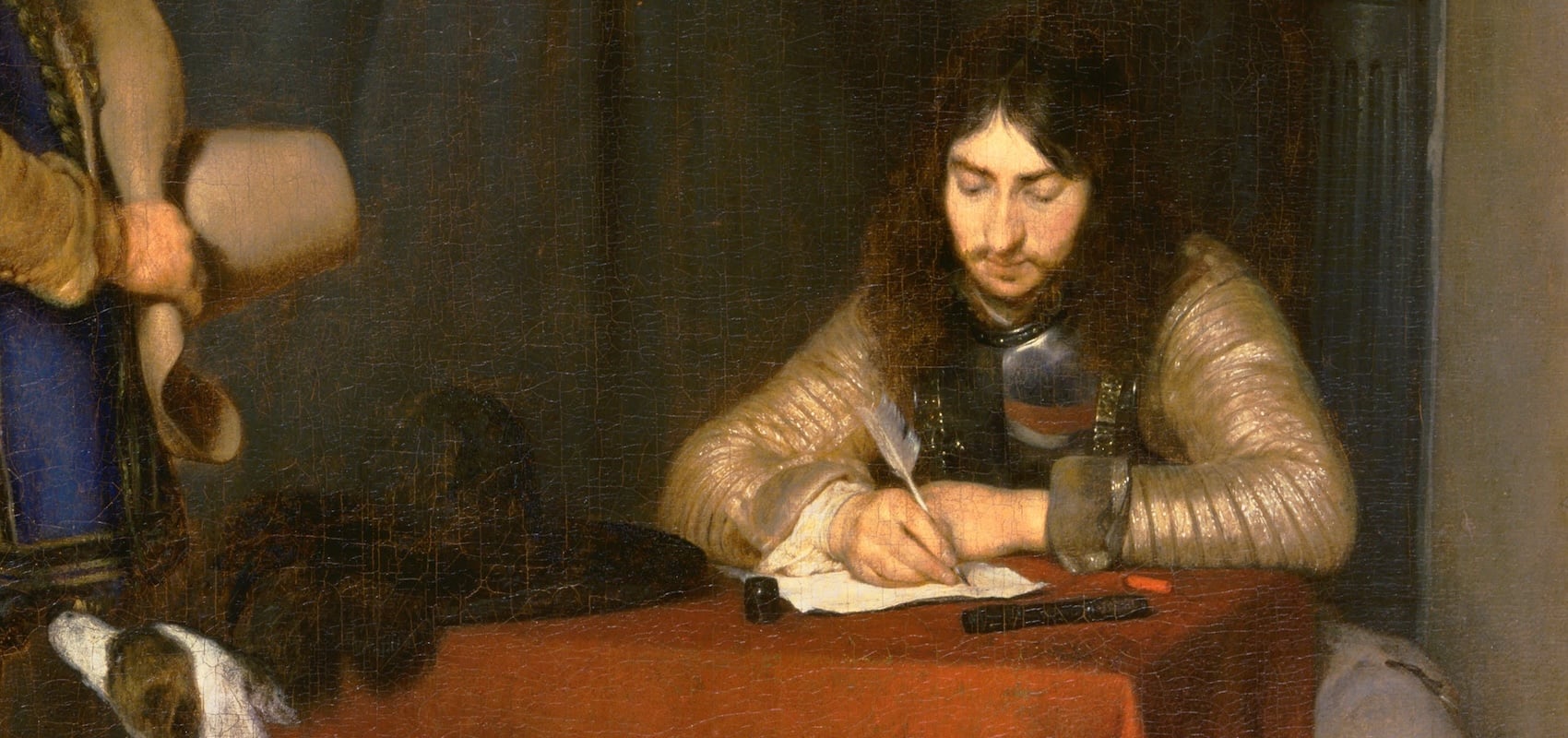
We welcome letters to the editor. Letters appear two issues after the article to which they are responding. Letters under three hundred words are preferred, and they may be edited for length and clarity.
Letters responding to articles published in this issue should be received by November 6 for publication in the January issue. Send them to submissions@firstthings.com.
The Telos of Torah
I appreciate J. H. H. Weiler’s desire for God’s mercy to be extended to Gentiles and his commitment to Torah (“The Scandal of Jewish Belief,” August/September 2026). However, it seems he has “a zeal for God, but not according to knowledge.” Weiler’s opinion piece is a fictional work of theological speculation—it is, indeed, a “startling proposition.” Paul’s concern in Romans 9–11 was for the conversion of his fellow Israelites to Jesus Christ. There is no “scandal,” however, for Paul knows God has not failed and YHWH’s elect remnant will be brought to faith in Jesus Christ.
The heart of Weiler’s theology is that people can be “saved,” or enter the eternal covenant, by different means: for Jews, obedience to Torah; for Gentiles, obedience to the gospel. The Bible does not support such a view. If Jesus is not the incarnate Son of YHWH, then to worship him would be idolatrous. If he is the incarnate Son of YHWH, then rejection of him renders one liable to judgment. While God ordains a partial hardening upon Israel, he still holds them morally accountable for their unbelief.
The coming of the Messiah was clearly predicted in the Old Testament—not least in Deuteronomy 18:15, of which Weiler says nothing. In preaching to Jews, Peter identifies Jesus as the fulfillment of these Old Testament predictions and warns “that every soul who does not listen to that prophet shall be destroyed from the people” (Acts 3:23).
Herman Bavinck wrote, “the New Testament views itself—and there can certainly be no doubt about this—as the spiritual and therefore complete and authentic fulfillment of the Old Testament.” Jesus is the telos of Torah for all who believe. As the Incarnate Word of YHWH, Jesus becomes Israel’s known God “wordified.” He once said, “If you believed Moses, you would believe me” (John 5:46).
The Church is to love all people—Jew and Gentile alike—and to proclaim in word and deed the gospel by praying that God would extend his electing mercy and bring his chosen remnant to faith in Jesus Christ, “for the gospel is the power of God for salvation to everyone who believes, to the Jew first and also to the Greek.”
Jacob J. Susek Jr.
royersford, pennsylvania
Landscapes of Disarray
I appreciate D. P. Curtin’s brief essay on the disappearance of the African Church (“The Sudden Death of the African Church,” August/September 2026). As someone who has been bringing into view long-forgotten Christian writings from this region, Curtin understands better than most of us the lay of the land of this lost era of Christianity. Certainly more than I.
That said, I sense that there is something anachronistically neat—too neat—about his application of this set of events to our present circumstances. There has been, after all, much debate about the character of ancient North African Christianity, first spurred by W. H. C. Frend’s pioneering work on the Donatist Church. Since then, various arguments have been pursued by scholars like Brent Shaw, Jonathan Conant, Corisande Fenwick, and others. It is not clear, from what I read, that the African church “suddenly died”—that strikes me as more rhetorically striking than precise—and the archaeological and epistolary evidence for Christianity’s continued presence even into the Arab period is perhaps more extensive than Curtin indicates. Furthermore, Curtin’s sense of a thoroughly Catholic culture characterizing the area over time does not quite jibe with the long-standing divisiveness and hostilities that exist among Christians in North Africa. Arguably just the opposite. Fatal germs contaminate the Church, sometimes for years. The still-misunderstood interactions (and conflicts?) of Berber and Roman culture; Latin and indigenous language; urban and rural life; and Roman, Vandal, and Byzantine (and finally Arab) conquest, rule, and politics complicate clear judgments about institutional continuities.
Of great interest is why Egypt and Syria maintained a vital Christian witness and ecclesial life, even under Muslim rule, and North Africa did not. Certainly, the indigenous linguistic and cultural forms differed there precisely in their disassociation from Rome and Byzantium. Perhaps not all continuities are helpful in landscapes of disarray. In short, although Curtin is right to challenge us with Christian North Africa’s fate, I wonder if we are really ready to draw clear lessons from it, other than Psalm 118:13: We slip suddenly, pushed from our places of stability; and only the Lord can pull us up again.
Ephraim Radner
wycliffe college at
the university of toronto
toronto, canada
End Times
It’s encouraging to see someone taking the Antichrist seriously, especially someone as smart as Peter Thiel (“The Pope and the Antichrist,” August/September 2026). But it baffles me that someone as smart as Thiel—along with coauthor Sam Wolfe—couldn’t offer a more serious argument for how the Antichrist is connected to Pope Benedict XVI.
Thiel and Wolfe slyly suggest that Benedict’s onetime colleague and friend Hans Küng (1928–2021)—or at least the Weltethos elaborated by Küng—embodied the spirit of the Antichrist. Stringing together snippets from Scripture, Vladimir Solovyov’s fiction, the prophecies of Joachim of Fiore, and Joseph Ratzinger’s Habilitationsschrift, Thiel and Wolfe weave an intricate web seducing readers into thinking Benedict had more to say about the apocalypse than he actually did.
Having worked for the former pope, I can assure you this is utter nonsense.
You can’t shed much light on Benedict’s profound insight into Bonaventure’s theology of history by focusing on a footnote, but you don’t have to read all nine hundred pages of his Habilitationsschrift to get the gist. All you have to do is read three masterly catecheses Pope Benedict gave on the great Franciscan saint in the spring of 2010. In the second, Benedict explains that “Jesus Christ is God’s last word—in him God said all, giving and expressing himself,” such that “there is no loftier Gospel, there is no other Church to await.” Benedict XVI’s entire life—as a priest, theologian, and as the Vicar of Christ—was dedicated to preaching that message rather than tiptoeing around the issue of the end times to avoid “spreading rumors of the apocalypse.”
Both as a young theologian and as a mature pope, Benedict adhered to the Church’s conviction that “history remains indecipherable, incomprehensible. No one can read it.” By associating individuals such as Greta Thunberg, Eliezer Yudkowsky, and now Hans Küng with the Antichrist, it seems Thiel and Wolfe want to arrogate the Antichrist for an ulterior agenda. To claim that the most fundamental difference between Christ and Antichrist is that the former stands for violence and the latter for peace is a gross oversimplification, to say the least.
To allege that “nothing would have surprised Ratzinger . . . less than to learn that the Antichrist had appeared as a fellow academic like Küng” is irresponsible and ill-informed. Küng obviously taught things contrary to the Catholic faith. But that didn’t stop Benedict from hosting his friend and former colleague at the summer papal residence shortly after his election as pope. A Holy See communiqué announced that “the meeting unfolded in a friendly atmosphere” as it “centered . . . on two topics” of mutual interest: “the Weltethos and the dialogue of the reason of the natural sciences with the reason of the Christian faith.”
An essay on either of those topics might be less sensational, but I think it would bear more fruit for lifetime First Things readers like myself.
Daniel B. Gallagher
ralston college
savannah, georgia
In “The Pope and the Antichrist,” Peter Thiel and Sam Wolfe rely on the observations of Peter Hebblethwaite to speak of Hans Küng’s significant influence at the Second Vatican Council, a synod that, allegedly, “adopted many of his recommendations.” I would counsel against ascribing much influence to Küng’s thought at Vatican II. The moderator of the council’s Theological Commission, Gérard Philips, barely mentions him in his conciliar journal, while often speaking of the signal contributions of the theologians Karl Rahner and Yves Congar. The same is true if one examines the diary of bishop André-Marie Charue, a vice president of the same commission and a confidant of Pope Paul VI.
Indeed, Küng’s lack of influence is confirmed by his own memoir, My Struggle for Freedom. He notes, “Even now, 40 years later, I get extremely angry when I once again pick up my original Council documents.” The cause of his anger is precisely that his vision—of a Church that is a non-hierarchical, egalitarian communion—had no traction whatsoever either in the Theological Commission, which drafted the conciliar decrees, or in St. Peter’s Basilica, where the bishops of the world voted on them.
Vatican II had the benefit of numerous mature, seasoned theologians who produced balanced, theologically rich documents. Küng, described by Congar in his journal as “always very radical,” was not a significant contributor.
Thomas G. Guarino
seton hall university
south orange, new jersey
In the introduction to his famous habilitation thesis, The Theology of History in Saint Bonaventure, Joseph Ratzinger stated that “it is above all at times of greatest crisis in human history that we find men concerned with the theology and the philosophy of history.” But such a statement does not speak only of those men who were interested in eschatology and the “signs of the end times.” It also reveals Joseph Ratzinger’s own personal and enduring concern with such a major theme.
“The Pope and the Antichrist” offers clear evidence of Pope Benedict XVI in what we might call “apocalyptic” reflection. Let us be clear: The two authors are not speaking of the academic preoccupation of a brilliant German theologian with “exotic” curiosities. Rather, they are speaking of an existential, vital concern on the part of an authentic Christian believer who, troubled by certain identifiable symptoms in these turbulent times, took seriously the possibility that the end of history might be imminent.
Their central thesis—“Benedict believed he was living in the end times”—may sound sensationalist, but it is by no means gratuitous. Undoubtedly, Wolfe and Thiel’s article draws attention to what may be the most astonishing contribution of Pope Benedict XVI. At the same time, given both the magazine’s space constraints and the article’s brevity, it is only a beginning.
A comprehensive study and an extended meditation on Joseph Ratzinger’s theology of history must necessarily include what has always seemed to me to be the most important legacy Pope Benedict XVI left us: the official canonization of St. Hildegard of Bingen (on May 10, 2012), followed by her proclamation as a Doctor of the Church (on October 7, 2012).
In the apostolic letter accompanying the latter act, the Holy Father made it clear what constituted the monumental contribution of the “Sibyl of the Rhine”: “In her visions and her subsequent reflections she presents a compendium of the history of salvation from the beginning of the universe until its eschatological consummation.” If we remember that, in his speech on December 20, 2010, addressing the priestly sexual-abuse scandals, Pope Benedict XVI referred to a mystical vision in which St. Hildegard contemplated the defilement of the Church, this makes clear the role he assigned to the Teutonic author: that of an interpreter of the history of the world—and, especially, of the signs of its “eschatological consummation.” This is why I believe that the discussion initiated by Peter Thiel and Sam Wolfe should be welcomed and continued.
Robert Lazu Kmita
stresa, italy
License to Preach
Although Vincent Phillip Muñoz offered a solid defense of the Founders’ public philosophy (and an implicit proposal for Americans in the twenty-first century), I now ask Muñoz if he has completely left behind the liberalism he seeks to avoid (“The Founders and the Common Good,” August/September 2026). I ask because his definition of liberalism is incomplete.
There are two aspects to Muñoz’s definition. As an anthropology, liberalism is moral license, and, as a political philosophy, it entails a public neutrality toward competing comprehensive conceptions of the good. Although this definition is helpful to start with, it only corresponds to its most extreme degree. Ignorance of the other degrees, which are as subtle as they are dangerous, disables a Christian from sanctifying society in certain areas.
Pope Leo XIII, who systematically defined and condemned liberalism in the social encyclical Libertas (1888), identified three degrees. Extreme liberals claim a freedom separated from the natural law. As a result, the state is either indifferent or neutral toward notions of the good. Clearly, Muñoz is right to remove the Founders from this degree, but the majority of them seem to fall into one of the following two degrees. Moderate liberals submit their freedom to the natural law, but they separate it from the divine law. Light liberals submit their freedom to the divine law, but they separate it from human laws. In Leo’s words, “the morality of individuals is to be guided by the divine law, but not the morality of the State, for that in public affairs the commands of God may be passed over, and may be entirely disregarded in the framing of laws.” This “absurd” position pursues and preserves the separation of church and state not only as an acceptable situation, but also as an advantageous one.
At this point, I ask my question: Does Muñoz’s proposal of return escape the other two degrees? I think not.
Even granting that Muñoz is primarily concerned about the right understanding of the Founders, the practical effect on readers is potentially dangerous without correction. A secular reader of Muñoz’s article may walk away as a moderate liberal, while a Christian reader, unless they are steeped in Gregorian, Pian, and Leonine social encyclicals, probably walks away as a light liberal.
Christian revelation contains much about the common good that goes beyond the limits of reason. Pope Leo XIV taught French politicians in August of 2025:
“You are therefore called to strengthen your faith, to deepen your understanding of doctrine—in particular the social doctrine—that Jesus taught the world, and to put it into practice in the exercise of your functions and the drafting of laws.” I’m afraid that teachings like this may surprise Muñoz’s readers. For the well-formed Catholic, they shouldn’t.
Patrick J. Friddle
rockville, maryland
Vincent Phillip Muñoz replies:
Leo XIII writes in his 1888 encyclical Libertas that “the two powers [church and state], though dissimilar in functions and unequal in degree, ought nevertheless to live in concord, by harmony in their action and the faithful discharge of their respective duties.” The genius of the American Founders was to devise constitutional arrangements appropriate to the conditions of modern life that facilitate this harmony and, thereby, the ability of the American people to fulfill their duties to their Creator and their fellow man.
The Founders’ prudence led them to limit the political common good to matters pertaining to the natural law. This limitation itself acknowledges the divine law. An example can illustrate the point. The state licenses a myriad of professions. To practice law, medicine, cosmetology, and so on, one needs a professional license issued by the government. But ministers, including Catholic priests, do not need a state-issued license to preach. No state in America issues preaching licenses. If Gov. Newsom or Mayor Mamdani tried to impose such a requirement—say, to prevent dangerous “hate preach”—we would say the proposed licensing scheme violates the separation of church and state.
The absence of preaching licenses does not mean that the state is indifferent to, separated from, or unguided by the divine law. Quite the contrary. Gov. Newsom and the state of California lack the authority to issue preaching licenses because divine law places that authority elsewhere. We the people do not, and could not, give our governments the authority to issue preaching licenses because we the people do not possess such authority. The authority of the people, and hence of the government, is limited. It is limited, in part, to recognize the authority of divine law. As I have written elsewhere, the Founders separated state and church and protected religious liberty in recognition of, and out of respect for, religious authority.
Limiting the positive law to matters pertaining to the natural law does not mean, of course, that all will agree about what positive laws we should legislate (or even what institution should exercise the legislative power). For us the people to use our freedom well requires wisdom and morality. This is why John Adams held that “our Constitution was made only for a moral and religious people.” The cultivation of morality is, first and foremost, the responsibility of parents and the church. The state, too, should do its part. But if the twentieth century has taught us anything, it is that the state poses great potential danger to the individual, the family, and the church, and, therefore, its powers ought to be carefully circumscribed.
The Amish Way
Brad Littlejohn’s essay was a virtuosic performance (“Left to Our Own Devices,” August/September 2026). I would like to complement it with some observations about the place of phones in an Old Order Amish community where I lived for over twenty years. The Amish have a phone shack at some distance from the house. The phone is intentionally made inconvenient. The preferred means of communicating is with a face-to-face visit. When the Amish need to speak to someone outside the community, they write to that party telling them to be at their phone at a specified time to receive a call. All of this is the Amish way of making the phone a servant and not a master.
I moved to town several years ago. Strolling through the park I often saw children at play, perhaps wishing mom would push them on the swing. Alas, she was on her phone in the car. I titled a poem “There But Not There.” Always, the sight broke my heart.
Jim Severance
spring green, wisconsin
An NGO Replies
Nathan Pinkoski’s review of Jacob Siegel’s The Information State (“The Enemy Within,” August/September 2026) opens with a characterization of the International Fact-Checking Network that deserves correction.
Pinkoski writes that IFCN “acts as if it were a regulatory body or government agency, but it lacks statutory authority or limitations.” IFCN has never claimed such authority nor acted as any sort of regulatory body on information. Instead, IFCN maintains a voluntary code of principles for fact-checking journalism organizations. The code outlines standards on accuracy, fairness, nonpartisanship, and transparency.
The IFCN strongly opposes censorship, as stated formally in our 2024 Sarajevo statement. Censorship removes information, while fact-checking journalism adds information in an effort to more fully inform public debate.
On funding: It is true, and openly disclosed on our website, that IFCN received early support from the National Endowment for Democracy because independent journalism has long been considered a means to promote democracy worldwide. This is not hidden; it appears in our annual transparency statement with our full donor list. Omitting that we publish this information ourselves creates a misleading impression of covert influence where none exists.
Finally, the review describes IFCN as pursuing “partisan objectives.” IFCN comprises more than 170 organizations in over sixty countries, across a wide range of political and cultural contexts, bound by a code that names nonpartisanship a core value. An assertion of partisan intent should come with evidence. None is offered.
I hope First Things readers will look more closely at what IFCN actually does. It should not be made an emblem of dynamics it actually opposes.
Angie Drobnic Holan
washington, d.c.
WWII Envy
“When you go home / Tell them of us, and say / For your tomorrow / We gave our today.”
So reads the inscription on a British war memorial for soldiers killed in a 1944 battle. I cannot imagine a better witness to the solidarity and self-sacrifice associated with the Allied cause in the Second World War, and I am at a loss to explain why R. R. Reno attempts to diminish the continuing relevance of such testimony in “Putting World War II Behind Us” (August/September 2026). His short essay is an attempt to reinforce Alec Ryrie’s much longer reflection in the November 2024 issue of First Things, “The End of the Age of Hitler,” but ends up taking it in a slightly different direction.
According to Reno, Ryrie had asserted “that, as secularism advanced in recent decades, World War II replaced the New Testament as our source of moral orientation.” He acknowledged and, within certain broad limits, approved of the war’s enduring mythic power because “the values we learned from World War II will be essential” (if incomplete) for dealing with the evils that confront us now, eight decades later. He sought mainly to incorporate the lessons of WWII into a broader, deeper civilizational consensus: specifically, a positive Christian (or Judeo-Christian) religious view of life and history, not just a negative anti-Nazism with no consistent content. Reno, on the other hand, celebrates the “waning” cultural influence of the war because, “its lessons, taken as gospel truth by Baby Boomers, now do more harm than good.”
The cult (or whatever one calls it) of WWII is not so much a form of secularism as the remembrance of resistance to a world utterly unmooring itself from Judeo-Christian roots. Secularism in its most violent, nihilistic form preceded and culminated not after but in WWII. Halting that advance, so fraught with ambiguities and excesses, and telling the story so expansively, should hardly be described as having done “more harm than good” to the ethical formation of subsequent generations. Without the war’s epic heroism, the New Testament—to say nothing of the Old!—would have been completely erased “as our source of moral orientation.” For those with even a slight residue of Western religion, the WWII narrative is less likely to supplant the Bible as a whole than to prompt a return to Scripture in search of answers, as seen in the Book of Job.
Referring to our continuing WWII fascination as “Manichean” is a strawman argument: No struggle between fallen human beings or nations is ever a contrast between “unmitigated evil” and “unimpeachable good.” As the American theologian Reinhold Niebuhr said at the time, responsible action in history is always a matter of distinguishing between relativities of good and evil, and of bearing moral hazards in which we cover ourselves with blood and guilt, despite our best intentions, because “we are men and not God.” Niebuhr saw WWII as having an almost singular moral clarity—if not of good and evil among all individual participants, then certainly of right and wrong in its large historical contours.
President Franklin Roosevelt, in his national prayer on D-Day, June 6, 1944, declared, “Almighty God: Our sons, pride of our Nation, this day have set upon a mighty endeavor, a struggle to preserve our Republic, our religion, and our civilization, and to set free a suffering humanity.” Seven months later, to the day, in his State of the Union Address of January 6, 1945, FDR added, “This war must be waged. . . . Everything we are and have is at stake. Everything we are and have will be given.” Would that we had a leader capable of delivering such words today—and a citizenry capable of receiving them.
Perhaps those fortunate enough to be born after 1945, and to enjoy a decent life because the Allies won, suffer from World War II envy—an envy of the sort conjured in Henry V regarding the Battle of Agincourt in 1415: “And gentlemen in England now a-bed / Shall think themselves accurs’d they were not here, / And hold their manhoods cheap whiles any speaks / That fought with us upon Saint Crispin’s day.”
It is of course too early to hold our manhood cheap: “Wars and rumors of wars” (Matt. 24:6) will persist until the end of history. In the meantime, no memories or lessons (at least none that we know well and agree upon) will serve us better than those of 1939–1945. It is too early for “Putting World War II Behind Us.”
Matthew Berke
madison, new jersey
Becoming Apart
An orchestra is never together, and cannot be (“Holding Things Together,” August/September 2026).
Sound crosses a meter in about three milliseconds. Between the front desks and the back of the percussion there is therefore a gap of some fifty milliseconds that no amount of rehearsal removes: The players at the back are hearing a past the players at the front have already left. Nor do musicians follow the beat. When someone finally measured it, an orchestra’s sound was found to sit roughly fifty milliseconds behind the conductor’s gesture, and beginners a good deal further behind than that. Nothing on that platform happens when it appears to.
What an audience hears as unity, then, is not a condition. It is a discrepancy being repaired continuously by a hundred people, not one of whom can hear the whole of it.
Radner’s word for this is “holding,” and it is the right one. The natural state of an ensemble is dispersal. Coherence is not a settlement reached and thereafter possessed; it is a labor renewed on every beat, against physics, by people who will never once achieve it and who get near enough that the room believes them.
Which is why the infra-ordinary does not redeem itself merely by being noticed. Attention is not the work. Repair is the work. Stop for one bar, and the thing does not simply persist. It comes apart at the speed of sound.
David Woodard
tampere, finland

YOU MIGHT ALSO LIKE
The Myth of St. Francis
At the beginning of his 2020 encyclical, Fratelli Tutti, Pope Francis speaks of “an episode in the…
Job and Her
It is said that Job lost everything, but she has lost more. All her possessions—the money, the…
De Gaulle Triumphant
The Second World War left Europe invaded and ruined, divided between Soviet and American occupations. Hitler’s defeat…
