
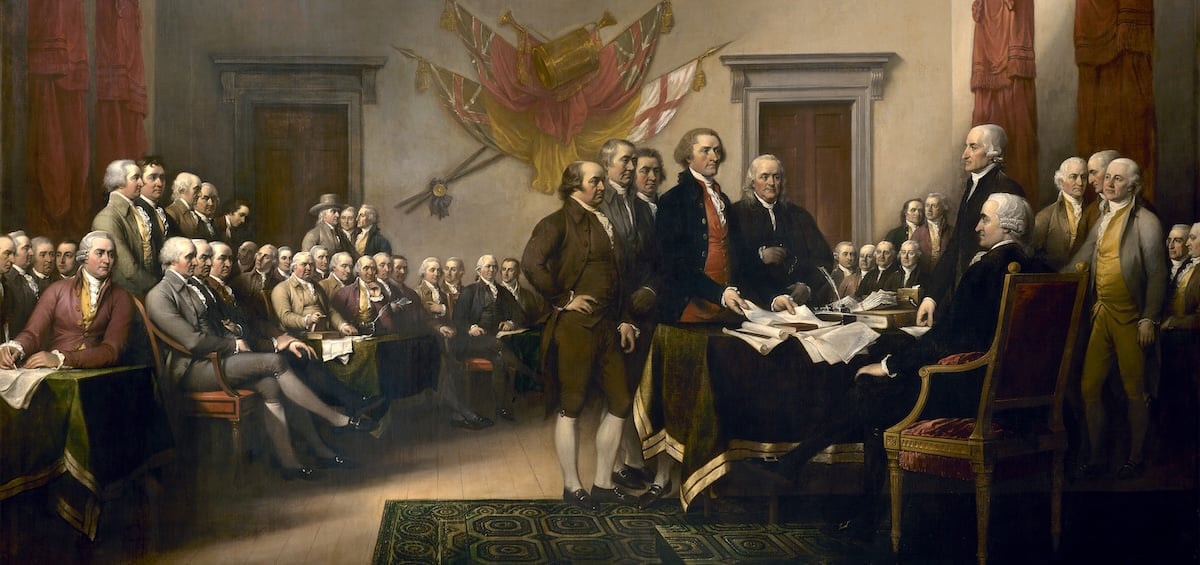
The dominant public philosophy among American elites is modern liberalism, often referred to merely as “liberalism.” Two beliefs make up liberalism’s core: first, that freedom is, in the words of Justice Anthony Kennedy in Planned Parenthood v. Casey (1992), “the right to define one’s own concept of existence, of meaning, of the universe, and of the mystery of human life”; and second, that to secure this understanding of freedom, the state must remain “neutral” toward competing comprehensive conceptions of the “good.” Liberalism so understood is both relativistic and, ultimately, nihilistic. It makes the individual’s will sovereign over reality. It denies the existence of a common good because it holds that there are no rational intrinsic goods that human beings hold in common. The essence of man, in the liberal view, is willful individual choice—asserting one’s view of oneself and of reality and then shaping one’s life in light of that posited worldview.
Given the thinness of liberalism’s commitments, it is not surprising that a conservative, postliberal intellectual movement has arisen. But postliberalism’s intellectual mistake has been to presume that modern liberalism’s conception of the person is the inevitable evolutionary outcome of the American political and constitutional tradition. That is simply not true. Liberalism sharply departs from the Founders’ natural rights republicanism, which offers a dignified understanding of the human person and a conception of human excellence that draws on both the Greek and biblical traditions. Rather than jettisoning American principles, we need to recover their genius.
The Founders asserted the justice of the American revolution on the basis of human equality and the natural right to liberty. All men are created equal in the sense that no person is born the natural ruler of any other person. The recognition of equality does not deny the natural authority of parents over their children, but it does deny that the parent-child relationship is a model for the rule of men over other men. In other words, no one is by nature subservient or a second-class citizen, and no human being is by nature a master. Just days before he died on July 4, 1826, Thomas Jefferson wrote that the “palpable truth” articulated in the Declaration is “that the mass of mankind has not been born with saddles on their backs, nor a favored few booted and spurred, ready to ride them legitimately, by the grace of God.”
To hold that we are equal does not mean all human beings are the same in all respects. “When we say, that all men are equal,” James Wilson wrote, “we mean not to apply this equality to their virtues, their talents, their dispositions, or their acquirements.” Wilson, who was one of six men to sign both the Declaration of Independence and the Constitution, continued:
In all these respects, there is, and it is fit for the great purposes of society that there should be, great inequality among men. In the moral and political as well as in the natural world, diversity forms an important part of beauty; and as of beauty, so of utility likewise. . . . Many are the degrees, many are the varieties of human genius, human dispositions, and human characters.
Human diversity and differences, Wilson said, make individuals dependent on one another, which is one of the reasons community and society are natural to man. But whatever the differences among men, no individual is born the natural political ruler of other individuals or a given political community. “Because Sir Isaac Newton was superior to others in understanding,” Thomas Jefferson wrote in 1809, “he was not therefore lord of the person or property of others.”
To hold that all men are by nature free and equal does not mean that individuals are free to act in any way they please or that they are exempt from the laws of morality. The 1774–75 pamphlet exchange between Alexander Hamilton and the American loyalist Samuel Seabury demonstrates that the Founders affirmed a binding moral law.
Criticizing those seeking independence, Seabury, under the pseudonym “A. W. Farmer,” wrote:
I wish you had explicitly declared to the public your ideas of the natural rights of mankind. Man in a state of nature may be considered as perfectly free from all restraints of law and government: And then the weak must submit to the strong. From such a state, I confess, I have a violent aversion.
Hamilton, writing “The Farmer Refuted,” vigorously denounced Seabury’s Hobbesian account of natural rights as a misrepresentation. “There is so strong a similitude between your political principles and those maintained by Mr. Hobb[e]s,” Hamilton wrote, “that . . . a person might very easily mistake you for a disciple of his.” Hobbes “held, as you do,” Hamilton emphasized, that man in a state of nature is
Perfectly free from all restraint of law and government. Moral obligation, according to [Hobbes], is derived from the introduction of civil society; and there is no virtue, but what is purely artificial, the mere contrivance of politicians, for the maintenance of social intercourse.
“Good and wise men, in all ages, have embraced a very dissimilar theory,” Hamilton continued.
They have supposed, that the deity, from the relations, we stand in, to himself and to each other, has constituted an eternal and immutable law, which is, indispensibly, obligatory upon all mankind, prior to any human institution whatever. This is what is called the law of nature.
The law of nature, Hamilton writes, “is binding over all the globe, in all countries, and at all times.” It is the moral law of the “supreme intelligence, who rules the world, and has established laws to regulate the actions of his creatures.” Man is subject to the law because the Creator “endowed him with rational faculties, by the help of which, to discern and pursue such things, as were consistent with his duty and interest, and invested him with an inviolable right to personal liberty, and personal safety.” Upon the law of nature, Hamilton concludes,
depend the natural rights of mankind. . . . Hence, in a state of nature, no man had any moral power to deprive another of his life, limbs, property or liberty; nor the least authority to command, or exact obedience from him; except that which arose from the ties of consanguinity.
The Founders accepted the premises upon which all natural law thinkers agree, namely, that a moral law of right and wrong exists and that all human beings are properly subject to it. The Founders called the authority behind the law of nature the “supreme intelligence” or “deity,” in Hamilton’s words, or the “Creator” and “Supreme Judge of the World,” to use phrases from the Declaration of Independence.
Unlike modern liberalism—which assumes that creation is without purpose and, thus, that the essence of man lies in his willfully creating meaning for himself—the Founders held that observation of and reflection on human nature reveal the basic moral truths that man is a free and rational being who has been created to direct himself within the bounds of the law of nature. When Jefferson proclaimed that “Almighty God hath created the mind free,” in his Virginia Statute for Religious Freedom, he did not mean that man is free to create his own morality. Jefferson and the Founders meant that the human mind follows the reasonable and rational evidence that comes before it, and that human beings are not slaves to their passions or deterministically governed by instinct. Human freedom lies in our capacities to articulate and debate principles of justice, to distinguish (however dimly) what is morally right from what is morally wrong, and then to choose to act in the morally correct manner, which in 1776 meant throwing off the king who suppressed these capacities.
Some conservatives today, like Samuel Seabury at the time of the Founding, presume that the Founders jettisoned traditional morality because they used the language of “rights.” Neither Aristotle nor the Bible, of course, proclaims that human beings have “rights.” And Hobbes, one of the most prominent modern theorists of rights, rejected traditional morality. But the Founders rejected Hobbes. They used the language of “natural rights” to communicate their ideas about natural justice. Individuals have natural rights to life, liberty, and the pursuit of happiness, they said, because humans are rational and free beings. Our unique capacity to govern ourselves through reflection and choice in light of what is morally right and morally wrong means that we ought to be treated as free and morally responsible beings.
Given human beings’ capacities for moral reflection and action, the Founders held that to prevent individuals from acting as free and responsible moral beings was to frustrate the Creator’s design. To say the same thing in a more classical frame, the Founders held that the excellence of man lies in men’s being most fully what they are. (“Goodness and being are convertible terms,” Thomas Aquinas writes.) An essential element of what we are is our freedom—meaning, again, our capacity to know right from wrong and to do what is right. Human beings, accordingly, have natural rights, including the right to liberty.
We misunderstand the Founders’ conception of rights if we conceive natural rights to be opposed to one’s natural duties or to license behavior contrary to the natural moral law. “The laws of nature are the measure and the rule; they ascertain the limits and the extent of natural liberty,” James Wilson writes. The Founders understood natural rights to be part of the law of nature, and the exercise of all natural rights to be bounded by this natural law.
We capture the Founders’ understanding when we say, “My rights end where your rights begin,” or “There’s no right to do wrong.” These phrases reflect the basic structure of the Founders’ conception of rights: To have a right means to possess the authority to reflect, prefer, choose, use, and act within the bounds of the natural moral law. To say that individuals have rights, in other words, is to say that it is wrong or unjust to punish an individual when he acts reasonably. But there is no natural right to act unreasonably and contrary to the natural moral law. The proper exercise of freedom respects the moral boundaries established by the law of nature. The Founders captured the elementary distinction between proper and improper uses of freedom by using the terms “liberty” and “license.” Natural rights protect “liberty”; they do not sanction “license.”
Strictly speaking, duties precede rights because our freedom (rights) is directed toward living as we ought to live (duties), and how we ought to live is established by “nature and nature’s God.” For those who still read John Rawls, in the Founders’ understanding “the good is prior to the right”—or to speak more precisely, the good includes individual rights.
The relationship between rights and duties and how our duties lead to our rights is perhaps made most clear by the way in which the Founders defended the right to religious liberty. “It is the duty of every man,” Madison wrote in his “Memorial and Remonstrance Against Religious Assessments” (1785), “to render to the Creator such homage and such only as he believes to be acceptable to him. This duty,” he continued, “is precedent, both in order of time and in degree of obligation, to the claims of Civil Society.” “The Religion then of every man,” Madison argued, “must be left to the conviction and conscience of every man; and it is the right of every man to exercise it as these may dictate.”
Madison’s reasoning is straightforward. Because we have a duty to worship the Creator and because true worship must be freely given, all individuals have an inalienable right to the free exercise of religion. The right to religious liberty follows from the duty to worship according to conscience.
Religious liberty thus did not emerge because the Founders believed the state must be “neutral towards competing conceptions of the good,” or because our constitutional republic is committed to “secularism,” as Justice Sotomayor suggested in a recent Supreme Court opinion. The state is prohibited from mandating or punishing religious worship because it is right, good, and a duty of individuals to worship according to conscience. “We hold it for a fundamental and undeniable truth,” Madison wrote, quoting the 1776 Virginia Declaration of Rights, “that Religion or the duty which we owe to our Creator and the manner of discharging it, can be directed only by reason and conviction, not by force or violence.” Because human beings ought to worship freely, they have a right to do so.
This understanding of natural duties that require political rights is why the signers of the Declaration of Independence could rely “on the protection of divine Providence” and “pledge to each other” their “lives, [their] fortunes, and [their] sacred honor.” To throw off a despot is to secure for oneself the freedom to live as human beings are created to live, as free and rational persons with the capacity to govern themselves. It is also to secure for one’s children, one’s countrymen, and future generations the liberty and dignity that are due to them as children of the Creator. “Rebellion to tyrants,” the Founders proclaimed, “is obedience to God.”
Not all natural rights are secured through express constitutional limitations on state power. The Founders held that the contours of most rights would be determined by the people, acting through representative legislative institutions. Here the postliberals help correct an error to which libertarians are prone. State power is not a necessary evil. Properly constituted, government secures the conditions that allow citizens to exercise individual freedom, form private associations that secure common goods, and act collectively to secure those freedoms and common goods that can be realized only with and through the rule of law.
As if responding to contemporary libertarians and some conservatives, James Wilson writes in his Lectures on Law:
The opinion has been very general, that, in order to obtain the blessings of a good government, a sacrifice must be made of a part of our natural liberty. I am much inclined to believe, that, upon examination, this opinion will prove to be fallacious. It will, I think, be found, that wise and good government . . . instead of contracting, enlarges as well as secures the exercise of the natural liberty of man.
We can illustrate Wilson’s point with a simple example from American life. Take your family’s and your neighbor’s enjoyment of your backyards around Independence Day. On the evening of July 4, your neighbor has a barbecue with many friends and enjoys a festive, noisy, and somewhat explosive celebration until midnight. The following night, July 5 (which in 2026 falls on a Sunday), your neighbor has a few friends over to grill his leftover hot dogs and hamburgers, and the kids shoot a few bottle rockets, but your neighbor packs it in by 9:00 to comply with the community’s noise-ordinance regulations.
Both you and your neighbor have a property right in the use of your own backyards. That right includes using it at one’s discretion, inviting and excluding whomever one wants. But it does not include noxious uses that are a nuisance to the community, including excessive noise. One’s natural right to property includes the right to use one’s backyard in reasonable but not unreasonable ways.
As many homeowners know, neighbors sometimes disagree on what exactly is reasonable. They can disagree, in part, because reason itself tends to issue general prescriptions, not precise rules. Reason commands that one should not be excessively loud in one’s backyard, especially when others might reasonably expect quiet. But reasonable people can disagree as to whether a Sunday evening party ought to end at 8:00 or 10:00. Municipal law clarifies the matter for everyone in the neighborhood, coordinating expectations and behavior so that all may enjoy their backyards and, also, peace and quiet. Importantly, local regulations also communicate to potential homebuyers what they can expect should they move into the neighborhood, thus lowering the risks of what, for many, is the largest financial investment they will make in their lives.
Regulations such as noise ordinances increase liberty by making clear the community’s reasonable limits on the exercise of property rights, limitations that are internal to the right itself. Law makes the exercise of one’s rightful freedom regular, in the sense of knowable and predictable. It accounts for the too-often overlooked psychological dimensions of liberty: Knowing when one may either expect quiet or make noise is itself an important aspect of the right to property. Knowing the contours of a right not only increases the ability to exercise one’s rights, but also provides the confidence that one will be able to exercise one’s rights. Law makes ordered liberty possible.
A fundamental but now significantly disfigured aspect of the Founders’ constitutionalism is the determination of where and by whom the regulation of rights takes place. The Founders’ general maxim was that, for the most part, local communities ought to govern themselves regarding matters that pertain exclusively to the local community. This precept is an extension of the idea of “no taxation without representation.” The colonists did not revolt because they were being taxed, but because the taxes had been imposed without the colonists’ participation and consent. “No taxation without representation” captures the idea that, just as an individual rightfully possesses authority over himself by virtue of possessing reason and freedom, communities ought to govern themselves. The best means to realize the common goods of any community will most likely be known by the members of that particular community. Similarly, that community’s members probably will know best which community members will govern best. The Constitution’s federal design—and within the states, the systems of county, city, and local government—anticipates the principle of subsidiarity in Christian social thought. The Founders used the older term “republicanism” to communicate the idea that each community ought to govern itself. And a community’s governing of itself includes its determination of the reasonable limits of rights.
The freedom of the press offers another pertinent example. It includes the right to print and disseminate one’s views consistent with the law of nature. For the Founders, freedom of the press did not encompass the printing of libelous, defamatory, or obscene statements or material. What exactly is unreasonable—what exactly constitutes libel or defamation or obscenity, in the context of freedom of the press—requires specification. The Founders expected the people to make these determinations through their local institutions. True, disputes over the meaning of the law in specific cases would be resolved by the judiciary. The separation of powers would help to ensure an impartial rule of law. But essential to the Founders’ republican vision was that the contours of rights, at least in the first instance, would be specified by local communities. “Every government degenerates when trusted to the rulers of the people alone,” Jefferson writes in his Notes on the State of Virginia. “The people themselves therefore are its only safe depositories.” The people, the Founders said over and over again, are to be guardians of their own rights.
To illustrate what the Founders’ republicanism might look like in practice today, we can take the vexed issue of gun rights. The text of the Second Amendment recognizes the right of the people to keep and bear arms, an extension of the general natural right of self-defense. Like all natural rights, the right of self-defense is not unbounded; it extends to defending oneself in a reasonable way. It would not protect, for example, my striking an unknown passerby who I think, for no good reason, might attack me out of the blue. The same sort of reasoning applies to guns: The people possess the freedom to keep and bear arms, including firearms, subject to reasonable regulations. Those regulations ought, first, to facilitate the ability of individuals to exercise their Second Amendment rights by providing a mechanism by which they can legally own and carry firearms. Second, and just as important, they need to determine the reasonable boundaries of the right by specifying what sorts of arms can be kept and how, when, and where they can be carried. The Constitution was designed to empower the people, acting through their representatives at the state and local levels, to make these decisions for their own communities.
Such legislative determinations could be reviewed by courts, including the Supreme Court. But the meaning of rights and the republican character of American constitutionalism suggest that the judicial question for the Court would be whether the people had legislated regulations that were clearly unreasonable. The Constitution was not designed for judges to balance rights against competing “state interests” or for judges to find in “history and tradition” how earlier generations of Americans protected rights. Whatever might be said about these interpretive approaches, both progressive and conservative philosophies of constitutional interpretation empower judges to determine the contours of the people’s rights, which is a departure from the Founders’ constitutionalism. The Constitution was designed for the people to govern themselves, including by determining the reasonable limitations on their rights in view of their own community’s common good.
It is certainly possible that a return to the Founders’ natural-rights republicanism would fail to secure the actual common goods of our multiple political communities or the natural rights of individuals. At the Constitutional Convention, James Madison, revealing his distrust of local communities, proposed that a national “council of revision” should have the power to veto state legislation. In the early twentieth century, progressives criticized the Founders’ natural-rights republicanism because, they thought, it hindered the expert rule needed by a modern, industrial economy. Cursory knowledge of American history reveals that local majorities often have not fostered the common good of all members of the community, especially in matters of race.
The Founders knew that self-government was an experiment, one that would require a vigilant and courageous spirit to protect individual rights, as well as an enlightened and virtuous people with deep ties of civic friendship to foster the public good. Through their deeds, writings, and the institutions they created, the Founders sought to set forth the civic education required for republican citizenship. Yet they themselves could not overcome slavery. The federal republic they created collapsed into a civil war in which some of their own grandchildren fought. American history is a story of progress, but it is also a story of how the American people have failed to live up to their own principles.
That people do not always do what they ought to do is the story of the Bible and the common experience of mankind. The fact that we have failed to live up to our principles does not mean that we should discard them. Moreover, our experiment in technocratic, expert-empowered administrative and judicial rule has not produced good results. Our governing class has colossally failed in recent years, both domestically and in foreign affairs. The judicial determination of rights has, despite the corrections of the last few years, generally undermined the traditional morality the Founders understood as the foundation of a free society. To take just one example, the Supreme Court’s First Amendment jurisprudence has weakened the ability of local communities to restrict pornography. The naive stupidity of the 1960s Supreme Court obscenity decisions alone should make us more trusting of the people than of federal judges to define their own rights and the boundaries of those rights.
Postliberalism can be seen as a rejection of the liberal consensus that has formed elite opinion and governed America since World War II. The postliberals are correct that that project is exhausted. But the governing failures of our recent past ought to caution us against the utopian dreams of those who think articulating a postliberal future will usher in something better. Prudence dictates that we should be cautious about embracing the new and unknown over what is most noble in our own civic inheritance.
What we most need today is to appreciate and develop the resources of America’s natural-rights republican tradition in light of current circumstances. Natural rights are not hostile or opposed to duties. They are, in fact, derived from the natural law and a traditional, Judeo-Christian understanding of the human person. The Founders’ natural-rights republicanism offers a rich and attractive understanding of the dignity of all persons, as well as a principled and prudent commitment to the common goods belonging to the political order.
In Federalist 1, Alexander Hamilton wrote:
it seems to have been reserved to the people of this country, by their conduct and example, to decide the important question, whether societies of men are really capable or not of establishing good government from reflection and choice, or whether they are forever destined to depend for their political constitutions on accident and force.
What was true then is true today. Let us celebrate the 250th anniversary of America by recovering the wisdom of the American Founding and its virtues. Let us see how a return to our Founding principles might advance our common good.
Dear Reader,
Can I be direct with you?
War abroad. Socialists on the rise. AI upending human life. Endless uproar online. The modern attention economy doesn’t want readers — it wants users enslaved to the tyranny of the present.
First Things is the antidote: literary excellence, timeless truths, and a fixed point of reference in a culture that has lost its bearings.
But we can’t do it without readers like you.
Our goal: Raise $150,000 by November 1 to sustain First Things in the year ahead.
Your gift anchors readers in the permanent things.
Make your Fall Campaign gift now using the button below.
If you have any questions or would like more information, please contact Giovanni Del Piero, Director of the Editor’s Circle, at gdelpiero@firstthings.com or 212-627-1985.

YOU MIGHT ALSO LIKE
Why the Death Penalty Is a Sore Point for Papal Authority
Pope Leo XIV marked World Day Against the Death Penalty, observed on October 10, with the following…
Forget Odysseus. Aeneas Is the True American Hero.
Who is our Odysseus? Or more precisely, who is the most Odyssean hero of American film? Matt…
Candace Owens and the Sin of Anti-Semitism
According to the online Encyclopedia Britannica, Sir Moses Montefiore (1784–1885) was “an Italian-born businessman who was noted…
