

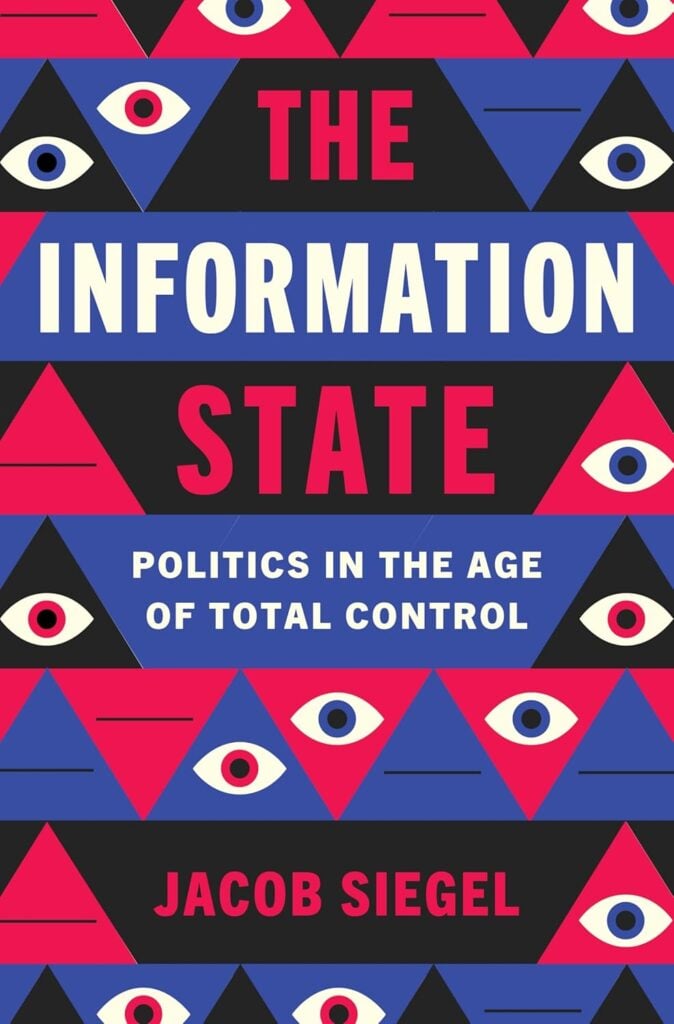
The Information State:
Politics in the Age of Total Control
by jacob siegel
henry holt, 336 pages, $29.99
The Information State is one of the most important books of the twenty-first century. In a virtuoso performance, Jacob Siegel harmonizes political theory, investigative journalism, and contemporary history to demonstrate how Americans are now governed.
The American model was supposed to be a form of liberalism in which an independent civil society limits the power of the state while restraining its own ambitions to greater control. Siegel is not the first to argue that this model has ended. But unlike the academic postliberals of the left and right, Siegel does not suggest that liberalism collapsed under its philosophical or cultural contradictions. Rather, liberalism collapsed in the wake of its failure to manage technological change. Siegel’s account is an elegant and insightful panorama of the twilight of American liberalism. The only question is whether, when it comes to the effects of digital technology on twenty-first-century politics, it goes far enough.
The typical twentieth-century political typology contrasts authoritarian regimes, which exercise power through the use of force, with democratic regimes, which exercise power through the consent of the governed. Yet the twenty-first-century state, Siegel argues, cannot be captured by either term. It is an “information state,” which has replaced the consent of the governed with control of “the codes and protocols of the digital public arena.” With the invention of the internet, most information went online, where it has proved remarkably easy to manipulate. The information state has its coercive tools, but they are wielded by means of informal mechanisms: alliances and partnerships between public and private actors that blur accountability and condition the electorate to accept certain outcomes.
Organizations with benign-sounding goals operate under the guise of objectivity to pursue partisan objectives outside normal accountability structures. Take the International Fact-Checking Network (IFCN). In December 2016, Mark Zuckerberg announced a new partnership between it and Facebook. Yet IFCN was funded by U.S. government agencies, such as the National Endowment for Democracy, as well as left-wing nonprofits. It acts as if it were a regulatory body or government agency, but it lacks statutory authority or limitations. And behind the scenes, social media platforms are subject to the direct pressure of the national security state. By autumn 2017, the Foreign Influence Task Force, an interagency office housed in the FBI, had established a channel on the messaging platform Slack. Security officials could communicate directly with social media executives about accounts they wanted the companies to flag or take down. Social media platforms are now at the center of a mode of governance that monitors the political expressions of millions. None of this would have been possible two decades ago. The key alliances that make the information state possible are downstream of the digital revolution.
When the internet first emerged, liberals believed that it would reinforce individual liberty, democratic government, and a free and open society. But of course it did the opposite. Among the other social problems online life produced, lies (disinformation) have mingled with unintentional falsehoods (misinformation) to break down all social and political consensus. These effects have devastated the internet’s opportunities for dialogue, deliberation, and cooperation. In response, liberals—supported by many conservatives—declared war on disinformation and misinformation. From 2016 onward, new government agencies, such as the Global Engagement Center (GEC), an interagency organization housed in the State Department, sprang up on the American institutional landscape. Partnering with social media platforms, media, academic institutions, and activist NGOs, these agencies and their allies promised to clean up the internet and achieve Barack Obama’s post-presidential goal of returning to a “common conversation” and “a common set of facts.”
This war against disinformation was supposed to be the legitimating moment for the information state, but the techniques of digital content control resulted in the largest political censorship operation in U.S. history.
By the 2020 presidential election, the GEC was working with the Election Integrity Partnership (EIP), a consortium of defense contractors, left-wing nonprofits, and academic institutions such as the Stanford Internet Observatory. Together, they created an informal pressure network to compel social media platforms to remove political content favorable to Donald Trump by flagging posts for removal by Twitter and Facebook. According to its own records, EIP identified 21,897,364 tweets as unique “misinformation incidents” between August 15 and December 12, 2020, with less than an hour average response time between government partners and social media companies.
More formal pressure mechanisms came directly from the national security apparatus, as the events of October 14, 2020, showed. Drawing from the laptop abandoned by Joe Biden’s son Hunter, the New York Post published allegations of the elder Biden’s business corruption. Antony Blinken, one of Biden’s most important campaign officials and future Secretary of State, contacted former deputy CIA director Michael Morell. According to the testimony of a White House whistleblower, this act “triggered” the drafting of a letter from fifty-one former U.S. government intelligence officials, with another CIA official soliciting the signatures. Their intervention suggested that the story was Russian disinformation designed to tilt the election toward Trump. Social media platforms restricted the story’s distribution, including by locking the New York Post out of its Twitter account. They thereby tilted the 2020 election toward Biden.
America’s leadership class largely endorsed the institutional arrangements underwriting this complex. To fight disinformation, they devoured the most valuable parts of liberal constitutionalism—representative government, freedom of speech, freedom of association, and consent of the governed—in order to reassure their supporters that they were in control. They intensified the weaponization of American law enforcement and media for partisan ends. And they handed over more power to an already unaccountable national security state. Unashamed in the face of criticism, they insisted that it was necessary to destroy the village of constitutional government in order to save it.
Where did this transformation first begin? Siegel argues that the censorship–industrial complex emerged out of the techniques developed to wage the global war on terror. The Bush administration launched the war on terror just as the internet was transforming the world. Terrorists used the internet to reach new recruits, thereby fueling insurgencies in Afghanistan, Iraq, and elsewhere. Striking back would require two changes. First, new powers were given to the national security state to master the emerging technological environment. As the Snowden leaks revealed, the government co-opted internet and telecommunications companies into mass surveillance. Second, the American state was mobilized to fight a new kind of hybrid warfare. To counter the jihadists who were radicalizing recruits online to strike anywhere from Baghdad to Bataclan, conventional military force had to be blended with sophisticated digital propaganda. By the 2010s, the enthusiasts for hybrid warfare argued that the only way to defeat actors such as ISIS was to scale up the U.S. government’s interventions online. The U.S. government pressured U.S. social media platforms to help them. Private companies acted on behalf of the state.
As the private-public demarcation began to blur, so did the demarcation between domestic and foreign politics. The same tactics of manipulation used against foes abroad could also be used against American citizens. During the Obama years, America’s leaders increasingly imagined they were fighting the same kind of enemy at home as abroad. A June 2011 conference organized by Google taught this lesson. Using an inclusive definition of extremism that lumped jihadists and right-wing agitators together, it changed a foreign terrorism problem into a domestic danger. Wherever extremism appeared, digital technology would provide the tools of social reengineering. Two months after the conference, the Obama administration released its new counter-radicalization strategy, “Empowering Local Partners to Prevent Violent Extremism in the United States.” Siegel argues that this strategy represented an important policy shift: “The national security apparatus was reorienting away from foreign groups to focus on Americans and their activities online.” Google’s conference reinforced the template for the U.S. government to follow.
Siegel shows how the strategic challenges of the new information environment created informal alliances and revolving doors between government and big tech, whereby they collaborate and urge each other onward. The extension of domestic surveillance and manipulation appeared inevitable. Yet the alliance also seemed to be the product of a particular elite. Ever since Obama first visited Google’s headquarters in 2004, he, along with his entourage, was enamored of the opportunity to fuse digital technology with progressive politics. From 2008 to 2016, 248 White House staffers moved between Google and government.
The question that haunts Siegel’s book is this: Could it all have been avoided? Is the triumph of the information state a historically contingent story of an ideologically driven smart set that seized the reins of power sometime in the early 2000s? Or did the power of digital technology make the end of the liberal “consent of the governed” inevitable?
Siegel seems to lean toward technological determinism. But he hesitates to say so outright. For instance, when it comes to military technology, he correctly observes that new inventions can change the entire social and political order. The stirrup, for example, makes the knight on horseback possible, thus giving rise to a social order that supports the knight—feudalism. Nuclear weapons require governments to coordinate their armed forces rapidly in preparation for an attack and to monitor potential threats around the world. They make the old constitutional restrictions seem impractical and necessitate sweeping powers for the military and intelligence agencies.
Yet when it comes to the internet, Siegel is only half a determinist. In the real world, he argues, materialism trumped digitization. Proponents of hybrid warfare were too entranced by their ideology to perceive ISIS’s old-fashioned strategic weakness. In the end, ISIS was defeated not by sophisticated online tactics but “by a thoroughly conventional and brutal combined arms campaign.”
That’s true as far as the foreign battlefield goes. But due to demographic change, the domestic battlefield is a different matter. Muslims, whether native-born or recent arrivals, can now connect instantly to the internet’s most effective radical preachers, a process whose full scale is now clear. October 2023 should have been a lesson in the brutality of Hamas. Its most consequential legacy seems to be the globalization of the intifada. Journalist Julie Bindel describes a white British woman who after a troubled upbringing converted to Islam, married a Muslim, and finally found a sense of belonging. It was exactly the kind of heartwarming story a diversity consultant would tell. Everything changed after October 7. Her husband “became a complete maniac after that, started doing nothing but pray, watching videos of really radicalized men. . . . [H]e was always going on about Jews, Zionists, how evil they are, how there’s a Zionist conspiracy, and how they rule the world.”
Through the digital ecosystem, a new generation of Western-based Islamists are ready to take power by—mostly—peaceful means. The late-twentieth-century liberal toolset, which either celebrates diversity or trusts integration to sort difficulties out, cannot cope with the challenge digitization now poses. In this environment, the hybrid-warfare component of the information state seems more or less inevitable.
The determinism question arises again in Siegel’s treatment of previous information revolutions. Drawing on Jacques Ellul and Marshall McLuhan, Siegel describes how new forms of information overwhelm our capacities to process them. We respond by developing new techniques of control, which give rise to new social and political structures. Louis XIV’s accounting innovations produced bureaucracy and the administrative state. The telegraph made a global financial empire possible.
The information state appears to be the next stage of this process, a response to new coordination problems created by new inventions. And in a troubling suggestion for cyberlibertarians, it also implies that the internet is itself a technique of control rather than a tool of liberation. (Siegel’s description of the internet’s military origins implies as much.) The information state flows out of these technological revolutions. Both Ellul and McLuhan agree that in the latest stage of technological change, you cannot hold onto the old liberal and democratic system.
But again, Siegel pulls back from strong technological determinism. Again, he offers an ideological explanation that diverges from the more radical trajectory of his thesis. He blames twentieth-century American progressivism for selling the illusion of control that gave birth to the information state. Woodrow Wilson demonstrates how this ideology captures the state, using war as an opportunity to tighten control. But his obsessions led to overreach. Wilsonianism was rolled back in the 1920s by a more traditional American republicanism. Perhaps such a reassertion could happen again. One could regard Biden as a second Wilson, guilty of overreach, and therefore expect a pushback. Siegel speculates on this possibility, though he is not persuaded that the new public–private partnerships between Donald Trump’s White House and Elon Musk’s Twitter/X can deliver.
The energy of Siegel’s argument suggests that the rollback could never happen anyway. The information state is not a software for government that can be replaced by a different republican program. Asking the government to give up its techniques of control would be like asking it to give up accounting practices. Those techniques are now part of the government’s hardware, a bureaucratic structure built for the present technological environment. The same goes for the internet. Your online activity is now as legible to Google and government as any other activity that was rendered legible in earlier times. So it is subject to control. The vagaries of the twenty-first-century digital environment, not least the smartphones in the hands of Muslim migrants, only increase the pressure to keep up the surveillance.
If Siegel pulls back from a strong determinism, it is partly because he sees a real turning point in the building of the information state: the Russia hoax. Under the guise of fighting the Russian online disinformation that ostensibly elected Trump, the censorship apparatus could, with the approval of former President Obama, work with the national security apparatus to censor Americans and attempt to remove Trump from office. The leadership classes threw their liberalism out, Siegel suggests, because Trump had been elected. Thereafter, they became censors of online speech. An erroneous belief—call it the “Trump the Manchurian candidate” ideology—captured elites.
This is all true. But Siegel’s picture is incomplete. Before Trump descended the escalator, other social pressures were prompting elites to turn away from their liberalism and become more fearful of free speech. Once again, the major factor is demographic change. The censorship–industrial complex is downstream not of Trump’s election victory of 2016, but of Europe’s migrant crisis of 2015.
For European elites, the problem posed by the migrant crisis wasn’t so much migrants watching videos of imams on their smartphones, but the way in which Westerners began talking about migrants. Angela Merkel changed Europe forever when she opened the borders in 2015. Her decision was supposed to showcase Germany’s commitment to diversity, forever burying the stain of Nazism. But it was broadcast instantaneously to migrants around the world. It induced millions to try their luck at getting in. The burdens on Germans and other Europeans quickly mounted. They complained—online.
In September 2015, Merkel began personally pressuring social media platforms to regulate content. She was caught on a hot mic telling Zuckerberg to take down anti-migrant posts. In November, the pressure on Facebook was turned up. German prosecutors opened a criminal investigation against the European head of Facebook for failing to do enough about alleged hate speech posted online. Yet “hate speech,” as defined by politicians and prosecutors, looked a lot like what used to be called political speech: opposition to mass migration and concerns about importing Islamic terrorism. By December 2015, Facebook, Google, and Twitter had reached an agreement with the German government. They would remove speech that could be classified as criminal within twenty-four hours of its being reported. The informal partnerships of 2015 were being institutionalized through law. Social media companies were subject to severe penalties if they failed in their policing responsibilities.
Deputizing social media platforms to police the internet was one prong of the strategy the Germans launched in 2015. The other involved financing and deputizing activist organizations to monitor social media platforms for potential infractions. In 2015, the German state began to fund grant-distributing programs such as Demokratie leben!, which became the main vehicle for launching organizations that could assist in the fight against state-designated extremism. By late 2015, then, the German government had created the state–society ecosystem to suppress anti-migration outbursts online, a model for Europe and other countries to follow.
Siegel believes the censorship–industrial complex in the U.S. collapsed because it overreached, misled by its fantasy of a Russian-controlled president and by heavy-handed, incoherent COVID policies. It certainly doesn’t exercise the same power today that it held in 2022. Several of the institutions that used to coordinate it, such as the GEC, have been defunded or shuttered under the second Trump administration. But the mass surveillance components of the information state continue: At the time of writing, Congress is set to renew the Foreign Intelligence Surveillance Act (unreformed) beyond 2028. Moreover, the censorship apparatus continues to be reinforced in Britain and Europe, where the penalties for politically incorrect online speech are only growing. The British government has just banned social media for those under sixteen—with a possible exception for the leftist Bluesky. This ban will probably be enforced by requiring all users to upload proof of identity to open a social media account, thus ending internet anonymity. Working with social media platforms, governments police online speech because they see expressions of anti-migrant sentiment and majoritarian nationalism as existential threats to diversity. The same mentality pervades the United States.
The First Amendment prohibits prosecution for speech, but there are other tactics that may be brought to bear. For instance, activists can pressure social media platforms and ad agencies to demonetize sites that breach the politically correct consensus. Moreover, national security justifications can provide leeway for the state to persuade social media companies to do more about online content that threatens diversity. In November 2017, at the height of the disinformation panic, both Republican and Democratic senators expressed concerns about how Russian ads and bots were dividing Americans—particularly on the subject of immigration. For Republican senator Chuck Grassley, Russian ads were “intended to worsen racial tensions” in American cities. Blaming Russia served as a proxy for deeper anxieties over how online speech was threatening multiculturalism.
With or without Russia, the template exists for suppressing online speech. Senators approve because the need to maintain the harmonious myth of the diversity project trumps their admiration for a culture of free speech, which by definition cannot be curated for niceness. For decades, Western elites prioritized diversity, building a multiethnic polity through mass immigration and monitoring the ethnic majority for signs of intolerance. In this environment, the censorship–industrial complex is more or less inevitable. Its goal is to safeguard the civic religion of diversity, which Western states have long regarded as more important than a regime of liberal rights. Horrified by border control, we’ve accepted content control instead.
Digitization has exacerbated this dynamic. A politician’s desire to signal moral purity on migrants can be instantaneously seen by millions. Sensing lax border control, those millions have reason to try their luck at getting in. With the internet in their pockets, migrants coordinate with others to find the most effective means of traveling. Smugglers quickly find their customers. NGO activists communicate directly with migrants to tell them what answers to give to border guards to trigger asylum protections and gain entry. Whether migrants work or receive welfare, they send their stories and their money back home, keeping their ties with their kin strong and encouraging others to follow their path.
Thanks to digitization, these operations are no secret. The beleaguered border guards and bureaucrats are filmed while being overwhelmed by migrants. The videos go viral. So do videos of the occasional beheading. Anyone who wishes to publish their sacred or profane reflections on these may do so on social media. People blame their leaders and the migrants. Ethnic tension increases. Protests cascade. Violent clashes between the dwindling ethnic majority and the ascendant minorities become more frequent.
Given these dynamics, shouldn’t we be doing more to regulate online content and control speech? The moral arguments are powerful, and resisting them takes considerable fortitude. But the responses to the new technological and demographic pressures are not just about tweaking “our democracy.” They demand a new regime, one that sacrifices civil liberties on the altar of diversity. The new technological environment makes the choice clear. We must either uphold the vestiges of republican politics, which requires discriminating at the border to enable a people to rule themselves and their technologies, or embrace a multicultural empire, which replaces border control with ever more intensive forms of content control. It’s not clear that we have the courage for such hard decisions.
Meanwhile, the agents of the disinformation complex are as zealous as ever. Their supporters and allies remain. Their funding spigots can be turned back on with the flick of a budgetary switch. Should they ever wield real power again, we know exactly what they’ll do.
Dear Reader,
Can I be direct with you?
War abroad. Socialists on the rise. AI upending human life. Endless uproar online. The modern attention economy doesn’t want readers — it wants users enslaved to the tyranny of the present.
First Things is the antidote: literary excellence, timeless truths, and a fixed point of reference in a culture that has lost its bearings.
But we can’t do it without readers like you.
Our goal: Raise $150,000 by November 1 to sustain First Things in the year ahead.
Your gift anchors readers in the permanent things.
Make your Fall Campaign gift now using the button below.
If you have any questions or would like more information, please contact Giovanni Del Piero, Director of the Editor’s Circle, at gdelpiero@firstthings.com or 212-627-1985.

YOU MIGHT ALSO LIKE
A Muslim Answer to Muslim Immigration
Modern America worships at the altar of youth and eagerly tracks in polls and market research its…
Algorithm, Interface, and AI
Many conversations about artificial intelligence end in a stalemate: A sentiment like “ChatGPT is awful because kids…
The Execution Will Not Be Televised
The editors discuss the canceled livestreaming of the Nidal Hasan execution, the stench of corruption in the…
