
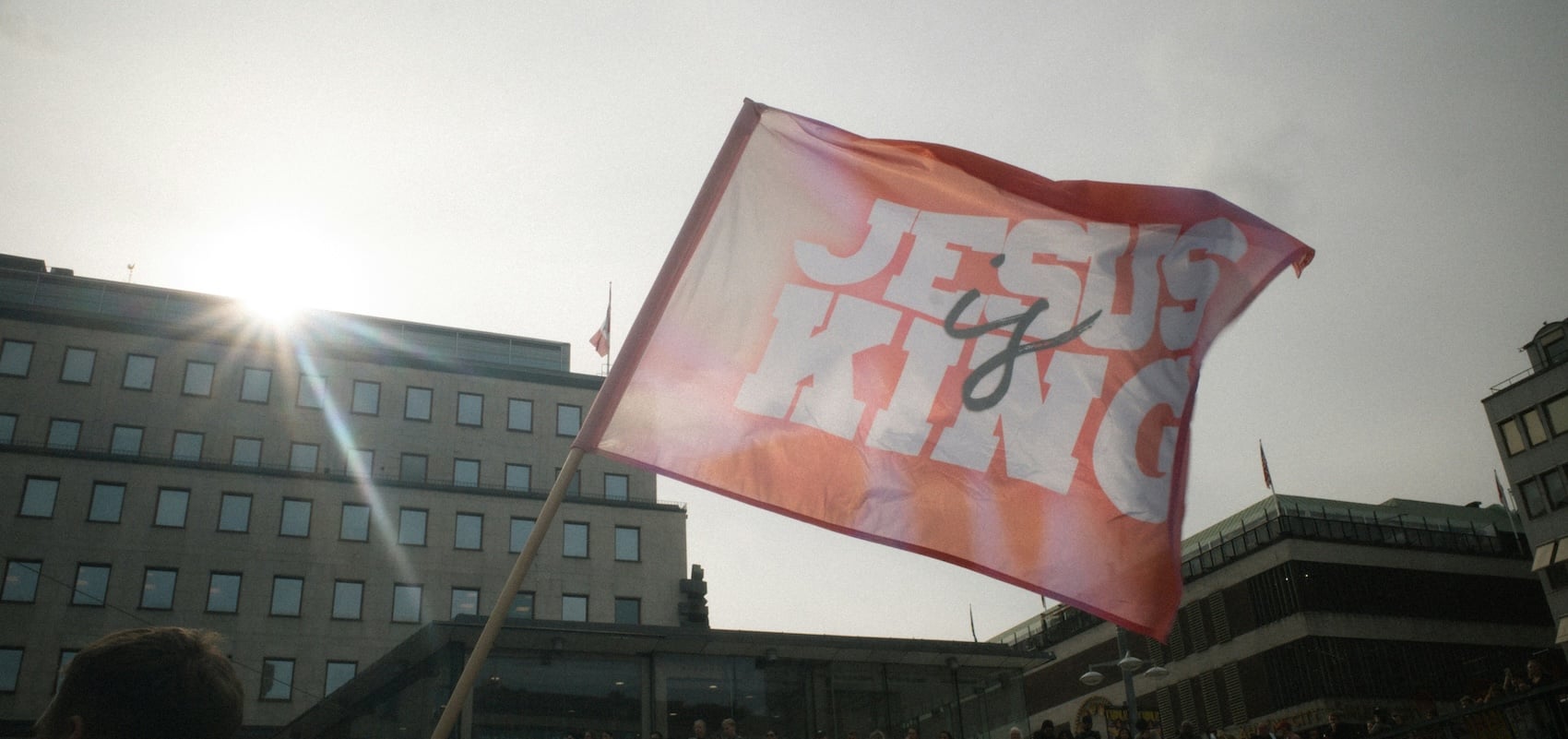
As most of the American right struggles to understand its recent election losses—and the leftward lurch of longtime conservative bastions like Texas and Kansas—one small faction of the movement claims to have the answer. To take the speakers at last week’s “Christ Is King: America After Trump” conference at their word, the real problem with the American right wasn’t any supposed overreach or negative polarization. The right lost because it wasn’t aggressive enough.
What the future now requires, in the words of conference organizer Joel Webbon, is a New Christian Right (NXR). This NXR will be unapologetically founded on four pillars: anti-Zionism, male leadership, “race realism,” and, last, “Christ is King.”
Each term has a plain meaning. “Anti-Zionism” means what most would call raw anti-Semitism: Webbon has called on his listeners to “righteously despise Israel” and described the Bible itself as “anti-Semitic.” “Race realism” means white nationalism: Webbon has argued that slavery was a “blessing” for black Americans. “Male leadership” means contempt for women: In Webbon’s own words, “every time you see a woman in leadership . . . there were at least a thousand men who were more qualified for that position than her.” And “Christ is King” means that all this identitarianism will be justified by a pastiche of citations to authority—including apparently AI-hallucinated citations—from the margins of the mainstream Christian tradition.
Webbon wasn’t alone. Also appearing at the NXR conference was a range of speakers, including conspiracy theorist Alex Jones, serial plagiarist Dale Partridge, the ecclesially ambiguous priest Calvin Robinson (who’s cycled through no fewer than six denominational affiliations in the last decade), Utah-based provocateurs Brian Sauvé and Eric Conn, and—in a surprise appearance—internet shock jock Nick Fuentes. To hear them talk, future victory is guaranteed: All that’s required is for the nation’s angry young men—white Christian men, that is—to rise up and claim their birthright.
At the heart of the NXR project rest two basic premises, which also anchor the larger “dissident right” as a whole: Human society is fundamentally defined by hierarchies, including and especially biological hierarchies, that render any appeal to equality questionable; and the modern world has, for decades, been hell-bent on suppressing this knowledge. Ever since the close of World War II, the argument runs, Western civilization has been in the business of denying reality. What’s required now is the recovery of an older and truer Western tradition.
How valid is that claim to tradition, though? It’s no coincidence that “Christ is King” ranks fourth in Webbon’s list of NXR pillars: In many ways, NXR theology recapitulates an old two-tiered metaphysical scheme, in which Christian “grace” rests neatly atop a self-subsistent “nature” possessing its own integrity without reference to the divine. But this strict bifurcation creates an epistemological problem: If “nature” can be read apart from God, then our reading of it answers to nothing beyond ourselves. Romans 1 says creation discloses something of its Creator; it does not say that whatever strikes us as natural is therefore ordained. It is perennially tempting to mistake the merely circumstantial for the natural.
Just such a freestanding conception of ungraced “nature”—and “nature’s” apparent privileging of some races over others—powered the political theology of Nazi Germany. And that theology was critiqued by Henri de Lubac from the Catholic side, and by Karl Barth and Dietrich Bonhoeffer from the Protestant side. Genuine transcendence cannot be safely gatekept; it unsettles “nature’s” received categories at every turn.
Viewed from this direction, the post–World War II settlement represented a development of the very Christian tradition Webbon and his allies claim to defend. A living tradition, as Alasdair MacIntyre argued, necessarily advances over time. That’s not to say the postwar settlement produced no problems of its own. But those problems ought to be debated within a Christian frame. Against this backdrop, the NXR’s retrieval of fringe elements of the Christian past—Partridge, for instance, has sought to repristinate old “Curse of Ham” theology—represents not a commitment to the Christian tradition as it has developed, but a very individualistic reinterpretation.
It’s little surprise that few—if any—NXR speakers have meaningful ties to historic Christian institutions. Though many claim the mantle of ministry, most abjure denominational affiliation—which would subject them to authorities beyond themselves. (In sedevacantist fashion, Partridge’s church describes itself as “in the Anglican tradition,” yet lacks any tie to an episcopate.) In the world of the NXR, it’s every minister for himself. What can any project of “Christian nationalism” possibly mean when the meaning of Christianity itself is up for grabs?
The NXR’s logic compels just one conclusion: Its “Christian nationalism” means ethnic identitarianism. That—rather than ecclesial communion or common doctrine—is the bond that unifies across difference, and the norm that norms theology itself. It is difficult to imagine, despite all the chants of “Christ is King,” a more godless political vision.

YOU MIGHT ALSO LIKE
Move Fast and Break Everything
When Donald Trump was re-elected in 2024, he was elected with a popular mandate and with a…
Realism and Reunion
Ecumenism has, to put it mildly, stalled. Since the beginning of this century, efforts aimed at bringing…
Actually Existing Literary Martyrdom
In Nanterre, France, Michel Houellebecq has been formally placed under criminal investigation for “complicity in incitement to…
