
In “The End of the Age of Hitler” (November 2024), Alec Ryrie observes that, as secularism advanced in recent decades, World War II replaced the New Testament as our source of moral orientation. The great conflict came to provide “the basis for our most fundamental convictions about what is good and what is evil.” Ryrie speculates that the mythic power of the war is waning. I hope so, because more than eighty years after the war’s conclusion, its lessons, taken as gospel truth by Baby Boomers, now do more harm than good.
World War II encourages a Manichean mindset, one that rushes to describe conflicts as world-historical clashes between unmitigated evil and unimpeachable good. Perhaps this conception was fitting in the struggle against Nazism. Winston Churchill warned that, if Hitler were not stopped, the world would endure a “new Dark Age made more sinister, and perhaps more protracted by the lights of perverted science.” Revelations of Nazi genocide vindicated Churchill’s dark prophecy.
But the affairs of men are rarely of this nature. Alexander Solzhenitsyn, no stranger to the evils of totalitarianism, observed, “The line separating good and evil passes not through states, nor between classes, nor between political parties either—but right through every human heart—and through all human hearts.” The great Russian novelist was characterizing the import of the famous line uttered by Jesus: “Let him who is without sin cast the first stone.” The statement was not meant to disarm us and prevent action on behalf of just causes. Jesus wished to encourage self-examination, which produces an awareness that our just causes are never pure and spotless, as well as the recognition that those who pursue unjust causes also have mixed motives. Because we are not angels, the righteousness and wickedness of men is never unalloyed.
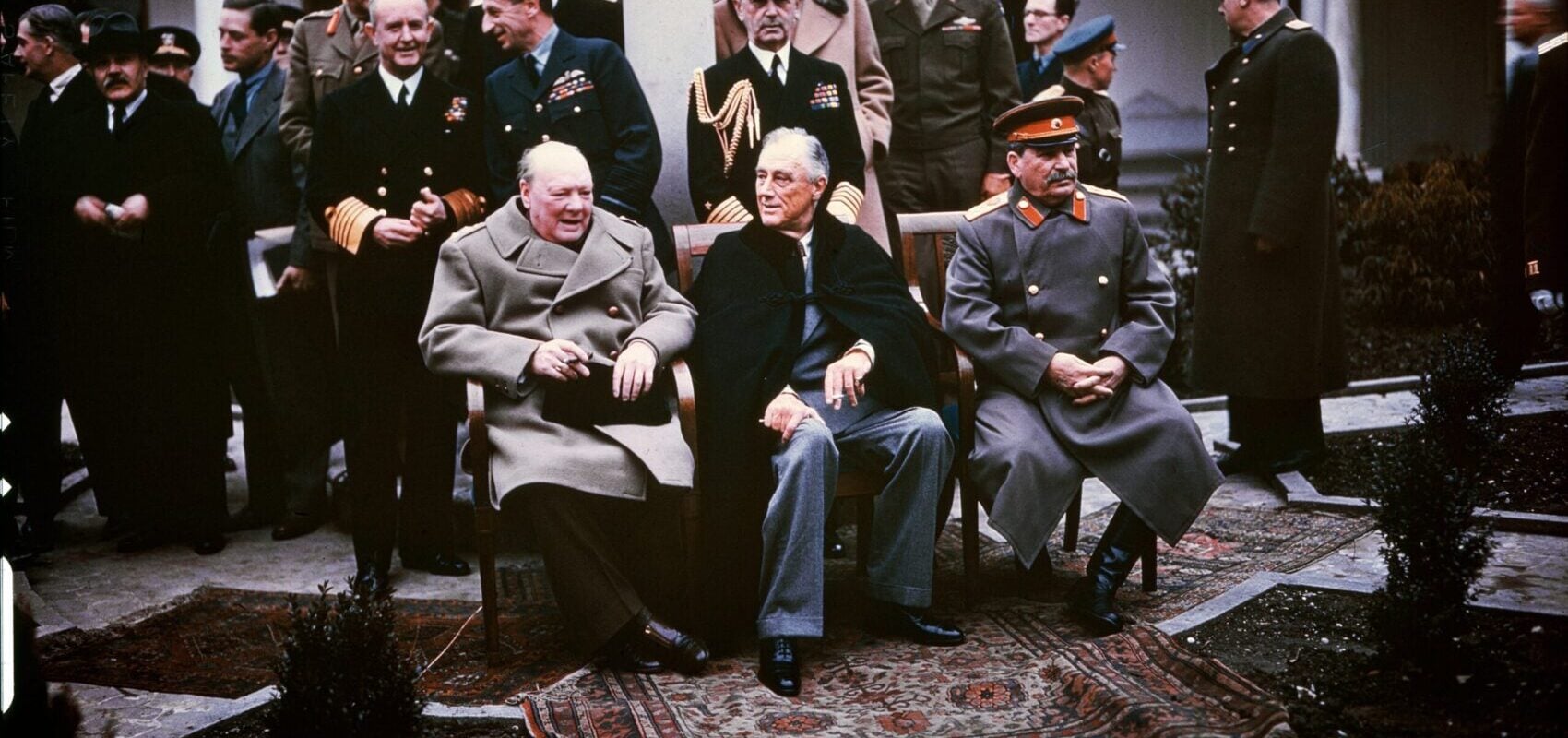
A sober historian recognizes that World War II participates in the inevitable moral ambiguity of the human condition. Although Franklin Roosevelt never said it out loud, his wartime decisions were motivated by his desire for the United States to replace European powers as the arbiter of global affairs. Moreover, at the Yalta Conference, FDR conceded entire peoples to Soviet domination in Eastern Europe. And Allied counter-population bombing, culminating in the use of atomic bombs, killed hundreds of thousands of innocent civilians. The good guys won, yes, but they were not without spot and blemish.
Nonetheless, the Manichean mindset is very nearly irresistible for Baby Boomers, who see World War II through the lens of myth rather than as a complicated and in many respects unhappy set of real events, as those who lived through those searing years of total war knew so well. Many Baby Boomers made a great show of their moral purity by being anti-war in their youth. Insofar as they have attained power and positions of responsibility in their later years, they have been eager to frame their labors in exalted terms, for which idealized conceptions of World War II provide foundational elements.
Consider the war in Ukraine. After his inauguration, Donald Trump initiated negotiations with Moscow, hoping to find a settlement that would bring the war to an end. Christian Caryl at Foreign Policy published a broadside, equating Trump’s efforts with those of Neville Chamberlain, who in 1938 made a deal with Hitler. Thomas Friedman at the New York Times took a similar line, awarding Trump the “Neville Chamberlain Peace Prize.” They were drawing on World War II mythology, in which Neville Chamberlain’s effort at Munich in 1938 to forestall (or at least delay) war with Hitler becomes not a diplomatic miscalculation but an odious and epic betrayal, a myopic failure to recognize that one must never negotiate with evil.
But this is absurd. Vladimir Putin is not Adolf Hitler. The Russian leader’s ill-considered aggression has not produced great victories. His nostalgia for Russian imperial dominance is dangerous and must be countered, but it does not arise from fevered notions of the limitless prerogatives of a master race, nor is it fired by a nihilistic ideology of the supremacy of the will.
I fear we will have to endure World War II analogies as Trump seeks a settlement with Iran. After the September 11 attacks, Christopher Hitchens popularized the term “Islamofascism.” Douglas Murray recently framed October 7 and Israel’s responses as a struggle with a “death cult,” on which the future of civilization rests. We’re constantly urged to view today’s conflicts through the lens of 1939.
Bidding up the stakes in this way encourages pursuit of definitive victory, utter defeat of our adversaries. At the 1943 Allied Casablanca Conference, Franklin Roosevelt insisted on a policy of unconditional surrender for the Axis powers. This policy meant that the Allied powers (which in practical terms meant the United States) would have a free hand in the remaking of Germany and Japan.
This historical pattern is echoed in calls for the total defeat of Iran and elimination of its proxies. A similar ambition characterized the War on Terror, epitomized by failed efforts in Iraq and Afghanistan. Some commentators insist that we failed because we did not apply enough effort; America did not “stay the course” and achieve the conditions that allowed for our successes in Germany and Japan. Now we are told that we must learn from those failures and employ as much force and resolve against Iran as is necessary to put an end to that nation’s capacity for mischief in the Middle East.
This ambition can seem idealistic, the position of those who take evil seriously and seek a better world. I think the reality is otherwise. Around 10 percent of the German population died in World War II, and the country was flattened. Achieving this level of destruction required the total mobilization of the United States, which fundamentally transformed the country, as conservatives such as Russell Kirk and Richard Weaver lamented. American troops occupied Germany, and they remain to this day. And of course, securing Japan’s unconditional surrender required the use of nuclear weapons.
Good arguments exist for every strategic and tactical decision made by American leaders during and after World War II. But we should recognize that the war, taken as a whole, was a catastrophe for Western civilization. To its orgy of violence—historians estimate a death toll between 70 million and 85 million—we owe the soul-eating nihilism that today threatens the future of the West more profoundly than do our external enemies. Those who now appeal to that war’s precedents to guide American foreign policy are misguided and misguiding. Were the United States to do to Iran what it did to Germany and Japan, military victory might be achieved, but the moral costs would knock out whatever stuffing remains in our civilizational self-confidence.
The war in Ukraine and the contest with Iran (and the aborning Cold War with China) are not titanic struggles between modern ideologies bidding for global domination, as the mythology of World War II encourages us to believe. We need to engage in creative forgetting of the supposed lessons of that long-past conflict. For thinking in reified, mythological terms impedes one of the important jobs of statesmen: to find workable, inevitably imperfect, and never permanent compromises in and solutions to the clashes between nations, so that men are not needlessly ground down in wars.
Dear Reader,
Can I be direct with you?
War abroad. Socialists on the rise. AI upending human life. Endless uproar online. The modern attention economy doesn’t want readers — it wants users enslaved to the tyranny of the present.
First Things is the antidote: literary excellence, timeless truths, and a fixed point of reference in a culture that has lost its bearings.
But we can’t do it without readers like you.
Our goal: Raise $150,000 by November 1 to sustain First Things in the year ahead.
Your gift anchors readers in the permanent things.
Make your Fall Campaign gift now using the button below.
If you have any questions or would like more information, please contact Giovanni Del Piero, Director of the Editor’s Circle, at gdelpiero@firstthings.com or 212-627-1985.


YOU MIGHT ALSO LIKE
How Sweden’s Immigrant Vote Toppled the Right
For decades, Sweden had perhaps the most open immigration policy and the strongest commitment to tolerance and…
The Last Statesmen?
In the latest installment of the ongoing interview series with contributing editor Mark Bauerlein, Steven B. Smith…
De Gaulle Triumphant
The Second World War left Europe invaded and ruined, divided between Soviet and American occupations. Hitler’s defeat…
