
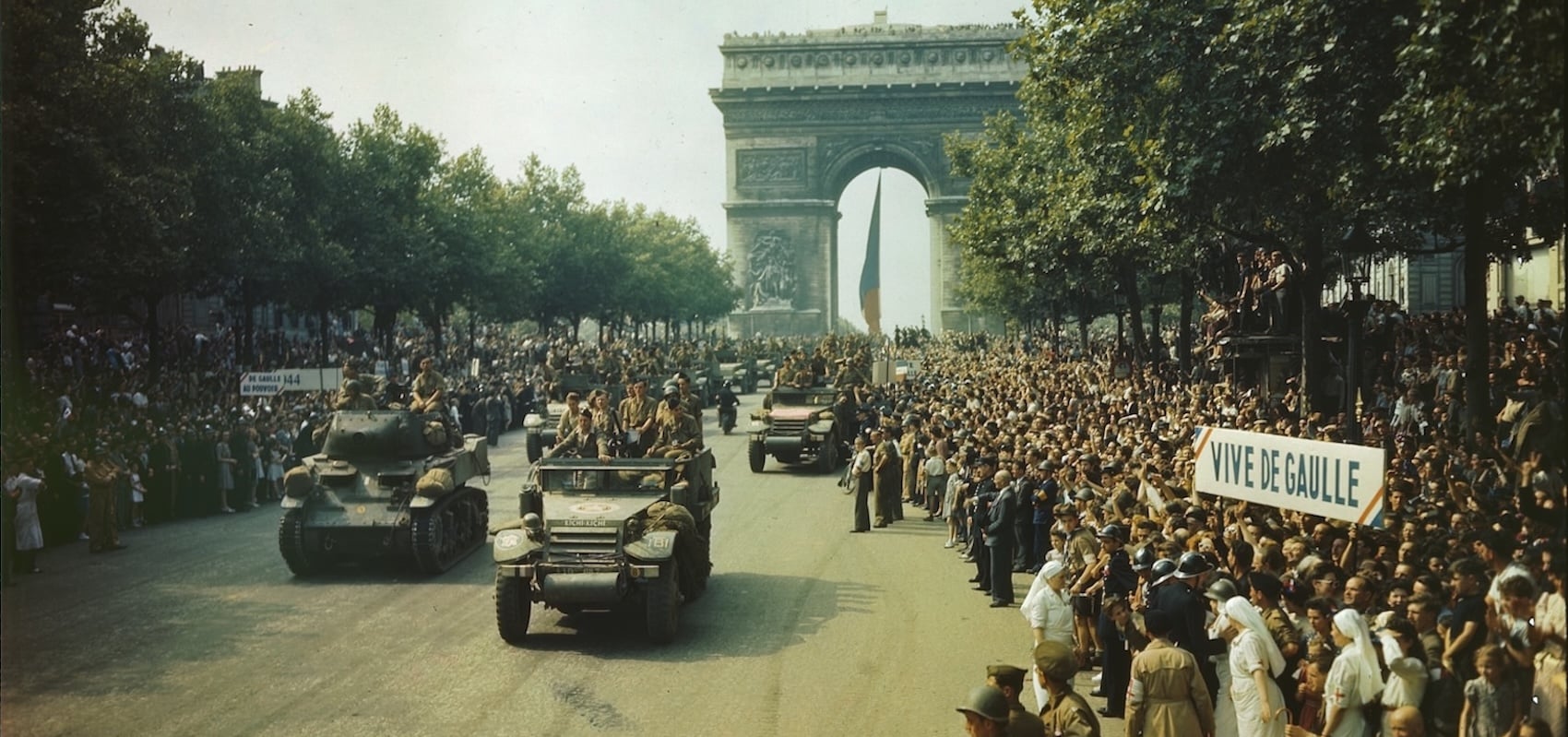
The Second World War left Europe invaded and ruined, divided between Soviet and American occupations. Hitler’s defeat represented a “triumph and tragedy”—the title Winston Churchill took for the final volume of his memoirs. But over time, this dual awareness faded. In the United States, the trade-offs that enabled Stalin to conquer Eastern Europe and America’s transformation from a republic into a global empire, with permanent bases in Europe, were put out of mind. A myth developed. The war became a morally unimpeachable victory over an anti-Semitic, xenophobic, and genocidal fascism. That narrative became the “greatest story ever told,” the central theopolitical drama for an increasingly post-Christian country.
Whereas the United States had embraced a myth of righteous infallibility about the country’s role in World War II, France also came to embrace a myth, but one of a very different sort. In the two decades after the war, Charles de Gaulle did his best to instill a myth of national pride. That fell apart during May 1968. The French thereafter embraced collective guilt. In this myth, all of France is tainted by collaboration with the Nazis and responsibility for the Holocaust, which has a way of reinforcing the American-made “greatest story ever told.” When it comes to the post-1945 era, France has nothing to offer except self-hatred and subservience to materially stronger and morally purer powers.
These myths answer to our deeper post-Christian spiritual crisis, which hungers for theological substitutes for the old, now sidelined faith. Eric Voegelin diagnosed how progressive movements promise redemptive revolutions, what he called “immanentizing the eschaton.” The observation is perceptive. But Voegelin did not live long enough to see a darker, more pessimistic mode of theologizing politics, one that revolves around evil and dreams of its full and final exorcism. To a great extent, the dominant myths of the Second World War participate in this mode of spiritual cleansing, epitomized in the constant conjuring of the ghost of Hitler to form new battle lines and underwrite new purity tests.
France’s summer blockbuster, La Bataille de Gaulle, suggests that change is coming. The film’s success shows that thoughtful people are ready to reassess the meaning of World War II. Released in the U.S. in two partsunder the title De Gaulle,the film is the first Hollywood-style epic treatment of de Gaulle’s Second World War, crowning him and his followers as great heroes. For Frenchmen and foreigners, the film restores the possibility of seeing France’s role in the war in a new and more positive light. This was, of course, de Gaulle’s singular ambition.
But despite its dazzling presentation, Bataille de Gaulle is in tension with itself. To enter into de Gaulle’s Second World War requires entertaining the (to the twenty-first-century mind) shocking proposition that his struggle for restoring France’s national sovereignty was more important than defeating fascism. To think with de Gaulle requires subordinating our predominant theopolitics and its aspirations to world-historical purity to very traditional understandings of politics as an affair of preserving nations and peoples. Perhaps those who produced Bataille de Gaulle understood this need. But to keep the viewer’s attention, the film invokes the tropes of the “greatest story ever told.” And so, despite the great energy of Bataille de Gaulle, it remains captured by the postwar myth that the supreme achievement of the war was the collective effort—perhaps unfulfilled—of purging Nazism from the West. This decision consigns de Gaulle’s conceptions of authority and sovereignty to the historical past, casting them as archaic appeals to noble sentiments of national pride that we might admire from afar. This is a shame, for we need de Gaulle and his sense of the primordial vocation of nations to challenge us to reform the way we are presently governed, a way that has forgotten that vocation.
But criticism must wait. We should appreciate that such a film even exists. In today’s France, making an epic film about de Gaulle is itself an act of subversion. After May 1968, the intellectual and artistic world joined in the revolt against de Gaulle, who went from being the symbol of national resistance to the symbol of the alleged authoritarianism of pre-1968 France. Thereafter, any filmmaker portraying the general risked being charged with glorifying “de Gaulle, assassin.”
The character defamation was effective. De Gaulle was portrayed briefly in Jean-Pierre Melville’s 1969 masterpiece, Army of Shadows (L’armée des ombres), a grim, accurate depiction of the French Resistance. The film shows de Gaulle awarding a medal to a Resistance leader. That short scene was too much for the sensitivities of the post-1968 critics. So successful was the French art world’s pillorying of Army of Shadows that the American version was not released until 2006. By that time, it was safe, because the deconstruction unleashed by May 1968 had stripped the altar of Gaullism bare. In the 1990s, the president of France and heir of de Gaulle’s political movement, Jacques Chirac, apologized on behalf of France for the Vichy government’s role in rounding up Jews. To apologize on behalf of the nation presupposes the responsibility of the nation. Chirac’s gesture implied that the Vichy government (complicit in the Holocaust), not the Free French in London, had been the legitimate representative of the French nation all along. This was exactly the opposite of de Gaulle’s central claim.
However, de Gaulle would not die. In the 2000s, the failure of every president of the Fifth Republic to measure up to its founder provoked nostalgia for an era when France was steered by a better statesman. De Gaulle became the hero everyone missed, and in popular consciousness he was reimagined as a unifying figure missing from the fractious present. In 2006, a publicly funded, made-for-TV miniseries about de Gaulle was released. Le Grand Charles depicted a middle-aged de Gaulle reflecting on the war in the 1950s, awaiting his return to power in 1958. In 2020 came a proper cinematic biopic: De Gaulle. Using the star power of actor Lambert Wilson (best known outside France for starring in The Matrix trilogy), it recounted the birth of the Free French in 1940.
Yet Le Grand Charles stayed clear of May 1968, while De Gaulle focused narrowly on his family life and the intrigues of the first few months of the war. The haughty general could return, but only on limited and safe terms. La Bataille de Gaulle strives to be more ambitious: The film embraces the Gaullist legend that the soixante-huitards spurned. Doing so signals an outright declaration of generational warfare. The film aims to demolish the consensus that puts Baby Boomers and their 1968 rebellion at the center of French history, with their obsessions about authoritarian personalities and their determination to erase them from the past. La Bataille de Gaulle glorifies de Gaulle as a great man of history. It’s a panegyric to personal political authority. One is hard-pressed to imagine a cinematic message more offensive to the spirit of May 1968.
The film’s emphasis on personal political authority is true to historical events. When de Gaulle arrived in London on June 17, 1940, determined to fight on, he had little else to bring to that cause but himself. With no troops or diplomatic position, he brought no visible assets. But he possessed invisible assets: his person and character. He used them to play well from a bad hand. The film understands this. It dramatizes some of the key battles of the Free French forces in North Africa. But its chief accomplishment is to keep de Gaulle’s strength of will and perspicuity of judgment at the center of the story.
Condemnations of Vichy France are now routine, but in the summer of 1940, the course of that regime was uncertain. Marshall Philippe Pétain was a great soldier, the hero of the battle of Verdun in 1916. He was universally admired and trusted. In June 1940, as France faced complete military defeat by German forces, the leadership of the Third Republic appointed Pétain to govern.
On June 22, 1940, he signed the armistice. It secured a beachhead of French self-government in Vichy, preserving sovereignty in the southern regions of France and in her empire. In July, Pétain secured an overwhelming parliamentary majority to govern as head of state and draft a new constitution. His patriotism, legality, and legitimacy appeared unimpeachable. Pétain seemed poised to lead France back from the defeat of 1940, just as a previous generation had led France back from the defeat of 1870. Intelligent and patriotic Frenchmen rallied to his side. Cardinal Pierre-Marie Gerlier spoke for many when he declared that “Pétain, c’est la France, et la France c’est Pétain.”
Rote condemnations of Vichy ignore these important factors. They downplay de Gaulle’s genius and the daring of those who followed him. The choice between de Gaulle in London and Pétain in Vichy was not a black-and-white matter. De Gaulle was great because he acted prudently in a situation where duties were not obvious. He foresaw that Vichy was doomed. The armistice entailed the eventual strangulation of an independent France. It was impossible to undertake a national renewal from a position of partial occupation. De Gaulle was only a junior minister in June 1940, yet he was the most senior Frenchman in government to understand that for France to achieve a real national revolution, she needed to keep fighting. That he saw reality clearly and had the courage to act was the essence of his greatness.
La Bataille de Gaulle handles this matter well. It shows how strange de Gaulle looked in the summer of 1940 to his countrymen, and why many hesitated to join him. At best, he appeared as an eccentric, comparing himself to Clovis, the first king of France; at worst, he appeared as an apologist for further attacks against his own countrymen, a traitorous pawn of Churchill, endorsing the British decision to sink the French fleet at Mers-el-Kébir.
Yet de Gaulle’s clarity of purpose proved attractive. He incarnated the spirit of an unbroken nation, ready to rebuild France by the force of his will. What appeared as arrogance or intransigence became over time a powerful legitimacy. The wills of others bent to submit to his.
One of the film’s best moments comes when de Gaulle, trousers covered in mud from an earlier plane crash, lands at Fort-Lamy in Chad to meet General Catroux, who commanded colonial forces in defiance of Vichy’s subordination to Germany. A five-star general, Catroux was the highest-ranked officer to join de Gaulle. In military terms, he outranked the two-star de Gaulle, so it would have fallen to de Gaulle to salute him. But in political terms, even the highest-ranking general is outranked by the head of government (however junior a military officer he may be). The film turns this episode at Fort-Lamy into a dramatic vignette, a contest of wills between Catroux and de Gaulle. Catroux yields and salutes first, thereby accepting de Gaulle’s command.
According to the tropes of the “greatest story ever told,” de Gaulle’s insistence on the proper chain of command is nonsensical. What does this have to do with defeating the Nazis? And so, for many, these episodes are proof of de Gaulle’s Caesarist and authoritarian impulses, distractions from the anti-Nazi war effort.
But his exchange with Catroux is no mere clash of egos. De Gaulle’s Second World War was oriented around a single existential question: What profits a nation if she defeats Hitler yet loses her sovereignty? For de Gaulle, some things are more important than defeating the Nazis. His war—France’s war—was a struggle to recover national sovereignty and independence in the face of greater powers that were willing, even eager, to accept the end of France. That’s the greater battle de Gaulle fought: to save France as a sovereign nation.
Therein lies the real significance of the Fort-Lamy episode. It depicts the difference between a state with authority in its proper sphere and a mere military junta that gives power to the man holding the highest rank. For want of the right salute, a whole state could be lost. The Fort-Lamy episode put de Gaulle and the Free French on the path to building a properly ordered ship of state that could house sovereignty and replace the collapsing hulk of Vichy. In short, the film embellishes a real event to a very important end: It makes clear that de Gaulle’s person and will was the beating heart of the Free French, the true, sovereign France.
In the film, de Gaulle’s will also inspires the emerging French Resistance. Its fighters are portrayed as having a special spiritual bond to him. De Gaulle is (as he indicated in his memoirs) the refuge from their suffering and the symbol of their hopes. After 1968, it became common to recount the French experience of the Second World War by foregrounding the exploits of popular resistance against the German occupation. This image of sui generis resistance kept de Gaulle in the background. Bataille de Gaulle inverts that conceit, keeping de Gaulle in the foreground. The Resistance is important, but it’s one front in de Gaulle’s larger battle. In this way, the film brings the pre-1968 Gaullist legend back to life.
Keeping the Resistance in the background also aligns with another important aspect of the pre-1968 outlook. Since the real drama of the war is the struggle for French sovereignty, the question becomes: Who opposes that goal? The Germans were certainly the enemy. So was the Vichy regime. But, as de Gaulle foresaw, the British and above all the Americans would prove to be the supreme foes.
This larger awareness of geopolitical realities, the film suggests, manifests de Gaulle’s second great perspicuity of judgment. While others rejoice when America enters the war, de Gaulle is wary. He knows that the defeat of Hitler is now assured, but he looks beyond that outcome. He recognizes that America will dominate the world for the rest of the century. The old great powers of Europe will become her vassals—“even the British.” If France is to avoid this fate and preserve her sovereignty, then she must start acting unilaterally, at once. As the Americans bargain with Pétain’s followers in 1942, de Gaulle seizes strategic but Vichy-controlled territory for the Free French. These actions put de Gaulle on the path of confrontation with the president of the United States.
If the Gaullist postwar myth is to reascend, the American myth of moral triumph must descend. The film pulls no punches. Roosevelt is portrayed not as the patron of transatlantic cooperation but as an imperial president. The fall of France, as Roosevelt tells de Gaulle at one point in the film, gave the American leadership class an immense shock. Other powers could not be relied upon to defend themselves. America would have to take up arms on their behalf. America owes the world her assertion of global hegemony. Roosevelt adds that the British and the Soviets must also play their part. For Roosevelt, it’s more important to build the new world order with the Stalinists than with the French. But the United States must be first among equals. To that end, America produces the largest military force assembled in human history. The film reveals the D-Day armada, kept secret from de Gaulle until the last moment, in the midst of a thunderstorm. It’s a visually impressive yet darkly ambiguous image of American military supremacy.
The imperial Roosevelt is also imperious. Others exist to do his bidding. FDR commands them to crush the leader of the Free French and the spirit of an independent France. Those skeptical of his obsession with nullifying de Gaulle, from Winston Churchill to General Eisenhower, are expected to fall in line.
In La Bataille de Gaulle, Roosevelt is the real villain of World War II. Twice he selects men associated with Vichy to lead French forces over de Gaulle. He makes a deal with François Darlan, admiral of the French fleet and Vichy’s former prime minister, to serve as the military and civilian head of France’s government in North Africa. But Darlan is assassinated in December 1942. And in 1943, de Gaulle outmaneuvers and neutralizes Roosevelt’s other choice for commander-in-chief, General Henri Giraud. Roosevelt is undeterred. He approves a plan to partition France after the war’s end and place its territory under U.S. administrative control. As a final insult to French sovereignty, plans are made for the U.S. Army to print banknotes for the French. Not only is France stripped of control over her own currency, by personal order of Roosevelt; the proposed currency is stripped of the symbols of national sovereignty.
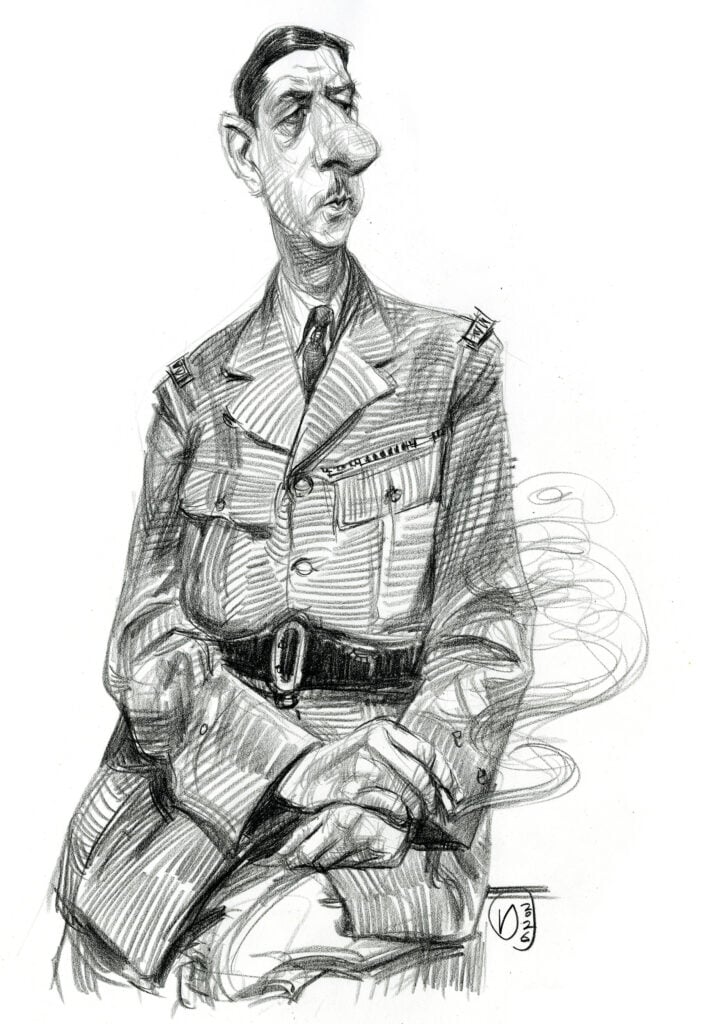
In this way, the film shows the birth of the American empire not in a just cause but in a crippled patrician’s haughty prejudices. Its visual tropes are droll. One scene shows a sick Roosevelt plotting France’s demise while receiving injections; another scene shows Roosevelt laughing while banknotes float around him. In the film’s dramatic climax, defeating Roosevelt’s schemes requires de Gaulle to stake everything on the Free French entering and liberating Paris, a powerful symbol of the return of the true France to her capital as a sovereign victor, not a vassal.
La Bataille de Gaulle is generally faithful to its subject matter; the scenes depicting Roosevelt’s plots are accurate, if overstated. Still, in other areas, the film takes numerous historical liberties that burnish the Gaullist legend. In real life, de Gaulle struggled to contain the influence of the communist Resistance; after the war, the French Communist Party traded in the prestige of resistance to win a quarter of the electorate for a generation. In the film, the communist Resistance might as well not exist. It has been dissolved into the Gaullist one.
General Giraud suffers a different treatment. Captured by the Germans in 1940 and imprisoned, the patriotic general made a daring escape in April 1942 that infuriated Hitler. Arriving in French Algeria later that year, he organized half a million Frenchmen to fight Rommel’s forces. But the film portrays him as a figure straight out of Vichy’s anti-Semitic milieu, scarcely better than Darlan.
Other changes reinforce recognizable tropes about the Second World War. Vichy did not require Jews to wear the yellow star in the regions it controlled, yet the film shows that happening. Darlan’s assassin, Fernand Bonnier de La Chapelle, was a royalist, a reader of L’Action française who seems to have plotted to kill Darlan to make way for the return of the king. The film turns his love for France’s monarchy into love for France’s Jewry. Fernand falls in love with a French Jewess, but she cannot escape occupied France. Darlan, the symbol of anti-Semitic collaboration, is killed for her sake.
These changes are understandable. References to the Holocaust are immediately intelligible to contemporary viewers, reinforcing the film’s pathos and the righteousness of de Gaulle’s cause. But they tacitly admit that even for a period so well-trodden as World War II, the past is a foreign country. A world with the French Communist Party, traditionalist officers, and royalists all running about, each with a real shot of forming a government, would baffle contemporary viewers. Better to cleave to familiar morality tales developed decades after the war.
Other changes evince caution. Though the film scorches postwar American pieties about the transatlantic relationship, it hesitates to undertake a complete revival of the Gaullist myth. The twenty-first-century French audience looks to de Gaulle as a source of unity. Bataille de Gaulle can expose the insolence of American empire; condemnations of the superpower draw the French together. Portraying Gaullism in full would have a different effect. It would reveal how divisive his project really was.
Take, for instance, the scandal of the Americans printing the French currency for them. This is a properly Gaullist affair. De Gaulle understood that national sovereignty is inseparable from economic sovereignty. But this theme is too on the nose for contemporary France. In joining the Euro—a project de Gaulle repudiated but his heirs pursued—France surrendered her economic sovereignty. Today, she endures the indignity of others printing her money for her (with banknotes bereft of national symbols). However, a film that drew too much attention to de Gaulle’s restoration of the franc would be seen as an attack on the Euro, the symbol and instrument of another very different postwar myth concerning the necessity of European integration. Between de Gaulle and the European superstate, one must pick a side. The film doesn’t, beyond slyly portraying the architect of European integration, Jean Monnet, as an American agent. Nothing more is said.
The same hesitancy applies to the film’s account of the liberation of Paris. In 1944, de Gaulle had two objectives. First, he aimed to reconstruct the French state. That meant spurning the popular Resistance and addressing the official organs of government, despite the compromised stances they may have taken during the war. In the liberation of Paris, de Gaulle met with the city’s prefect of police before he met with the leaders of the Resistance. The point was clear, even if it scandalized many members of the Resistance: It was more important to build a functioning government around competence than around antifascist moral purity. De Gaulle’s political realism was ruthless. It cut old allies out in the name of new plans. But the ruthlessness was principled, not cynical. He sought an institutional, state-driven solution to France’s problems because he grasped that there could be no adequate political or legal solution to the problem of moral impurity.
De Gaulle’s second objective was to provide a stable regime to order the postwar French state. His answer was the republican monarchy, a republic governed by a strong president. De Gaulle was opposed in both objectives. He wrote that, even at the moment of the liberation, he saw “the Communists’ unyielding scheme,” the rancor of collaborationist elites “who would not forgive me for their error,” and the “eager desire for agitation” within the political parties. De Gaulle could not defeat them all. He failed in his objectives, at least initially.
In 1945, de Gaulle’s scheme for the republican monarchy was thwarted. The Fourth Republic, established in 1946, imitated the structure of the Third Republic. De Gaulle resigned; his preferred regime had to wait until his return to power in 1958. More complicated was his failure to contain the drive toward antifascist purity.
Throughout 1944 and 1945, the communists pursued their scheme of parlaying the moral prestige of their resistance into raw political power, exercised for the cause of purification. They largely had the upper hand. It was a civil war that dared not speak its name. Gangs of Johnny-come-latelies to the Resistance roamed France, rounding up and lynching those suspected of collaboration. Courts with dubious legal standing sprang up to exercise the summary justice of the victor. Yet questions of guilt, innocence, and purity could not be resolved so neatly. The French became embarrassed by the purges. Albert Camus, who had supported them, changed his mind and called them “odious.” Even Pétain’s trial fell flat. An elderly man with inconstant judgment was meant to serve as the scapegoat for both the shipwreck of Vichy and the disaster of the Third Republic that enabled it. That was an impossible role. Proceedings revealed the sordid side of republican politicians while muddying the waters around Pétain’s own wartime intentions. Pétain was sentenced to death. But with self-serving and self-righteous mediocrities among the judge, the prosecution, and the witnesses they called—men complicit in the same actions for which they had indicted Pétain—the trial failed to bring the moral purification to France that zealots of antifacism have sought then and ever since. No single, unified national narrative of what went wrong in the France of the 1930s and 1940s was ever consolidated. Even today, only half of the French believe Pétain was guilty of treason.
De Gaulle was right: Government cannot provide its citizens with moral purity. Legal authorities do not possess the competence to resolve certain questions—or to compel those on the dock to make certain confessions. Pétain, for his part, was right to say at his trial that a “Marshal of France asks no one for mercy.” It fell to God—or the sovereign—to show that quality. De Gaulle commuted his death sentence to life imprisonment. Pétain lived out the rest of his days to reckon with the voice of his conscience and his maker, at the phonetically appropriate island called “L’île d’Yeu.” Those who wanted the 1940 head of state to serve as a scalp for their countrymen’s failures (and their own) were thwarted. As de Gaulle reconstructed state authority in 1945, he began commuting more of the death sentences that the lower courts delivered. Later generations hated him for that. When the charge of anti-Semitism became more important in the nineties than it ever was in the forties, the zealots gained a new casus belli against their fathers. In retrospect, de Gaulle had served as a katechonic figure, restraining the operation of the scapegoat mechanism in the French community and arresting the cycle of violence.
Bataille de Gaulle does not hint at any of these profound and enduring divisions. That hesitancy turns the film against itself, deflating the Gaullist legend even as the film strives to raise it up. De Gaulle tried to use his personal eminence to resolve the question of French sovereignty and the nation’s right to endure as a distinct and proud people. The zenith of that personal power came during the liberation of Paris, when the nation’s integrity was fused with his own. After the end of the battle for the city, de Gaulle marched in a triumphant procession through the streets, with millions of Frenchmen coming out into public to chant his name. “As far as I could see,” wrote de Gaulle, “it was nothing but one living swell in the sunlight and under the tricolor. . . . [A]t that moment was occurring one of those miracles of national consciousness.” The millions anointed him as they might a sovereign. Yet in a startlingly brusque denouement, the film shows none of this. It denies de Gaulle his coronation. One never sees the source of his supraconstitutional legitimacy—the nearly metaphysical potency he possessed that transcended the rule of law, which he exercised to solve the crises of the late 1950s, with his characteristic indefatigability and ruthlessness (no matter how much they divided the French).
Instead, the film embraces the safer, familiar theme of moral unity through popular resistance. It concludes with historic footage of Parisians fighting for and celebrating their liberty. It’s uplifting. But it dissolves the will of the General into the general will. Sentimentalism reigns in place of a sovereign. The film closes with a warm reunion between de Gaulle and Churchill at the Arc de Triomphe on Remembrance Day, November 11, 1944, before flashing forward to a present-day shot of the Arc as the credits prepare to roll.
Bataille de Gaulle offers a cinematic antithesis of the post-1968, late-twentieth-century culture of repudiation. For those reasons alone it should be commended. It popularizes the courage and honor of the French at war, reminding them that they have good reasons to hold their heads high. Bataille de Gaulle also reminds us that the affairs of men are often driven by large and dominating personalities who are touched by providence and assume outsized roles. “Constituent power cannot be defined by the legislator or formulated by the philosopher,” wrote Juan Donoso Cortés. “When it appears, it is like lightning sundering the bosom of a cloud. It inflames the atmosphere.” De Gaulle has that effect. His electric legitimacy rallies supporters to him and bends skeptics to accept his command. By portraying de Gaulle in this way, Bataille de Gaulle suggests that the myth that encourages us to see the Second World War as a theopolitical struggle between good and evil distorts the true nature of politics, which demands judgments about whom to follow, whom to admire, and whom to trust. Greatness operates in a gray zone where good and evil intermix: the gray zone of history, of human life. Moreover, to understand the true nature of politics requires grasping that the survival of a people with its honor intact is the primary ethical-political imperative, not extirpating every trace of fascism from the human soul. The first duty of the sovereign is to preserve the realm.
But we are schooled in the theopolitical drama of the postwar “greatest story ever told.” It is too painful for us to reckon with the wisdom of de Gaulle’s approach. The twenty-first-century West is an assembly of decayed political communities, populated by demoralized citizens distrustful of those who wield power over them. The distrust is well earned, as their leaders trade away the remaining fragments of national, popular, and economic sovereignty. To suggest that de Gaulle’s objectives were more important than the antifascist crusade that has preoccupied us since 1945 would be to indict our own civilization for taking a spectacularly wrong turn.
And so Bataille de Gaulle is a cautious film. It reconstructs what a previous generation repudiated, yet it dares not go any further. The real de Gaulle was the man with an iron will, resolved to divide and conquer to make whole that which had been compromised and to honor the sovereign that so many in positions of power had dishonored. Instead, the film settles on safe nostalgia for de Gaulle the unifier. The shots of present-day Paris at the end are reassuring leitmotifs of stability. They coax the French to imagine that another figure will soon emerge to reconcile their disagreements, to draw them together around a new collective consensus that can shake off the stains of the past. That won’t happen. Much has been compromised. Within the hollow crown of France, dishonor keeps its court. The French still need de Gaulle, but not for the reasons they think.

YOU MIGHT ALSO LIKE
New Founders Wanted
It’s now 250 years since America declared her independence and embarked on the experiment of fashioning a…
While We’re At It
♦ Erin Piacenti, a thirty-two-year-old wife and mother, was killed in Times Square on August 31. Her…
Smashing the Images
As the postwar era draws to an end, some Christians continue to reach for analogies to the…
