
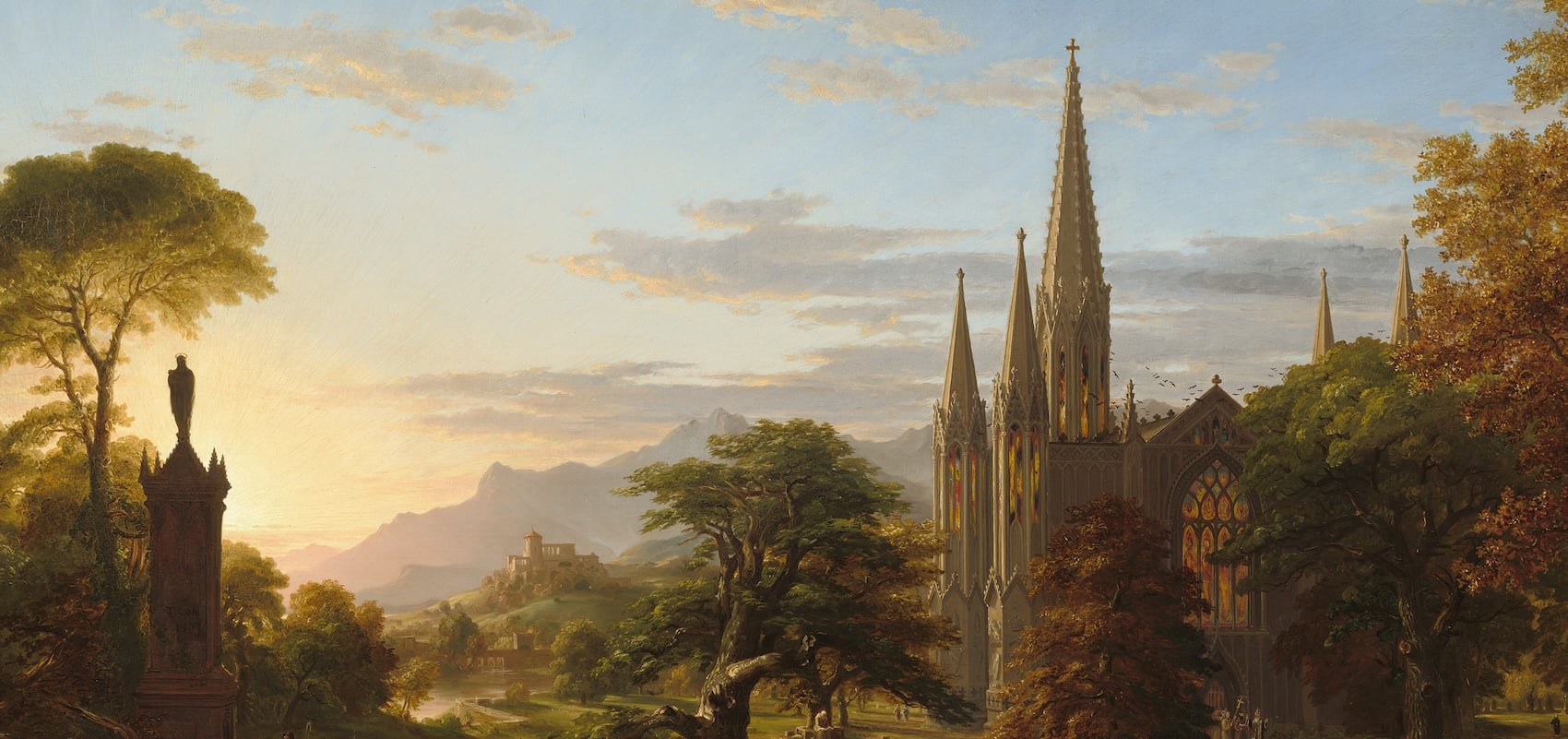
In the Republic, Plato writes that unless liberated by philosophy, by the awakening of the divine part of the soul, the condition of man is akin to living in a dimly lit cave, enthralled by the passing shadows of truth and overwhelmed by the echoes among the rocks. One movie version of this bondage to deception is The Matrix. Another, one more suited to the circumstances of conservatives today, is The Devil Wears Prada. Poor Andy Sachs (played by Anne Hathaway) thinks she is immune from fashion trends, but in fact her outfit consists of this bit from one designer and that bit from another.
Today, the vocabulary conservatives use to understand their world exhibits the same predicament: one idea, or fragment of an idea, from this political theory, another from that political theory, all adopted willy-nilly and advanced with no larger coherence. This is particularly true for the most important threat facing our country: identity politics. American conservatism cannot succeed without a greater measure of clarity about what it is up against and how it can be fought. Let me address some confusions that need to be cleared up if conservatives are to win back territory they have lost.
First, they need a better understanding of the common conservative opinion that cultural Marxism has animated the “long march through the institutions,” and that therefore cultural Marxism is the real enemy they face. This is at best a half-truth, at worst debilitatingly superficial. In the author’s introduction to Democracy in America, Tocqueville observed that “deeper than laws are mores, and deeper than mores is religion.” Institutions march together when underlying habits of mind are held in common, not because of conspiratorial takeovers. Revitalize Christianity, and different habits of mind will emerge, which will alter institutions without, so to speak, giving the matter a second thought. Yes, politics is downstream from culture—but culture is downstream from religion. Until conservatives grasp the fundamental role of religion, and act on it, they will lose.
Second, orthodox Christians in America have been competing on an uneven playing field, in part of their own making. These days, many of us recognize that our nation will either be healed or suffer further wounds. Repentance or retribution: That is the choice before us. If we live in a secular world, proposing the former sounds like the reintroduction of something—Christianity—that America no longer needs or wants. Isn’t the modern age a godless one? Isn’t our modern age held together by the grand fable that we left religious warfare behind and chose commerce and enlightenment instead? I think this narrative offers a distorted account of the modern age, and if conservatives refuse to challenge it, those who want retribution will prevail over those who want repentance.
America will always be a city on a hill, a light among the nations. She will always either celebrate the innocent victimhood of this or that group, and fly the rainbow flag on embassy flagpoles around the world and soon on the moon and Mars—or she will celebrate the Lamb of God who takes away the sins of the world, the only truly innocent victim the world has ever known.
It is crushingly obvious that we do not live in a secular age, given the fact that we have an established church, the Church of Identity Politics, which permeates all of our institutions and determines what counts as morally permissible speech and action. Conservatives must seek to replace the established Church of Identity Politics with orthodoxy. The Christian nationalism debate, which I will not enter here, is disadvantaged by the current playing field, which presupposes that having a religious nation would be a radical departure from the supposedly secular status quo. But we do not have a secular status quo. And since there is no secular status quo, there is no secular solution to our current problem in America, which is a religious one.
An incarnate innocent victim or immanent innocent victims, take your choice: either the blood of the Incarnate God that is “shed for thee,” or the actual shedding of the blood of those who must be purged for the sake of the innocent victims of the world. Conservatives must never lose sight of this choice. We will always live, to borrow the title of Toby Sumpter’s 2015 book, in a Blood-Bought World. There are no halfway solutions of the sort that many Christian conservatives today propose. Nature’s God, spoken of in the Declaration of Independence, will not be enough to hold America together during the identity politics reign of terror. The deepest problem in man is sin and the need to be washed clean of it. In its way, the left knows this. Nature and Nature’s God cannot provide medicine strong enough to cure that affliction.
Third, conservatives are so overwhelmed by what I call the John Rawls Problem that they seldom see it, let alone look for a way out. After the Civil War, Americans gave up asking the profound questions that had torn the nation apart, and turned to pragmatism. So too, after the uprisings of the 1960s and the agony of the Vietnam War, Americans found in Rawls’s A Theory of Justice a way to bracket the deeper religious vocabulary that has always animated national conflict in America. We were told, instead, to use “public reason,” that is, a form of reason that everyone, irrespective of their religious (or anti-religious) convictions, would understand. Before the 1960s, America had Reinhold Niebuhr and Fulton Sheen, among others, who spoke without reservation about why Christianity was important for our families, churches, and government. After Rawls, full-throated public conversations about Christianity were ruled out.
Alas, Christians and conservatives complied. Instead of talking about sin and salvation in public, they used the allowable terms: “values,” “preferences,” “meaning,” “identity.” In short, they voluntarily rendered their convictions incoherent or indecipherable. I am thinking of phrases like “I have Christian values,” or “I get my meaning from Christianity,” or “I identify as Christian.” Search the Bible for the terms “values,” “meaning,” and “identity.” They either do not exist, or if they do, they do not have the philosophical valence they have for us today. These terms are traceable to Nietzsche, who in the 1880s offered them as a Dionysian alternative to Christianity, which he thought needed to be fully overcome if the West was to be revitalized. Little wonder, therefore, that so many of us who live in the Rawlsian language prison operate as if we were living in a secular world. The very vocabulary that is publicly allowable is tacitly anti-Christian. The way—the only way, I think—to push back against the John Rawls Problem is to speak from our minds and hearts, using the vocabulary that Christianity provides rather than the vocabulary that so-called public reason allows.
I have used the term “secular” a number of times, and as is obvious by now, I am wary of it. Since the time of Hobbes and Descartes in the mid-seventeenth century, we have determined that the physical world can be understood scientifically in terms of matter in motion. This breakthrough marked a departure from the enchanted science of Aristotle, and in material terms it has proven useful. But at the level of perennial human problems, the situation looks quite different. The story we tell ourselves in the West is that Europe was consumed by religious warfare for more than a century (the 1520s to the 1640s), but that the Peace of Westphalia in 1648 gave us the state, the rule of law, the foundation for orderly commerce and improvement, the consent of the governed, a diminished role for the Church, and more.
Christianly speaking, this is an odd narrative, because it supposes that religion is something of an accident of history, swept away by an emerging, enlightened world. The religious stage of human history is taken to be the childhood of man; the secular, enlightened stage is the adulthood of man. Enlightened man takes St. Paul’s formulation, “When I was a child, I spoke like a child, I thought like a child, I reasoned like a child. When I became a man, I gave up childish ways” (I Cor. 13:11), and turns it against him. Writing in 1835 in Democracy in America, Tocqueville understood that this turnabout was the great illusion of the age. “Eighteenth Century philosophers,” he wrote, “thought that religious zeal would die out as freedom and Enlightenment spread. It is tiresome that the facts do not fit the theory.” Man is a religious animal; no “stage of history,” no “modernity,” will ever alter that bald fact. In Democracy in America, Tocqueville told us that in the modern, democratic age, Christianity would not disappear, but would be modified by what he called “conditions of social equality.” And so he thought we could expect, for example, pantheism, which is at the root of the heresy of environmentalism. He thought we could expect the collapse of the distance between God and his creation, leading to the abolition of the awesome God of judgment in favor of a sentimental God of love, who demands nothing of us, who accepts us “just as we are.” The recent work of Joe Rigney and Gad Saad on the pathology of empathy dovetails with this Tocquevillean insight. All this is to say: A disenchanted, secular science can emerge side by side with religious longings that can never be eradicated. This is what Ernst Troeltsch argued in 1912 in Protestantism and Progress.
There is a deeper insight about religion that Tocqueville grasped later in life, which can be found in the early sections of his unfinished work, The Old Regime and the French Revolution, which appeared in 1856, three years before he died. There, he described the French Revolution as an “incomplete religion.” Enlightenment thinkers took the Revolution to be a new thing, an event that inaugurated a secular, modern phase of human development. Tocqueville, who thought that man could never stop being a religious animal, knew better. The supposed new thing was not a delivery from Christianity but a distorted development of Christianity. It was an incomplete religion.
Tocqueville died long after the French Revolution, but before Marxism captivated the minds and hearts of purportedly secular Europe. The French Revolution was, for him, a case study in incomplete religion. But must we, who have witnessed many revolutionary upheavals since the French Revolution, leave it at that? Might Tocqueville’s term “incomplete religion” be applied to every revolutionary idea the left has devised since the French Revolution—Marxism, feminism, postcolonial theory, and, more recently, identity politics?
In my estimation, the answer is yes. The modern age is best understood not as a secular break from Christianity, but as one incomplete version of Christianity after another, each one both resembling the original and violently opposing it. We might call them heretical versions of Christianity. For this reason, the so-called “modern age” should be understood as one “anti-Christ” revolution after another, without end—until either orthodox Christianity is reinstated, or the anti-Christ revolutions finally succeed in destroying Christianity altogether, as they surely wish to do. Man is a religious animal. He is elevated through Christianity; he is debased by heresies. Our alternatives are not Christian dogma or secularism, but orthodoxy or heresy. The choice is Christ or anti-Christ, to paraphrase Douglas Wilson and invoke an idea to which Peter Thiel has devoted a great deal of thought.
The first thing we must observe about modernity’s incomplete religions is their indebtedness to the extraordinary breakthrough that Christianity announces, namely (as Girard recently, and Nietzsche before him, pointed out), the transvaluation of the category of the victim, a transvaluation that we can scarcely see—because it has won, characterizing both Christianity and its incomplete religious echoes. Leaving aside the crucial prefigurations of this awesome leap forward in the Old Testament (Cain and Abel, the sacrifice of Isaac, passages in Isaiah), in the pre-Christian, pagan world, the sacrificial victim was guilty. In the New Testament, a different, world-transforming breakthrough occurs. God, not man, provides the victim, who, in the eyes of a world darkened by sin, is regarded as guilty but is in fact innocent. In this blood-bought world of ours, this “slaughter-bench of history,” as Hegel called it in The Philosophy of World History, this world that mercilessly grinds up the invisible and the weak, we learn the inner secret of the Triune God: The divine innocent victim alone redeems the blood-soaked world. “The world” cannot recognize this redemption; its denizens dwell in darkness. The victim is regarded as a troublesome outlier, nothing more. He is purged with a clean conscience. The Christian, however, sees what “the world” cannot see. The invisible has been made visible. All things are made new, through the innocent victim. In the pre-Christian, hierarchical, pagan world, the weak—the outcasts, the crippled, the children—are sacrificed without a second thought. They remain unseen. Power is made perfect in strength. “The Other,” to invoke postmodern terminology, is invisible, an afterthought. In the Christian world, “power is made perfect in weakness” (2 Cor. 12:9). “The Other” must be man’s first thought. In orthodox Christianity, that “Other” is the Incarnate God. Within incomplete religions, that “other” is an immanent group of heretofore invisibles.
I have named five incomplete religions: the French Revolution, Marxism, feminism, postcolonial theory, and identity politics. The central tenet of each is that man’s task is to make visible an innocent victim who heretofore has been invisible, and in so doing, illuminate how the world can be made new.
For the French revolutionaries, the category of the invisible was occupied by universal humanity, which only needed a little bloodshed to emerge and be recognized. Universal, disembodied man would have remained invisible if the inherited forms of life committed to particularity—the Roman Catholic Church, the landed aristocracy, patriotism, the traditional family—had not been purged. In a ghastly twist of the words of John the Baptist—“He must increase, but I must decrease” (John 3:30)—for the parishioner in the heretical Church of the French Revolution, the heretofore weak and innocent invisible ones must increase, and the heretofore powerful visible ones must decrease. Victor Hugo’s 1862 novel Les Misérables exemplifies the transvaluation that we witness in the French Revolution.
Marxism operates in the same manner. The opening of the 1848 Communist Manifesto announces that the whole of human history can be understood in terms of just two categories: “the oppressors and the oppressed,” the unclean and visible bourgeoisie who live in clean houses, and the pure-of-heart proletarians who live in squalor, whose invisibility takes the form of being “wage slave[s].” The latter must increase, and the former must decrease. Hence, the slaughter of millions over the past 150 years. These millions were not men; they were proxies for uncleanliness, filthy rags to be purged. Their massacre was a blood sacrifice that would make the world new.
Feminism? Already in the writings of Mary Wollstonecraft’s 1792 Vindication of the Rights of Women, we have in nascent form the general pattern present in the French Revolution and Marxism: Men are visible; women have been invisible. The heretofore weak and innocent invisible ones must increase, and the heretofore powerful visible ones must decrease. Hence, in our own day, the need for men to shut up, not to lead. (Paradoxically, in some Christian circles, the man who shrinks from headship positively fulfills his role as head of household.) When men talk, they “mansplain” and must apologize. Feminism means women never having to say they’re sorry. Male protection, heroism, defense, chivalry, self-sacrifice? Only in video games, please, or in a dark corner of the internet. The complexities of human affairs are reduced to a simple opposition between two categories—in this case, “the patriarchy” and the world remade around borderless empathy. Like every revolution, this one is justified in the name of equality. Operationally, however, it means something different, namely, the purging of the visible by the invisible. It ends not with equality, but rather with “equity,” by which is meant retribution.
The massacre of October 7 brought to the fore another incomplete religion, one that has been a staple in colonial lands since the 1960s, namely, postcolonial theory. Here, the complexity, the nuance, the moral agony of the Arab–Israeli conflict is reduced to two categories, the colonizers and the colonized. The slaughter of more than a thousand Israeli Jews? It means nothing within the framework of an incomplete religion in which the purportedly weak and innocent invisible one—Hamas—must increase, and the heretofore powerful, visible ones must decrease. “From the river to the sea” is more than a political slogan. It is a religious dogma, a chant, of an incomplete religion.
The rough outline of identity politics in America we know all too well, for we have already endured its dozen-year reign of terror. It will still be here, waiting to exact vengeance, when the Trump administration comes to an end in 2028. True to the pluralistic American habit of mind, there is a rainbow coalition of innocent victims, arrayed along an intersectional continuum, each achieving their ranking in accordance with their distance from him whom I have elsewhere called the prime transgressor, namely, the white, Christian, heterosexual man. Here, again, the heretofore weak and innocent invisible ones must increase, and the heretofore powerful visible ones must decrease. The future? It is globalism, socialism, feminism, people of color, Islam. The future is every Christian heresy that stands against the original.
In America, we have so far largely avoided purification through blood sacrifice. But we will get there. So far, we have had the job firings and purgation words—“racist,” “hater,” “denier,” “fascist,” “Nazi,” “Islamophobe,” “transphobe,” “misogynist,” “homophobe,” “authoritarian,” “insurrectionist”—of cancel culture. We have had not the virtue-signaling, but rather the innocence-signaling of performative justice, a Passover ritual by which social death spares us if we post “Black Lives Matter” or “Stand with Ukraine” on our front lawns.
Identity politics will not die off in the next few years. We are probably still in the early stages of its attempt to cleanse the world. These efforts always end in blood, not in mere job loss and social cancellation. Man cannot escape his stain; in America, because it was constituted theologically, with biblical roots, man will either be thankful for Christ’s payment on the cross for his unpayable debt, or he will hide and deflect, pretending that someone else is the dirty one, that his fault is actually someone else’s. It is the pattern depicted in Genesis: “The devil made me do it.” “The woman you gave me is at fault.” Why go to church and confess your own sins, when you can join an incomplete religion that locates fault elsewhere, in this or that group—particularists, capitalists, the patriarchy, Jews, or “whiteness”? It is far easier to outsource filth as, say, green energy revolutionaries do, by locating ecosystem-destroying lithium mines in China and Peru, so they can sleep at night with clean solar panels on their roofs and clean electric cars in their garages. How we achieve cleanliness is always the question. The well-documented “Nones” in recent polling are religious; they know that atonement for uncleanliness is the issue. They find what they think they need not in the churches of America, but in the incomplete religions of the modern age, for whose adherents stain and filth are always someone else’s problem, not theirs.
Thinking about identity politics as one incomplete religion in the modern age among others allows us to address a confusion on the right. The partial truth that circulates among conservatives is that identity politics is best understood as “cultural Marxism.” Eric Voegelin famously wrote that Marxism immanentizes the eschaton. Identity politics, however, is demonstrably different: It immanentizes the scapegoat.
Moreover, identity politics probably owes a greater debt to Nietzsche than to Marx. Until recently, America has largely been immune from Marxist-inspired attacks on private property. Identity politics, by contrast, took America by storm. The reason is plain: Americans are essentially a religious people who, starting with the Puritans, have felt the full weight of sin, as Reformation Christians especially do. Marxism gets to the level of property but goes no deeper. Identity politics goes all the way down, to guilt. Recently, Helen Andrews’s insightful work has suggested that identity politics may be attributable to the feminization of the professions. This conflates commonality and causation. Since the French Revolution, we have endured wave after wave of incomplete religions. Identity politics isn’t cultural Marxism; neither is it feminism. But it is kindred to both. Although it is a different species, it joins the others as members of the same genus—“incomplete religion”—which operates under a common formula: The weak and innocent invisible ones must increase, and the powerful visible ones must decrease.
Locating the root of the incomplete religions of the modern age in the French Revolution still raises the question: Is there a deeper, premodern source we have not yet identified? If the category of the innocent victim is of religious origin, we must ask how it became a reigning political category in the modern age, and why it fails to provide the answer to the problem of man’s uncleanliness. The answer is as old as the New Testament itself. Christ or Barabbas: Whom do you want? So important is this scene that it appears in all four Gospels (Matthew 27:15–26, Mark 15:6–15, Luke 23:13–25, John 18:39–40). Christ, the Son of the Father, or Barabbas, the social revolutionary whose name means “son of the father”? Two “sons of the father” are on offer, and they represent two different ways of thinking about innocent victimhood. The possible confusion between Christianity and its incomplete religious temptation in the modern age, in other words, is already there at the very beginning of Christianity. It’s the temptation to read the Beatitudes as a cultural-political project for us to realize, rather than as the new creation made possible by the death and Resurrection of Jesus Christ.
Let me end by offering a friendly amendment to the framework R. R. Reno provides in Return of the Strong Gods (2019). Reno rightly notes that the post–World War II order, now receding, demanded the softening of our allegiances. But Reno needs to go to the deepest level, which is theological. The imperative of weakening gave us liberal Christianity’s “God of Love,” John Rawls’s language prison, and a thousand other signals that told us to temper our enthusiasms. In that world, Jews, Protestants, and Catholics could not allow their differences to obtrude; nor could they tap into the deepest roots of their religion. They were allowed to speak of anodyne and non-threatening “Judeo-Christian values,” but could go no further.
We are now stepping into a new world. Our differences are obtruding, as anyone attuned to online discourse knows. The conservative movement must be a place where hard conversations can be had and difficult decisions made—not least about the standing of the Hebrew Bible within Christianity and, by extension, what U.S. foreign policy toward Israel should be. There will be many other issues to hash out. But deeper divisions will also appear—notably between postliberal Roman Catholics, drawn to nature and to Thomas Aquinas, and Reformation Christians, drawn to covenant and to Calvin. If I may be cryptic, the Catholic tradition of natural law offers guidance for the ethical use of political power. That’s helpful. But the great crisis of our day concerns the justification of any regime that has inherited the sin that stains every dimension of human history—and that crisis demands the language of covenant.
The defining feature of the modern age has been the succession of incomplete religions that, since the French Revolution, have sought to purge the unclean oppressors so that the innocent victims might be made visible and ascend. The lure of incomplete religion became very powerful in the mid-twentieth century as the stain of slavery and Jim Crow in America, and the stains of two world wars, colonialism, and the Holocaust in Europe became publicly visible. At the very moment when sin and stain bore down on the West with unprecedented force, we were told to decommission our deepest religious understandings. That is why, since World War II, we have lived in a paradoxical world in which attention to uncleanliness has increased exponentially and popular demand for atonement has become deafening, while orthodox Christian accounts of how to deal with man’s sin and stain have been ruled out. Into this void stepped the incomplete religions of the left—cosmopolitan universalism, Marxism, feminism, postcolonial theory, and identity politics—which have offered immanent accounts of whom and what to cleanse so that the world can be made new. Modern ideologies have not just immanentized the eschaton; they have immanentized the atonement.
It remains to be seen whether conservative Christians in America will understand the problem in this way and use the only weapon they have that can actually defeat the enemy: the unabashed assertion that Christian orthodoxy—the cross and Resurrection of Christ—alone can address the problem of the weight of sin and the uncleanliness of man.
I fear that men without chests within American conservatism will continue to use the weak-gods term, “religious values,” and lose the war. What is needed within American conservatism are men and women who understand that the modern age is best characterized as one Christian heresy after another, and who will, therefore, don their armor and gather together around Athanasius and the Nicene Creed.
Only if conservatives prevail in this struggle—only if they convince their fellow citizens that sin and atonement are categories that belong in the churches of America but not in American politics—will America return to its political genius, which consists of innovation, problem-solving, and improvement. In Democracy in America, Tocqueville wrote that the “spirit of religion and the spirit of freedom . . . are marvelous companions.” We may take this to mean that only when sin and atonement cease to be political categories will we be able to grapple with the issues set before us by the incomplete religions of the modern age: the never-ending gap between longings for the universal and embodied life; the mystery and difficulty that “the poor will always be with us” (Matt. 26:11); the perennial tension between men and women for which nature gives us no unequivocal guidance; the sometimes painful legacy of empire, after it has receded; the meaning of inequalities in the democratic age. Having treated these issues within a framework of mere politics, we can then proceed with the understanding that before the end of time these issues can be ameliorated, but not cured, for it is not man’s lot to purify and redeem the world.
Image by FrozenShutter via iStock.

YOU MIGHT ALSO LIKE
Does the West Have a Future?
Secretary of State Marco Rubio gave a weighty speech in early October on the Acropolis in Athens,…
There Is a Season
This brutal winter, ice, and snow, / deer, once again, assault the holly, ...
Zionism for France
It is never a wise idea to write about historical events as they unfurl, but with much…
