
Reuniting Rome with the Orthodox:
How the Great Schism Unfolded—And Might Yet Be Healed
by dmitri solzhenitsyn
creed & culture, 272 pages, $29
Ecumenism has, to put it mildly, stalled. Since the beginning of this century, efforts aimed at bringing about greater unity among the Protestant mainline churches have settled into a friendly mutual indifference. No effective way has been found to involve evangelical Protestants in ecumenical discussions, even when they are interested. Protestant–Catholic dialogues that had achieved agreement on some conceptual theological issues, such as justification, hit a wall when topics related to practice and ecclesiology were taken up. In addition, shifts in the ethical teachings of many mainline Protestant churches in North America and Europe have deepened their separation from Catholicism and limited their dialogue with the Orthodox.
Catholic–Orthodox relations form a partial exception to this assessment. Progress in Catholic–Orthodox dialogue has slowed to a crawl, but not because the issues seem insoluble. East and West have been divided for centuries over the nature of the primacy and authority of the Bishop of Rome as well as the role of the Son in the procession of the Holy Spirit. For the East, the Western idea that the Spirit proceeds from the Father “and the Son” (in Latin, filioque) endangered the unity of the Trinity. That the West added the word filioque to the Nicene Creed was shocking. Over the last fifty years, dialogue between theologians of the two churches has shown real progress on these issues. One might have thought that the millennium-long schism was on the verge of solution. New roadblocks arose, however, as the Orthodox world was upended following the fall of the Soviet empire. Orthodox churches in Eastern Europe sought greater independence from Moscow, an independence Moscow contested. Institutional turmoil ensued. Russia’s invasion of Ukraine has only made matters worse.
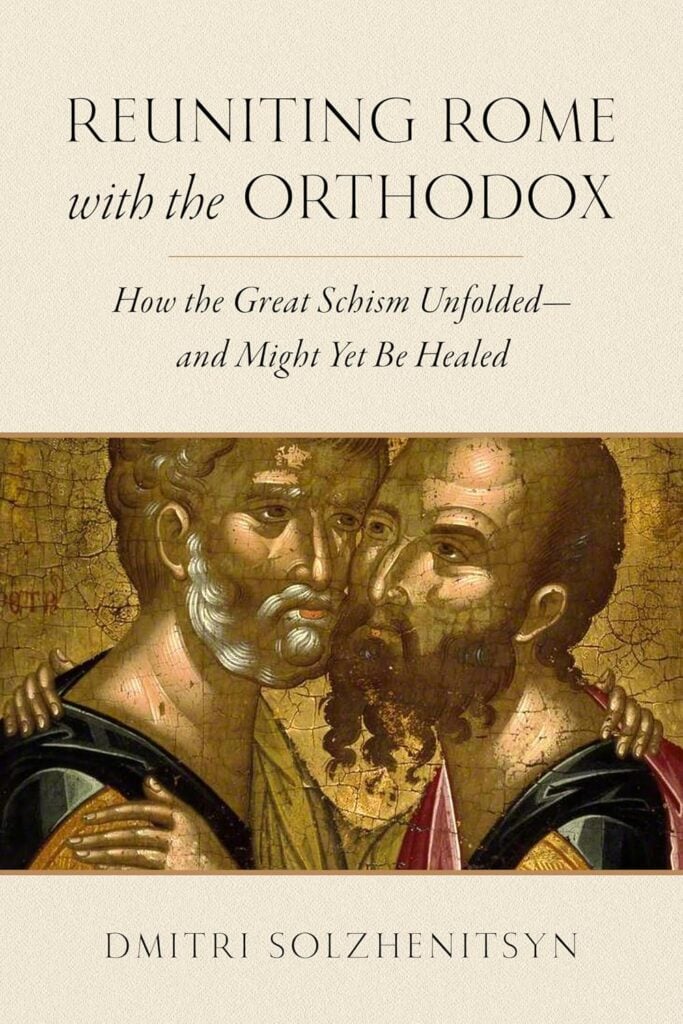
Dmitri Solzhenitsyn hopes to help break this logjam in his Reuniting Rome with the Orthodox. Solzhenitsyn, grandson of Aleksandr, has written a learned and comprehensive introduction to the history of the Catholic–Orthodox divide and how it might be overcome. This is not a book for specialists only; it is eminently readable, and technical issues are, for the most part, explained well. In addition, the history and theology are presented with remarkable evenhandedness, a virtue not always encountered in discussions of these matters. For anyone wanting to learn more about the present state of Catholic–Orthodox relations, this book is an excellent place to begin.
Reuniting Rome with the Orthodox has two halves. The first is a history of East–West Church relations, from the early Church through the nineteenth century, with particular attention to points of disagreement. This history is maddeningly complex. Century-spanning, seemingly inexorable trends—especially the drifting apart of the two ends of the Mediterranean culturally, linguistically, and politically—interacted with the contingencies of personalities and events, and with exceedingly subtle theological disputes. Solzhenitsyn does a good job of tracing these strands, though the reader’s eyes may glaze over at times. The historical detail, however confusing, is important; it shows how what might seem like purely conceptual debates were entwined with the concerns of all-too-human structures and individuals. The chronic mistake of theologians is to think that ecumenism is primarily about theologies. In truth, ecumenism is about religious communities formed primarily by theological commitments, but also much else. The history Solzhenitsyn recounts makes clear that simply returning to the exercise of papal primacy as it existed in the first millennium is not a solution. Though some form of primacy was almost always recognized, arguments over its actual exercise constantly recurred. Yes, for the most part communion between Rome and the East was preserved, but the factors that led to mutual isolation, not least the limited technologies of communication, also meant that disputes were less likely to arise. An arrangement that works in a world where news must travel physically by land or sea might not last long in the world of the internet.
The book’s second half traces the shifts in Catholic–Orthodox relations since the mid-nineteenth century. On both sides, the movement toward rapprochement was part of a wider engagement with the ecumenical movement. The Second Vatican Council was a turning point, leading in 1965 to a declaration issued jointly by Pope Paul VI and Ecumenical Patriarch Athenagoras consigning the mutual excommunications of 1054 to oblivion and lifting the mutual anathemas. National and international dialogues have ensued. Solzhenitsyn accurately summarizes the most important results of the dialogues, focusing particularly on two topics. On the filioque, widespread agreement has been reached that a certain degree of variation is permissible in how one understands the precise relation of the Son to the procession of the Holy Spirit from the Father.
Papal primacy is a tougher nut to crack, but a framework for a more constructive discussion has been elaborated. East and West affirm that some kind of primacy and some kind of conciliarity are both elements in a fully faithful and adequate ecclesiology. The development of an understanding of the Church as communion in Catholic circles provides an opening to Orthodox understandings, and some Orthodox theologians see a need for a more effective primacy.
In his last chapter, Solzhenitsyn sketches out the sorts of initiatives and events that might be needed to prepare for and restore Catholic–Orthodox communion. We should learn from past failures and realize that a lasting agreement requires reception by the churches, a reception that will not occur without intelligent planning.
A great virtue of Solzhenitsyn’s presentation is its realism. The challenges to be overcome in Catholic–Orthodox rapprochement are not minimized. He opens his final chapter with the question: “Do we even want to reunite?” This is a real question. A lesson to be learned from the history of the modern ecumenical movement is the resilience of division. What has been broken is not easily repaired. Catholics and Orthodox each reached agreements with the non-Chalcedonian Orthodox decades ago, but in neither case has actual communion been re-established.
Some of the difficulty lies in the simple resistance of all institutions to deep change. Ephraim Radner and R. R. Reno have described how division is reinforced by the tendency to understand the identity of one’s own community in contrast to that of some other community. Another reality, however, is that too often clergy and laity have not wanted what was being sold. Great time, effort, and money went into the Consultation on Church Union between the 1960s and 1990s, in an effort to achieve a merger of most of English-background American Protestantism: Disciples, Congregationalists, Episcopalians, Methodists, Presbyterians. The project ended in failure—a failure that might have been predicted on the basis of a survey conducted in connection with the 1957 North American Faith & Order Assembly, which found among Protestant laity and clergy an overwhelming lack of interest in an organizational merger and a deep worry about possible compromises of congregational autonomy. Solzhenitsyn rightly stresses the need to ask about levels of on-the-ground interest in achieving greater unity.
I wonder, though, if Solzhenitsyn is realistic enough. We can agree that reconciliation must rest on mutual charity, a charity too often missing in the history of Catholic–Orthodox relations. But is charity, however necessary, also sufficient to reconcile the differences? With true charity on both sides, there may still be real disagreements about, for example, papal primacy—theological disagreements about how to interpret the role of Peter in the New Testament, and organizational disagreements about the advantages and disadvantages of different ways of balancing primacy and conciliarity. Questions closely related to a particular practice—the ordination of women to the priesthood; the role of the pope as a judge of last resort in disputes between churches—are more difficult to settle than strictly conceptual questions. On a matter such as the filioque (or, in Catholic–Protestant discussions, justification), one can settle on a general statement with room for different opinions. When concrete practices are involved, however, disagreements are often found in the details—details that are usually missing from general frameworks developed for balancing primacy and conciliarity.
Solzhenitsyn elaborates various possibilities, such as a sharper distinction between the Bishop of Rome’s authority over Latin churches as Patriarch of the West and his authority as universal primate. But just what is that universal authority? How far does it extend? Would such authority extend, say, to discipline of a patriarch who blesses seemingly without qualification an aggressive war of conquest launched by his country?
One might justly respond that all details cannot be spelled out in advance. Some will need to be worked out in practice. That response—correct though it is—brings home the ecumenical need not just for charity, but for faith and hope: faith as trust, and hope as confidence that the goal is achievable. Solzhenitsyn notes that many Orthodox, for plausible reasons, don’t quite trust that Rome has given up the ultramontane papacy of the late nineteenth and early twentieth centuries. Conversely, a Catholic might look at the recent history of intra-Orthodox relations and doubt that restraining papal primacy in the name of patriarchal autonomy is a viable form of communion.
Any proposal for Catholic–Orthodox rapprochement will involve changes, and changes imply risks. Solzhenitsyn stresses the kinds of changes that will need to be made by the Orthodox if rapprochement is to be achieved: for example, far more effective means of cooperation among the various Orthodox churches. The Catholic theologian Aidan Nichols, in an afterword to the book, notes that reconciliation would require a new willingness on the part of Rome to live with greater regional autonomy. One cannot say in advance just how such changes will work in practice.
Marriage offers an analogy. One promises “to be true to you in good times and in bad, in sickness and in health, till death do us part,” not knowing just what kind of good and bad times, what forms of sickness and health might come. The risk is part of the adventure of love. But some kinds of prudential calculation are not misplaced. I may love someone and think seriously of marriage, but also see that, despite our love, we just don’t agree on decisive matters—on children, on how to budget and spend money, on what we want out of life—and conclude that marriage is a bad idea. Love itself may demand that one not marry.
Similarly, a judgment to accept a concrete proposal of communion must be both theologically and prudentially considered (and the two sorts of judgment intertwine). If maintaining the integrity of the faith in an increasingly secularizing and hostile culture is the greatest challenge facing the Church in the foreseeable future, do we need a primacy with more or with fewer restrictions? Persons of good faith can disagree. Solzhenitsyn quotes Kierkegaard to the effect that love does not calculate, and in the sense Kierkegaard means—that love does not calculate its own interest—he is right. But we are called to be not only as innocent as doves, but also as wise as serpents in considering how love is best embodied in organizational arrangements.
I don’t intend my extra dose of realism as a counsel of despair. We must distinguish between natural optimism and supernatural hope. As I look at the contemporary scene, I am not optimistic about progress toward full communion between Catholics and Orthodox in the foreseeable future. Solzhenitsyn’s optimism is likewise tempered. He is no Pollyanna. Supernatural hope, however, is a matter not of weighing the evidence, but of confidence in the power of God to bring about his ends in his own good time.
Robert Jenson said some time ago that our ecumenical hope must now be for a new outpouring of the Holy Spirit. Our work is to prepare for such an outpouring so that when it comes, we will be ready. Solzhenitsyn’s Reuniting Rome with the Orthodox—careful, learned, concrete—is a useful part of that preparation. One can only hope that it meets with a wide readership.
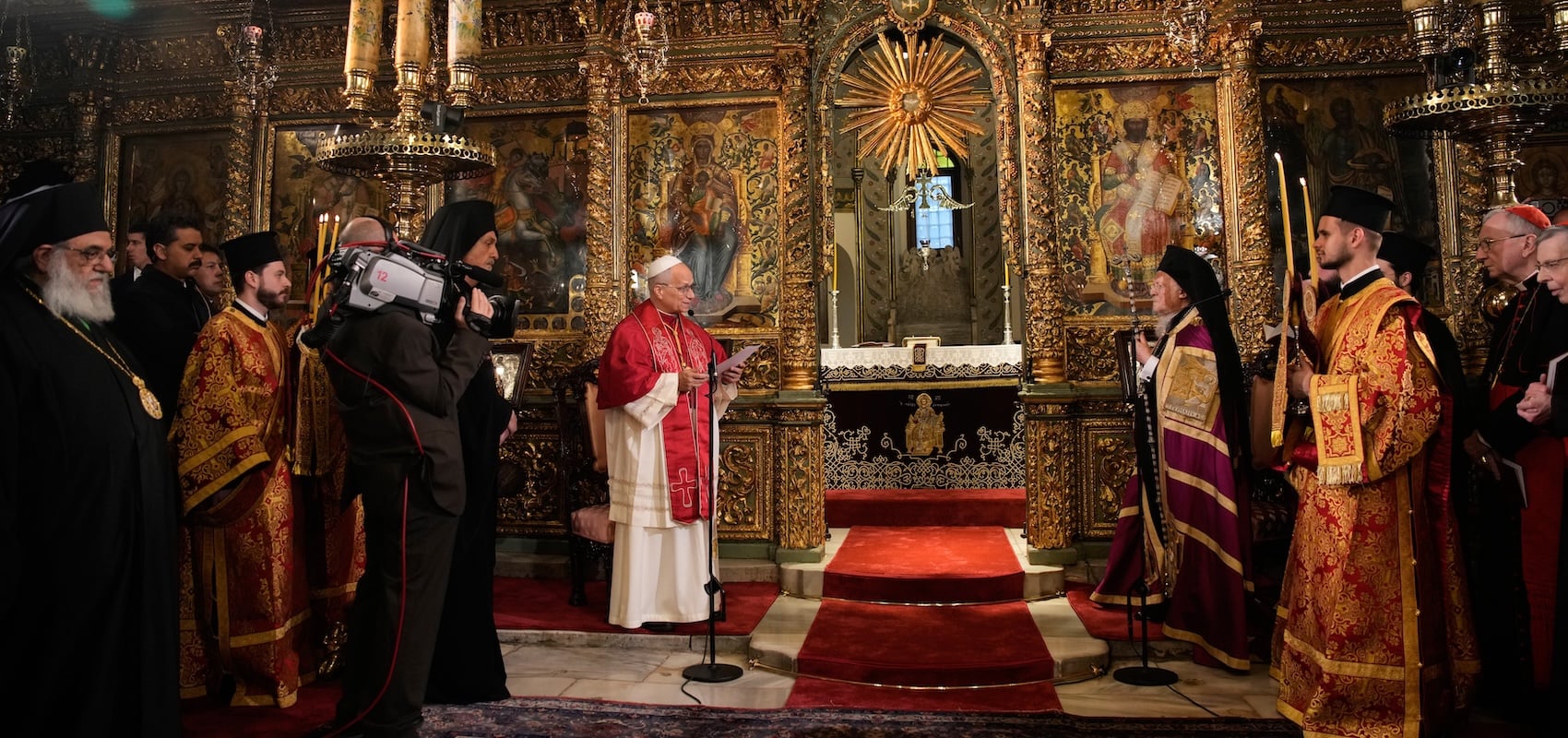
Image by Emrah Gurel via AP. Image cropped.

YOU MIGHT ALSO LIKE
Form vs. Monsters
The nature and aims of Catholic fiction have been a matter of debate for generations now. What…
Say It with Your Chest
Recent years have seen an explosion in a particular subgenre of sociopolitical commentary. Bonnie Kristian calls it…
Briefly Noted
Contrary to its titular claim, Joshua W. Brown’s Proving a Miracle does not prove that miracles can…
