
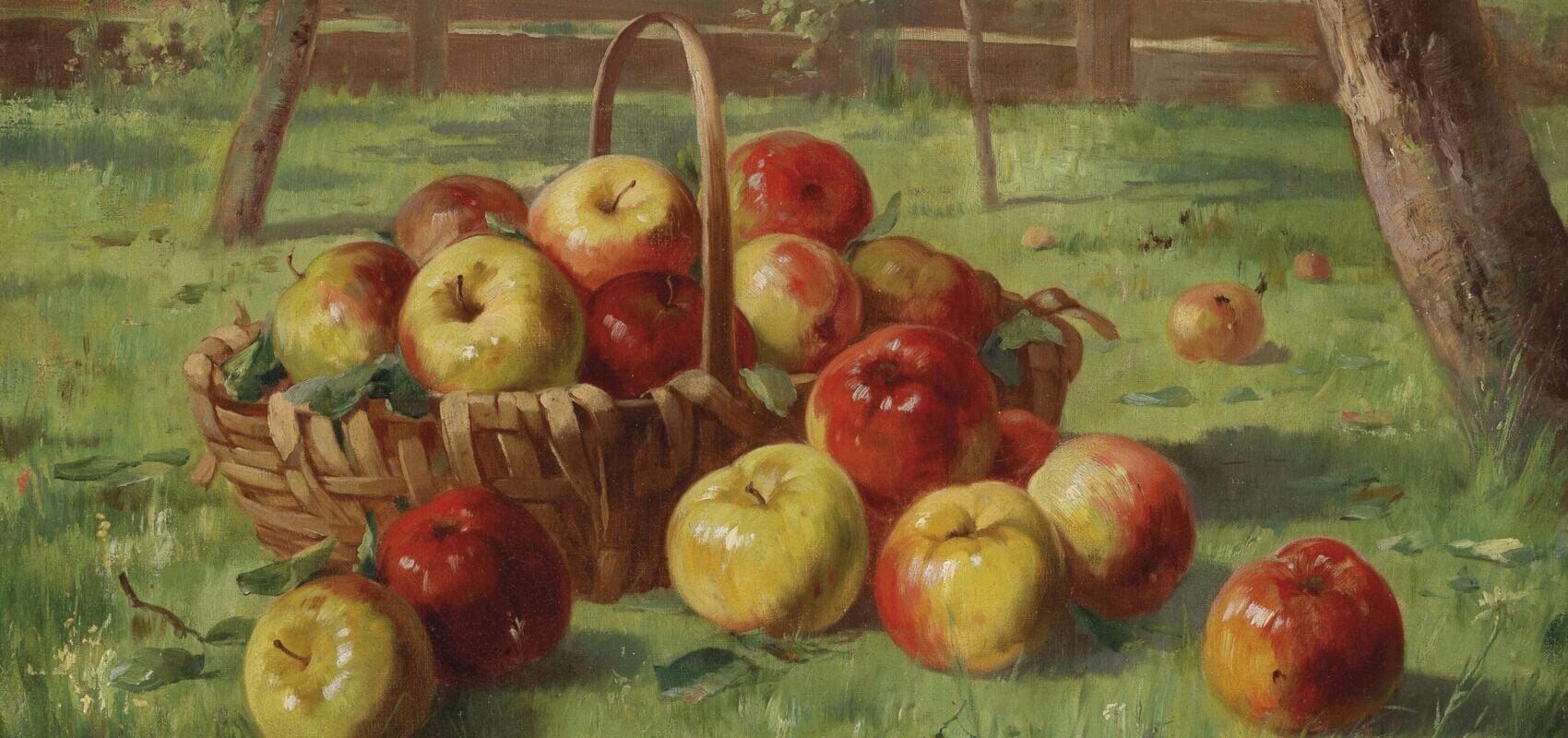
Hiding in most of our pockets is a shiny black mirror with a logo on the back that evokes the forbidden fruit of Genesis 3. As the apple was the irresistible temptation that promised Adam and Eve the freedom to be as gods, so today the iPhone gnaws at our minds, promising us the answer to any question, the power to summon any pleasure, and the ability to be present anywhere. But the symbol goes deeper: Meditating on that forbidden fruit reveals how we have surrendered control to our devices, abdicating our God-given responsibility to rule the world he gifted to us.
Before the Fall, Adam is placed in the garden as a king, with a mandate to exercise dominion over the earth. That means he is a builder, like David and Solomon—and of course like God, in whose image he is created. Dominion is not domination, however, for Adam can exercise his kingly agency only by first submitting to the order of creation on which he depends and working “with the grain of the universe” (in Stanley Hauerwas’s happy phrase). Man is called to name the richly varied order of creation and to draw out from each created thing hidden glories and put them to their fullest use.
Technology, then, is intrinsic to the human vocation. But it is also tainted with sin, as Scripture highlights by attributing the first technologies to the descendants of Cain, especially Tubal-Cain, “the forger of all instruments of bronze and iron.” And yet these same instruments were used to beautify the tabernacle by Bezalel the son of Uri, “filled with the Spirit of God, with ability and intelligence, with knowledge and all craftsmanship” (Exod. 31:3). The glory the kings of the earth will bring into the New Jerusalem in Revelation 21 will include the astonishing fruits of human technology over the millennia.
Technology has posed a profound temptation from the outset of creation. The tree of the knowledge of good and evil can be seen as the first technology, a technique for gaining knowledge. God intends Adam and Eve to grow into moral knowledge and exercise royal judgment, but only in the right time and in the right way. The tree is there to offer a shortcut. Many of our technologies likewise offer easier, shorter paths to some desired result.
Adam and Eve were supposed to gain knowledge by listening to the word of the Lord. It is, after all, the dignity of human beings to be dependent, as Leah Libresco Sargeant reminds us in her recent book, The Dignity of Dependence. For physical life we depend on the dust of the earth, on the breasts of our mothers, on the breath of God in our nostrils. For virtue and knowledge we depend on friends, parents, and other authorities. And yet we forget our dependence constantly. We take credit for our own achievements or crumble under burdens we imagine we must bear alone.
The more time we spend with others, the harder this illusion is to sustain. The sight of a human face and human need summons me to care and concern. As I reach out to care for another, grateful to be depended on, I am reminded of my own need, of the web of interdependence that typifies the human condition. “It is not good for man to be alone,” God says of Adam, so he creates “a helper fit for him” (Gen. 2:18). From the beginning, Adam depends on Eve, and Eve on Adam. Far from a mark of weakness, this mutuality is the glory of humanity, for it is only together that man and woman bear the image of God (Gen. 1:27). To the extent that technology separates us from others, offering shortcuts to goods that once required human relationships, it is apt to make us forget the reality of our dependence.
We refer to many technologies as “labor-saving devices,” but this is a euphemism. Too often they are people-saving devices. In the age of the smartphone, I can, with a few swipes or taps, have a warm dinner, a stack of books, and a new smartphone charger delivered to my doorstep without seeing or speaking to another human being.
In eating the forbidden fruit, Adam and Eve sought to acquire knowledge without dependence on God and to transcend their dependence permanently by becoming “as gods.” Instead, they traded their dependence on the Creator for dependence on a lower order of creation: a fruit. We depend on food every day, of course, but we are wont to forget that dependence. No sooner do we receive food than it becomes part of us, and we imagine that the new spring in our step, the new clarity in our mind is simply ours. We do this day after day, meal after meal, in defiance of the obvious facts of life.
So eager was Eve to escape personal dependence that she did not even linger with the serpent, himself seemingly an extraordinary source of knowledge. Much better to rely on something she could consume, and thereby imagine herself independent. The forbidden fruit is the paradigm of the modern technological device, a paradigm most fully realized in the smartphone: an object fashioned from the created order, small and unobtrusive, mysterious and full of hidden powers, delightful to the eyes and desirable to make one wise. The smartphone may not yet be physically part of us (we’re still waiting on Neuralink for that), but, as Antón Barba-Kay writes, “The more we carry our devices on our persons, the more completely are our devices identified with us as persons. . . . There is more to human nature than biology: Digital technology already touches us much more deeply than it would if it were merely under the skin.”
Does digital technology pose temptations unique in the long millennia of human making? Or are our worries simply nostalgic hand-wringing over the disruption intrinsic to human ingenuity?
In his brilliant but neglected 1984 book, Technology and the Character of Contemporary Life, philosopher Albert Borgmann distinguishes between “thing” technologies and “device” technologies. Man has always forged technologies to take dominion over the world and mitigate the toil of fallen life. But since the industrial revolution, he argues, we have increasingly replaced thing technologies, which draw us into the world and toward one another, with devices that isolate us.
He offers the humble woodstove, an essential technology for early Americans. The woodstove provided “more than mere warmth.” It provided light in the dark days, and the comforting smell of wood-smoke. More than that, “it was a focus, a hearth, a place that gathered the work and leisure of a family and gave the house a center. . . . The mother built the fire, the children kept the firebox filled, and the father cut the firewood.” These tasks required bodily engagement with the thing, a “sensibility . . . sharpened and strengthened in skill . . . [that] molds the person and gives the person character.”
Thing technologies invite us into relation with other persons. They call us to develop skill and character, challenging and sharpening us as another person might. Above all, they call forth acts of service—usually from several of us, enhancing its social dimension. The woodstove serves us, but it first asks us to serve it, reminding us of our need by reminding us of its own. In many cases, the thing demands our care for a lifetime—or more. A well-loved piece of furniture might be regularly cleaned and oiled, occasionally repaired, and eventually passed down to children and grandchildren. Of course, very few of us have furniture like this today; we buy a table from IKEA that will last us five years, and then we throw it in the dumpster. We have demoted our things to devices.
A device like a central heating system “makes no demands on our skill, strength, or attention, and it is less demanding the less it makes its presence felt.” The device is optimized for efficiency and unobtrusiveness. It is an unlikely focal point around which a family or a community might gather or choreograph their chores. Indeed, ideally, it is self-sustaining. It unburdens us of the need to develop skills. It serves us and does not demand our service in return.
The last century of technological development has steadily pushed repair out of the household. Older machines were complex enough, but with a little know-how and practice, you could pop the hood, poke around, and fix the gasket. No longer. Today, when a device in your home stops working, you throw it away and get a replacement, or ship it off to a corporate repair center hundreds of miles away so that they can throw it away and ship you a replacement.
Who wants to have an iPhone 12 repaired, now that we’re on to the iPhone 17 Pro? We are consumers above all, and these Apples are meant to be consumed. Device-technologies are consumables, products of what Hannah Arendt called “labor,” the cyclical life-process of birth and death, planting and sowing. Thing technologies were durables, products of what she called “work,” which structures the human world.
The contemporary philosopher Byung-Chul Han laments: “We are today experiencing the transition from the age of things to the age of non-things. Information, rather than things, determines the lifeworld. We no longer dwell on the earth and under the sky but on Google Earth and in the Cloud. The world is becoming increasingly intangible, cloud-like and ghostly.” He writes movingly of a jukebox he bought from a local antique store, which became an anchoring presence in his small, sparsely furnished apartment. Contrasting the “thing noises” of the jukebox with the “bodiless and smooth” digital sound of a Bluetooth speaker, he observes, “The magic of the jukebox is that it imparts presence, presentness and intensity to trivial, trifling, ordinary, customary, or fleeting matters.”
Relative to a violin or a piano, of course, the jukebox is as much device as thing. The distinction names a spectrum, not some clear and absolute dichotomy. But it is a spectrum that we seem to move along in only one direction, away from the world of things and to the world of non-things. Technology becomes steadily more invisible and convenient, even as it grows more antisocial: Moralists two generations ago wrung their hands over the evil of the television, but at least the family still often gathered around the set like an ersatz hearth. Today, we all have our own handheld screens.
Device technologies excel at concealing our dependence on them—they seem to vanish as we consume them, just like food. Persons remind us of our dependence even as they call forth our care, as do things like the woodstove or violin, which serve us as long as we continue to care for them. Food, by contrast, is transformed into our bodily strength as soon as we consume it, inviting us to hubris and carelessness.
It is not just food that Adam and Eve eat, but a fruit. To the eager eye, fruit appears as the most device-like of all foods. Most foods require long preparation, processing, and work to make them edible. The loaf of bread, like the woodstove, is the product of a whole community of practices, from reaping to threshing to grinding to kneading to baking. Fruit, by contrast, is almost pure edibility. We are tempted to think it requires almost no work, and certainly no community of work: You simply pluck it on the go; no need to spread a table with friends and family. It is thus a powerful metaphor for everything we are liable to take for granted, to consume thoughtlessly, to depend on while imagining ourselves free, independent, autonomous—“as gods.”
In reality, good fruit comes only from good trees, long planted and well tended. The fruit I harvest today may come as a gift from my grandfather, who planted with foresight long ago, and my father, who pruned and fertilized the tree. Adam and Eve, however, grasped the fruit without having first tended the tree, anticipating our own consumerist relation to the world.
If we understand ourselves as called to serve and protect what has been entrusted to us, we mature from possession to ownership, and from ownership to stewardship. By taking possession of a thing in this spirit, I take it under my care, make it rich and fruitful, and perhaps pass it on to the next generation. Such possession is the ground of true sharing. But today, we find ourselves sharing without first possessing—beholden to platforms that own all our files and all our data. We accept this arrangement because, as Han observes, “we no longer want to be tied to things or people.” Somehow, in our sharing economy, we find ourselves each alone.
In his classic text on marriage, Bed and Board, Robert Farrar Capon makes the case for recovering a “Christian materialism” that recognizes the connection between possession and care: “Our possessions make demands upon us; they form us as much as we form them. . . . Closet and dump [and, today, the cloud] now hide the corpses of our shallow care.” “If care is shallow,” Capon writes, “possessions will be discarded.” The habits of mind we cultivate toward the lower orders of creation will seep into our attitudes toward living things and even fellow image-bearers. We forget that our possessions are gifts and treat them as mere instruments, and soon we find that we have begun to instrumentalize one another as well, “ghosting” when a relationship no longer feels worth the investment. Is it any wonder that a civilization accustomed to throwing away old clothes and old furniture should begin to wonder why we should let the elderly hang around, draining resources rather than exiting quietly through MAiD?
How do we find our way back to “Christian materialism”? If it is in the nature of technology to dissolve our care and foster the delusion of independence, must we throw our devices in the dump once and for all? Not quite. The analogy of technology and food suggests healthier habits of resistance, habits that draw on millennia of Christian practice. Recognizing the profound spiritual ambiguity of food—its ability to unite us sacramentally to our Creator or to draw us away from him in pride and self-worship—the Church has historically put disciplines around food at the center of Christian life. The Church has always stressed the importance of fasting, feasting, and saying grace. Let’s reflect briefly on each of these before applying them to our technological lives.
God’s first command to Adam was a dietary restriction, and fasting was long a central discipline of both Jews and Christians. Today, though, it has fallen on hard times. We tell ourselves to beware of “legalism,” when the truth is that we can’t handle the discomfort. We are accustomed to on-demand satisfaction of every desire and the soothing of every pain, and so the thought of enduring even a few hours’ hunger is too much to stomach. This is precisely why the Church has traditionally insisted on regular fasting: so that we might learn to suffer well and wait in patience. Even more than that, we fast to remind ourselves of our dependence, to remind ourselves not to take food for granted and imagine that we can run on our own strength.
Feasting, the counterpart to fasting, reminds us that the problem is not food, which is a glorious gift of God, but our disordered relationship to it. Feasting is not the same as bingeing, which is usually done privately or even secretly, and ends up feeding the appetite it purports to sate—like doomscrolling. Food is meant to draw us together with other people and toward God in worship. Bingeing happens at random intervals, at moments of self-indulgence, whereas in almost every culture, feasting follows a calendar. The Church historically established fixed rhythms for the days on which the people of God are meant to grill up the best cuts of meat, bake their richest pies, and pour their finest wine—preparing and enjoying the feasts together as a community, and thus using food to recall our interdependencewith other persons. And by rooting us in time, as Josef Pieper argues, it helps us take true dominion over time. The sabbath feast is itself a fast from work, from what Han calls “self-exploitation.” Without taking time to rest from the ceaseless flow of activity, we lose our grip on time, our ability to hold the past and future together with the present. The world of the device is an endless succession of nows, with no time for gratitude.
Most of us who grew up in Christian homes take saying grace as much for granted as brushing our teeth before bed. But it is an essential antidote to hubris. We cannot run on our own strength but must eat several times a day. More, we must not imagine that the food is our own produce, however hard we may have worked to prepare or purchase it. The practice of prayer before meals is critical today, when most of us have no firsthand experience of what goes into bringing a meal from farm to table, all the chances of soil and weather on which a simple head of lettuce depends. Every daily meal is impossible without God’s providential care.
If the Apples in our pockets are likelier to seduce us today than are the apples on the trees, if we have become as dependent on them for our psychic lives as we are on food for our physical lives, how might we apply these ancient Christian disciplines to our devices?
The “digital fast” is almost a cliché—a lot of people will do it for Lent, for instance, and even secular writers extol the thirty-day digital detox to gain mastery over our devices. But we fast not simply to regain control, but to remind ourselves that we aren’t in control of our lives. Again, Adam’s task of dominion is inseparable from submission—not only to God but to his own created limits and dependence on fellow creatures. These limits bound and direct our agency, and thereby make it possible. Without them, we would find ourselves acting into a void, rather than into a world, incapable of fixed purposes or attachments. Technology promises us immediate, effortless satisfaction of any desire, tempting us to be as gods. We must break this spell, by deliberately making it more difficult to stream that video or open that attachment. If and when we choose to return to the technology, we will be less apt to take it for granted, but will humbly acknowledge our dependence on it.
Of course, it might not go over so well at the office if you suddenly go on a technology fast and delete most of your apps without warning. But if the purpose of fasting is to return us to dependence on one another, fasting is best done in community, as the Church has long recognized. Technology, like food, has a social dimension, and rather than resisting its pull as individuals, we should call on our workplaces, schools, and churches to normalize routine digital fasting—even practices as basic as not checking messages over weekends or leaving phones in the church parking lot.
It is hard to say as much about feasting, because our devices seem designed to isolate us from one another. Thus our feasting might simply be the flipside of a technological fast: spending less time with our devices so that we can spend more time serving and rejoicing with one another. This isn’t to say that technology can never be convivial. A movie night or old-fashioned trip to the cinema, or the LAN parties of my youth, can be great ways to feast. Indeed, these experiences can remind us of what a poor substitute scrolling alone is. Perhaps a good family practice might be: If a movie, interview, or YouTube clip is worth watching, set aside a time in the evening for the family to watch it together. Think about which devices are most suited for conviviality, and ruthlessly strip out the others.
Here is a truly radical idea: If we have become as dependent on our devices as on food itself, what if we cultivated a liturgy of saying grace whenever we pull out our laptops? Pause to praise God for the incredible gift this technology is, for the hands that made it and the programmers who created the software you depend on. Pray to God for the wisdom and discipline to use it well, and confess your sin of pride in forgetting just how much of your work is made possible by the work of others. And then perhaps say another quick prayer when you shut your laptop or get up from your desk, thanking God for whatever you have accomplished—or confessing your distraction and overindulgence.
Of course, while food is a gift of God, our technologies are more ambiguous, and we should beware of thinking that a hasty prayer can hallow or redeem them. But at least it can help us think more critically. Today, we may not be able to do without our technologies any more than we can do without food, but we can learn to order our hearts rightly toward them, transforming them into gifts of God to be yielded up to his service. If we find that they have seduced us, like the forbidden fruit, with dreams of doing without God and our neighbor, we should not hesitate to cast away our rotten apples—however delightful to the eyes, and desirable to make one wise.
Dear Reader,
Can I be direct with you?
War abroad. Socialists on the rise. AI upending human life. Endless uproar online. The modern attention economy doesn’t want readers — it wants users enslaved to the tyranny of the present.
First Things is the antidote: literary excellence, timeless truths, and a fixed point of reference in a culture that has lost its bearings.
But we can’t do it without readers like you.
Our goal: Raise $150,000 by November 1 to sustain First Things in the year ahead.
Your gift anchors readers in the permanent things.
Make your Fall Campaign gift now using the button below.
If you have any questions or would like more information, please contact Giovanni Del Piero, Director of the Editor’s Circle, at gdelpiero@firstthings.com or 212-627-1985.

YOU MIGHT ALSO LIKE
Algorithm, Interface, and AI
Many conversations about artificial intelligence end in a stalemate: A sentiment like “ChatGPT is awful because kids…
Cornell’s Secret History
The editors discuss the NatCon in Jerusalem, the scandal at Cornell University and its broader implications, and…
The Second Death of Charlie Kirk
It used to be that if you died horribly and honorably and happened to be a person…
