
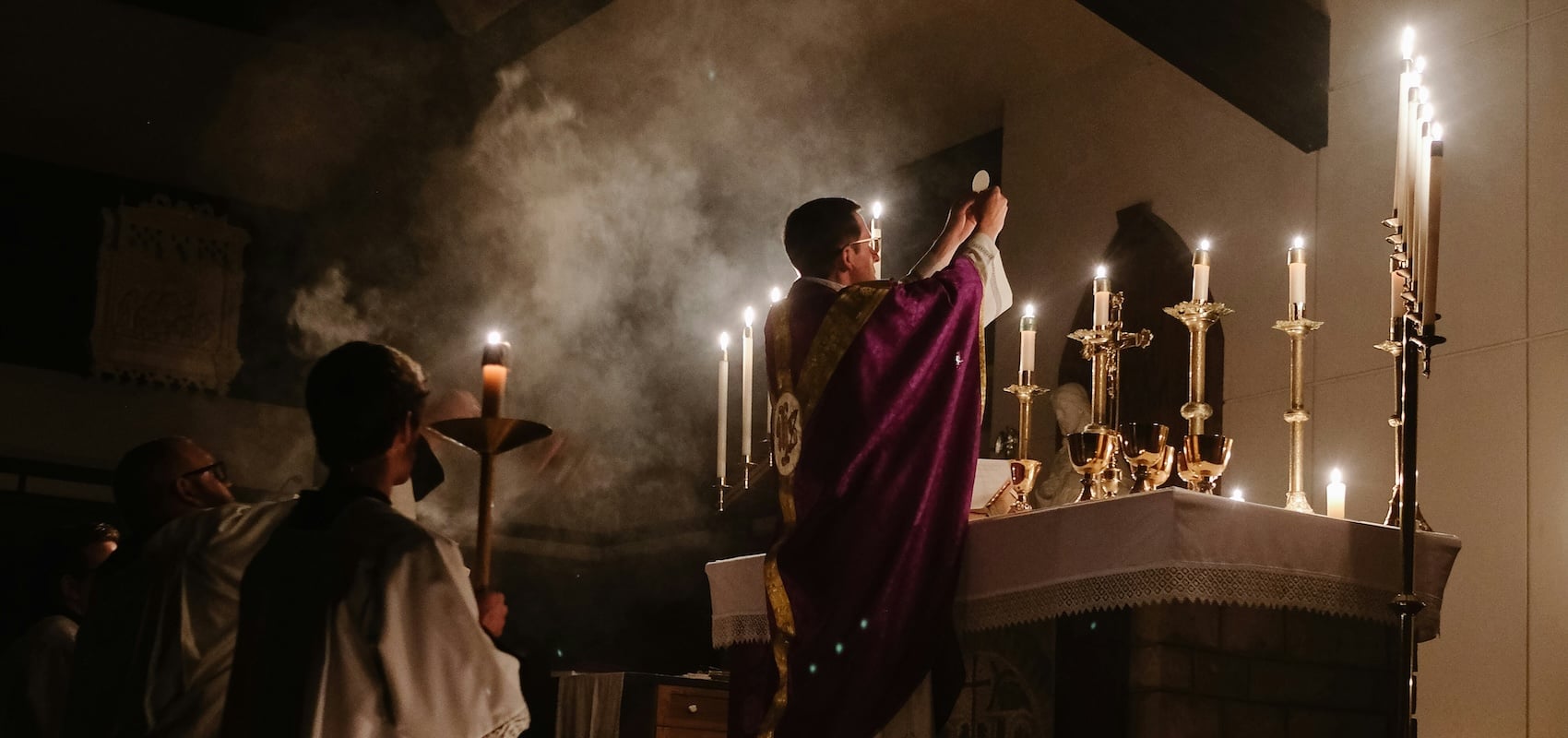
In any messy breakup, there are the inevitable conflagrations over custody of the kids, the dog, the vinyl collection. The parting of ways between the Catholic Church and the Society of St. Pius X (SSPX) has certainly been messy, with the Church saying the SSPX brought it on themselves, and the SSPX accusing the Church of dumping them without justification. Talk is turning to the division of assets, specifically the Church’s greatest treasure. Who gets custody of the Latin Mass?
The SSPX, an ultra-traditionalist sect that rejects important reforms of Vatican II, famously spurns today’s Mass, known as the Novus Ordo or Ordinary Form, in favor of the Mass as it stood prior to the liturgical revolutions of the 1960s, known as the Latin Mass or Extraordinary Form. SSPX parishes and seminaries celebrate the eucharistic sacrifice according to the 1962 Roman Missal, with the rite entirely in Latin, the priest facing the altar rather than the pews, and Communion available only on the tongue.
Parishes and other institutions in communion with Rome, on the other hand, typically celebrate the Ordinary Form, with Mass in the vernacular, the priest facing the congregation, and Communion usually received, in the United States at least, on the hand while standing. The Ordinary Form is the liturgical standard, but there remains a segment, especially among the young and recent converts, that is attached to the Extraordinary Form.
In the 2007 apostolic letter Summorum Pontificum, Pope Benedict XVI acknowledged that young Catholics, having discovered the Extraordinary Form, “found in it a form of encounter with the Mystery of the Most Holy Eucharist, particularly suited to them.” As such, he granted priests the faculties to celebrate the Latin Mass without having to ask their bishop for permission. Perhaps anticipating certain episcopal objections, Benedict stated: “What earlier generations held as sacred, remains sacred and great for us too, and it cannot be all of a sudden entirely forbidden or even considered harmful.”
His successor, Pope Francis, thought otherwise. By means of his own apostolic letter, Traditionis Custodes, he abrogated Summorum Pontificum and imposed harsh restrictions on celebration of the Extraordinary Form, essentially putting bishops in control of whether their priests could say the 1962 Mass. The old rite flourished during the fourteen years that Summorum Pontificum was in force, and the resulting crackdown left many devotees feeling pastorally abandoned. Some turned to the SSPX in defiance while others did so resignedly, not eager to involve themselves with a canonically irregular institution but finding it the only remaining option for a Latin Mass near them.
The question of what to do with the Latin Mass has been bubbling away in the background of Leo XIV’s papacy. Catholic influencers rushed to assure their followers that the new pope was “based” and would soon toss out Traditionis Custodes and let a thousand Latin Masses bloom. Since then, the pontiff has mostly swerved the issue, understandably so given suspicions—some might say superstitions—within the hierarchy that making the Latin liturgy more readily available could lead in time to a schism, with liberal Boomer Catholics siloed in the Novus Ordo and “traddy” Zoomers chained to their altar rails.
These matters are far more polarized in rhetoric than they are in practice, but they have been thrust into a new context by the breakdown in the Church’s relationship with the SSPX, following the Society’s decision to defy the pope and consecrate new bishops without a papal mandate. This act of schism has rid the Holy See of some troublesome priests, but the issue of the Latin Mass remains unresolved. Truth be told, in this particular breakup, the Church doesn’t seem all that eager to fight for the Latin Mass, and would probably rather this controversy went away. But given the attachment of a growing number of young Catholics to the old rite, the ostrich approach seems unwise.
The danger is not only that some among the next generation of the faithful will feel so famished for tradition that they stray to the SSPX for nourishment, but that in upholding Pope Francis’s restrictions while the Society offers the Extraordinary Form, the Vatican could inadvertently allow schismatics to hijack and claim ownership of one of the Church’s most precious treasures. Contrary to the impression given by some of his followers, Marcel Lefebvre did not originate the Latin Mass.
The Church should also give thought to SSPX priests and their flocks whose spiritual lives have been upended by the actions of the Society’s hierarchy. Excommunication is a medicinal censure, after all, and one in which the Church must be mindful of “the restoration of justice, the reform of the offender, and the repair of scandal.” The Latin Mass could play a role in bringing these souls back home.
For some, this would be an olive branch too far. They see the excommunications as an opportunity to suppress the Extraordinary Form once and for all. They have lost patience with this noisy traditionalist minority and resent the ecclesiastical bandwidth taken up by their Mass-going preferences. Trads are convinced the hierarchy and the progressives are seething with hatred for them, but the more accurate emotion is exasperation. Perhaps we can air and address some of the grievances.
Who are these obdurate obscurantists, these liturgical knuckle-draggers who wish to conceal the gospel behind a cloud of incense and the whispers of a dead language? I confess to being one of them—and while I can speak only for myself, it’s difficult to reconcile the discourse around Latin Mass attendees with the experience of being among them. For a start, we’re not all Lefebvrists, we don’t drive around with “I [heart] Fr. Gregory Hesse” bumper stickers, and we don’t think the Vatican is hiding the real third secret of Fatima. Some of us aren’t even trads, many of us aren’t converts, and lots of us attend the Extraordinary Form in addition, not in competition, to the Ordinary Form.
I can hardly blame anyone who harbors these stereotypes because I once harbored them too. With the invincible confidence of ignorance, I believed that the only Catholics who went in for the Latin Mass were sedevacantists, Francisphobes, and Mel Gibson. I attended my first Latin Mass in February 2025, shortly after my father died, and having last regularly attended Mass as a teenager. I’m not encouraging mortal sin, but you haven’t lived until you’ve begun a confession with the words, “Bless me, Father, for I have sinned: this is my first confession this century.”
As to why it was the Latin Mass that drew me back, it’s difficult to say. As a cradle Catholic, I had only ever attended the vernacular Mass, and when I served as an altar boy, it was the Novus Ordo. Truth be told, I had never encountered the term “Novus Ordo”: Mass was Mass, and it was in English, with the priest facing the people and the organist playing “Shine, Jesus, Shine” while we all collected our Communion on the hands. The Latin Mass had all but vanished by the time my parents approached adulthood, and all I knew of it came from a few scenes in The Thorn Birds, a soapy 1980s miniseries in which Richard Chamberlain plays a priest with his eye on a scarlet cassock. The series is hardly an advertisement for tradition: Not only does Chamberlain impregnate a farmer’s daughter, he neglects to say “Amen” when distributing Communion on the tongue.
It was a friend who recommended a nearby parish that offers a monthly Latin Mass, after I mentioned that a few recent attempts to return to Mass at my old parish had proved unsuccessful. I more or less remembered the prayers and responses—wait, what happened to “And also with you”?—but I was mentally pushing back on them as I had begun to do during my angry-teenage-atheist phase. I quickly realized I wasn’t back at Mass; I was back for a fight with God, a God I didn’t strictly believe in but wanted to have it out with nonetheless. At first I could not comprehend my friend’s recommendation. If I felt alienated at Mass in English, what chance did I stand with the Latin version? But I relented.
My first Latin Mass was a washout. I couldn’t keep up, not even with the printed Ordo Missae kindly provided by the parish. I sat when I was supposed to kneel, knelt when I was supposed to stand, and wondered if a malfunctioning audio setup was the reason I couldn’t hear the priest. Plus, they did a second Gospel reading, right at the end of Mass—just chucked it in, no warning, while I was putting my rosary beads away and getting ready to switch my phone back on. The whole experience was confusing and stressful, and I wondered how people got through it weekly—daily—before the new Mass came in. No wonder they made Paul VI a saint.
To my surprise, however, I found myself returning, month after month, until I couldn’t not go. I began to read more about the Mass, and even picked up a 1962 missal, though I continue to get lost in the liturgy to this day, and I know Catholics who have the same experience after forty years of attending the Latin Mass. That, I have come to realize, is part of the mystery and the majesty of the Mass, something the old rite perhaps does a better job of underscoring. As Benedict XVI put it, the Latin liturgy “confirmed many peoples in the virtue of religion and enriched their devotion.”
The priest faces God rather than us, whispering words we cannot hear in a language we cannot speak, because Mass is not a performance for us but a sacrifice to him. The humility this stirs in the soul is immense and pride-shattering. Some Catholics are attracted to the high and solemn Masses, with their Latin chanting and ever-swinging thurible—material evocations of the spiritual senses—but it is to the low 1962 Mass that I am drawn. No smells, some bells, and just the liturgy.
Strip away the Latin and the ad orientem and the differences between the old and new expressions of the Mass might seem minor, but they are of profound spiritual significance. There are the introductory prayers by which the priest and altar boy stake out the base camp of their liturgical ascent. There is the priestly genuflection that follows “hoc est enim corpus meum” and precedes the elevation of the host. There is the emphasis placed on the spiritual nature of salvation in the priest’s communion prayer. In the Ordinary Form, he says: “May the Body of Christ bring me to everlasting life.” But in the Extraordinary Form, the priest says: “May the Body of Our Lord Jesus Christ preserve my soul unto life everlasting.”
These and other divergences lead some to regard the two forms of the Roman rite as separate Masses, but we know from Benedict XVI that “there is no contradiction between the two editions of the Roman Missal” because “in the history of the liturgy there is growth and progress, but no rupture.” The only possible break could be one we will into the Mass to serve our own ends, and that truly would be scandalous because the Mass, in whatever form, is not about us; it is about the One who gave it to us. Guarding the treasure of his Mass and the unity of his Church may call for a new approach, drawing on the generosity shown by Benedict XVI and the caution practiced by Francis. Parish priests might be permitted to celebrate the Extraordinary Form provided it does not come at the expense of the Ordinary Form. In practice, this might mean a rule that an Extraordinary Form Mass can only be introduced in addition to established Ordinary Form Masses, so that a daily Novus Ordo, for example, could not be dropped to accommodate a daily Vetus Ordo Mass. The priest in this instance would have to offer two daily Masses.
Meeting this condition would be sufficiently burdensome for the priest to confirm the strength of his conviction: that offering the Extraordinary Form was necessary to satisfy some of his flock’s spiritual hunger for celebrating the eucharistic liturgy under the old rite. To neutralize concerns about the old rite sowing division within parishes or schism within the wider Church, priests could be required to catechize their parishioners that both forms of the Mass are valid and both the fruit of Vatican II, with the Ordinary Form celebrated as the living expression of the Mass and the Extraordinary Form as the enduring expression. Making this compromise work would require trads and other Latin Mass attendees to show the Novus Ordo the same reverence they demand for the old rite.
Recovering my faith remains a work in progress, with much rough terrain still ahead, but I wouldn’t be on the path at all without the Latin Mass, a most unexpected and still largely inexplicable guide. Going unto the altar of God brought me back to the Church. Perhaps it can do the same for others if given a chance.
Dear Reader,
Can I be direct with you?
War abroad. Socialists on the rise. AI upending human life. Endless uproar online. The modern attention economy doesn’t want readers — it wants users enslaved to the tyranny of the present.
First Things is the antidote: literary excellence, timeless truths, and a fixed point of reference in a culture that has lost its bearings.
But we can’t do it without readers like you.
Our goal: Raise $150,000 by November 1 to sustain First Things in the year ahead.
Your gift anchors readers in the permanent things.
Make your Fall Campaign gift now using the button below.
If you have any questions or would like more information, please contact Giovanni Del Piero, Director of the Editor’s Circle, at gdelpiero@firstthings.com or 212-627-1985.

YOU MIGHT ALSO LIKE
Why the Death Penalty Is a Sore Point for Papal Authority
Pope Leo XIV marked World Day Against the Death Penalty, observed on October 10, with the following…
Candace Owens and the Sin of Anti-Semitism
According to the online Encyclopedia Britannica, Sir Moses Montefiore (1784–1885) was “an Italian-born businessman who was noted…
The Myth of St. Francis
At the beginning of his 2020 encyclical, Fratelli Tutti, Pope Francis speaks of “an episode in the…
