
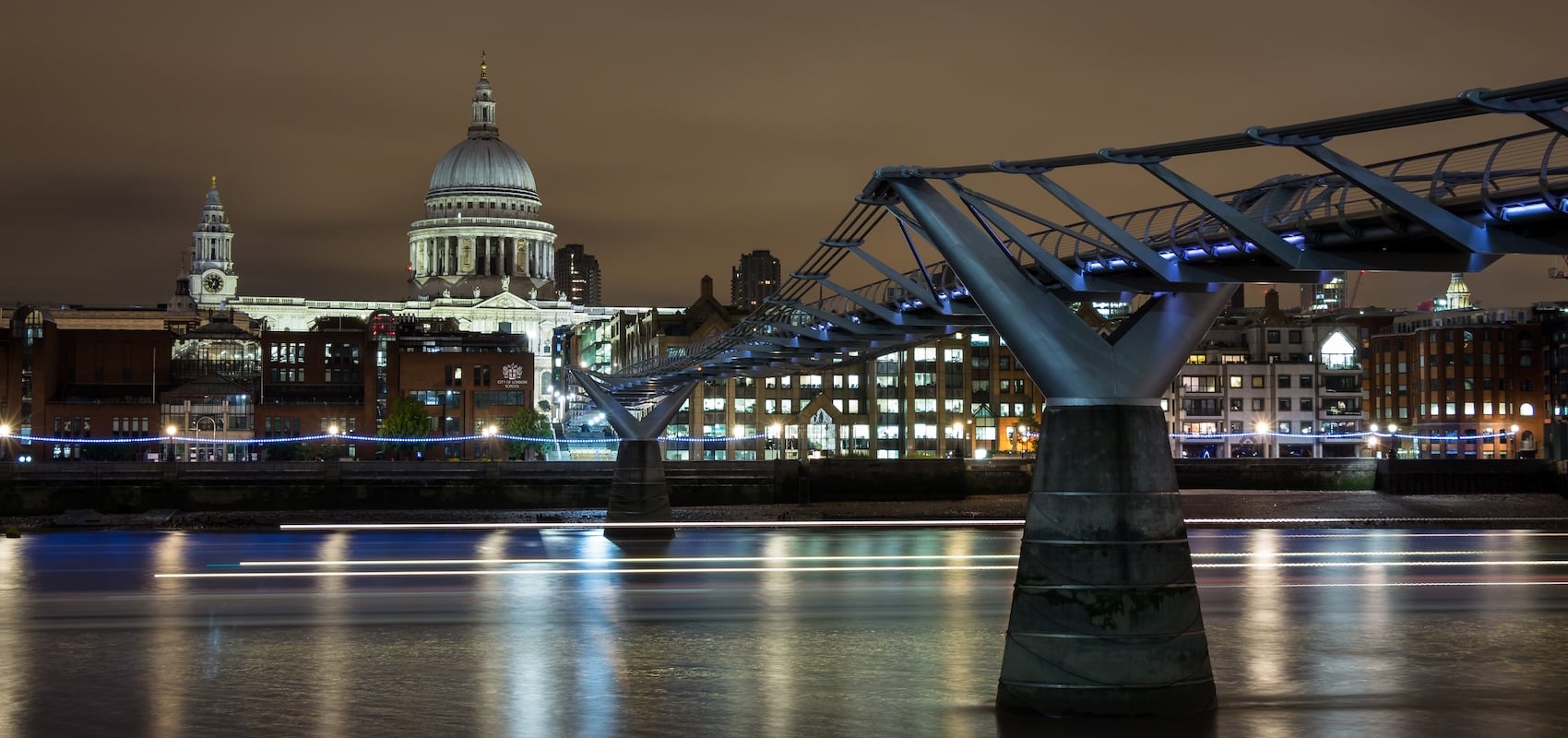
St. Paul’s Cathedral has come up with a novel way to fill the pews: It is becoming a concert venue. Under a newly inked agreement, London nightclub Fabric will be the “exclusive partner for contemporary music events” at Christopher Wren’s masterwork to God’s glory, or, as St. Paul’s describes itself in a press release, “one of London’s most iconic spaces.”
Two years ago, Fabric organized a concert by Australian synth-pop artist RY X, whom it credited with “bringing synthesizers, electronics and live performance into a space built centuries before any of them existed.” The revelation that live performance at St. Paul’s originated in 2024 will be news to its nine-hundred-year-old choir. If only they had sampled some EDM in their evensong.
Critics who fear a repeat of the silent disco at Canterbury Cathedral, dubbed “the rave in the nave,” have been assured that events on Ludgate Hill will be “done respectfully,” with the cathedral’s director of visitor engagement, Sandra Lynes Timbrell, telling Church Times the plan is for “seated concerts” with “minimal amplification.”
The partnership deal has seen the Church of England admonished by Robert Barron, the Roman Catholic bishop of Winona–Rochester, in Minnesota, who accuses the Anglican leadership of having “lost any sense of the crucial distinction between the sacred and the secular.”
Rev. Marcus Walker, a thoughtful commentator on ecclesiastical affairs and rector of St. Bartholomew the Great in London, tells me that “God uses beauty to draw us to him.” He contends that certain forms of music, such as symphonies, can be in keeping with the reverent character of a church. He cites a candlelit concert given by Nick Cave at St. Bart’s last December, in which the singer interspersed musical performances with discussions of his faith, as “one of the most profoundly spiritual moments of the year.”
Rev. Walker admits, however, that the involvement of Fabric “makes it more complex.” The club shut down briefly in 2016 when its license was withdrawn following the drug-related deaths of two eighteen-year-old patrons. The venue reopened four months later with more stringent checks and safety measures.
Some of the consternation is down to a post on X from Sadiq Khan, the mayor of London, which welcomed the partnership agreement in less than graceful terms: “Fabric. St Paul’s Cathedral. Name a more iconic duo. Bringing together these two institutions will create a one-of-a-kind experience, pairing world-class music with one of our most special landmarks.”
The sight of London’s Muslim mayor celebrating the transformation of a crown jewel of the Anglican estate into a semi-secular setting, and doing so while reducing a venerated place of English Christian worship to the status of a landmark, felt like a provocation to some. Taking up Khan’s challenge, the journalist Tom Harwood proposed: “Heaven nightclub. Baitul Futuh Mosque,” referencing a prominent gay nightspot and a south London masjid.
The mayor’s disregard for England’s Christian heritage notwithstanding, the Fabric collaboration comes at a time of profound tribulation for Anglicanism. The denomination has been the established church in England continuously since the seventeenth century, but its origins stretch back to the Reformation. Its (temporal) head is King Charles III, and its bishops sit in the House of Lords, but its nominal flock, the English, are a thoroughly irreligious lot. Just 5 percent of British adults attend church weekly, a figure that rises to a mere 13 percent for professed Christians. The collapse in formal worship in the United States in recent years might leave American clergy despairing, but their English brethren would consider such numbers a gift from the Almighty. The sunset of English religiosity is by no means only an Anglican phenomenon, as a glimpse at a typical Sunday Mass in England’s Catholic churches will attest. Only Islam is experiencing growth in Blighty.
The emptying of the pews has coincided with a hollowing out of the church in other senses. Between 2010 and 2019, 423 Anglican churches closed their doors permanently. The Church of England’s website advertises shuttered churches for lease or sale. There are currently forty-one listed. Amid widespread reports of overstretched and underpaid vicars, forced by a decline in vocations to minister to an ever-growing number of parishes, our friend Rev. Walker recently warned the church was “on a path to annihilation,” noting a 20 percent drop in paid clergy since the turn of the century. The Labour government hardly eased the financial pressure when it announced that grants from a £23 million per annum church restoration fund would now be liable for 20 percent value-added tax.
The Church of England benefits from an £11.6 billion endowment fund, but parishes see precious little of it. Commercial ventures like concert-hosting might seem benign enough as money-spinning schemes go, but whether it’s raves in the naves or Fiona Apple by the lady chapel, there is a risk that by welcoming in the secular, England’s cathedrals and churches are letting some of the sacred escape. A Christian house of worship offers the pilgrim something no secular space can: the chance to encounter the Divine within a monument to his majesty. Step over the threshold to a church, and you are instantly aware of having left behind the worldly and ventured into the spiritual. Nothing that diminishes this experience is worth any financial reward.
England is a nation undergoing profound changes in its politics, culture, and demography. The national question—what does it mean to be English—is to the fore of public debate for the first time in my life. For centuries, the Anglican Church was at least part of the answer, a point of commonality that crossed social, educational, and regional differences. A nation’s identity map changes, of course, but Anglicanism is unlikely to be replaced by anything quite so benign or unifying. The contest to fill the space once occupied by the Church of England is already drawing entries from authoritarians left and right, nationalists civic and ethnic, and believers in ideas postmodern and post-Christian. Without their church, the English are flocking hither and thither, stumbling unshepherded into the unknown.
If it hopes to guide and pastor this nation of lost sheep, the Church of England ought to offer what worldly institutions cannot: tradition, custom, and continuity; the solace of the sacred, and a glimpse of the Divine. No concert, not even the most respectful and refined, can compete with the angelic suite hymned in Heaven when God’s house is kept holy for his people to visit him.
Image by Rafa Esteve via Creative Commons. Image cropped.
Dear Reader,
Can I be direct with you?
War abroad. Socialists on the rise. AI upending human life. Endless uproar online. The modern attention economy doesn’t want readers — it wants users enslaved to the tyranny of the present.
First Things is the antidote: literary excellence, timeless truths, and a fixed point of reference in a culture that has lost its bearings.
But we can’t do it without readers like you.
Our goal: Raise $150,000 by November 1 to sustain First Things in the year ahead.
Your gift anchors readers in the permanent things.
Make your Fall Campaign gift now using the button below.
If you have any questions or would like more information, please contact Giovanni Del Piero, Director of the Editor’s Circle, at gdelpiero@firstthings.com or 212-627-1985.

YOU MIGHT ALSO LIKE
Why the Death Penalty Is a Sore Point for Papal Authority
Pope Leo XIV marked World Day Against the Death Penalty, observed on October 10, with the following…
The Myth of St. Francis
At the beginning of his 2020 encyclical, Fratelli Tutti, Pope Francis speaks of “an episode in the…
Job and Her
It is said that Job lost everything, but she has lost more. All her possessions—the money, the…
