
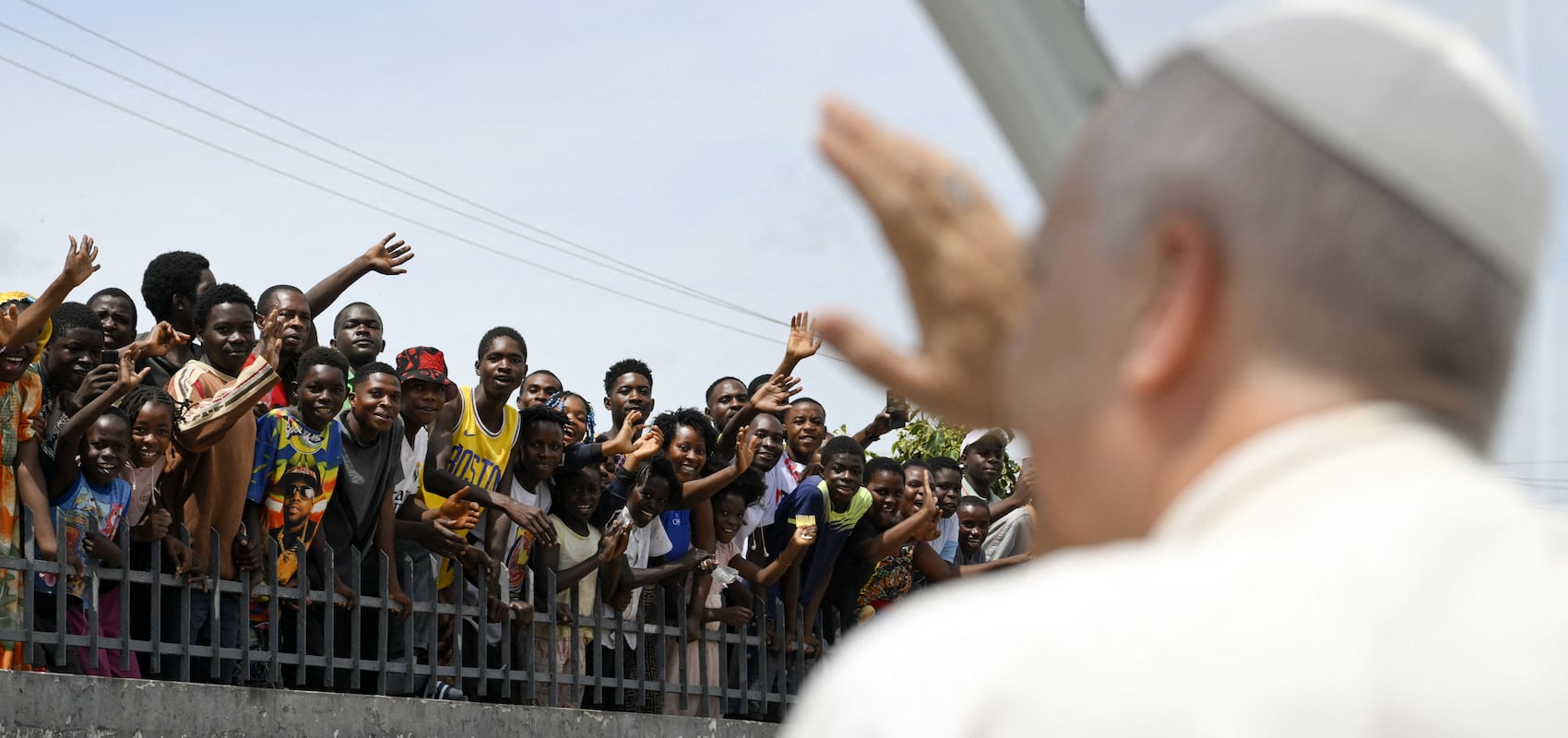
Every pope has his defining mission, a papal charism of sorts that characterizes and in time becomes a shorthand for his pontificate. Paul VI was the reformer of the liturgy who turned the Mass to the people. John Paul II was the apostle of human dignity against the twin anti-gods of communism and secularism. Francis was shepherd to the poor and the climate in an age of economic and environmental instability. Just over a year since he assumed the throne of Peter, we can already see Leo XIV’s papal charism: He is the migrants’ pope. His recent visit to Spain was in large part a mission to the European nation’s migrants, the organizations that support them, and the Spanish lawmakers trying to balance a broadly welcoming stance against the social and cultural pressures that come with immigration. A centerpiece of the visit was a meeting with migrants at Las Raíces, “The Roots,” a detention center on the island of Tenerife, ground zero for illegal immigration from northern and western Africa.
Here Leo told detainees: “God’s love knows no borders, makes no distinctions, is given to all and brings us together in unity.” He also compared them to the missionaries who took the gospel to new lands but learned from the natives and their ways of life, adding: “I also invite you to share the treasures of your humanity, of your dreams and of your culture, which you have brought to these islands, and to be open to receiving what is offered to you. We must live this exchange responsibly, considering the future generations to whom we wish to bequeath the heritage of a civilization of love.” In these brief sentences, the pope teased out a theology of migration for a world in which the large-scale movement of people across borders is the new normal. These developments are a source of fraught political dispute, and interventions by the Catholic hierarchy, which naturally emphasize empathy and Christian charity, are often interpreted by conservatives and nationalists as expressions of quixotic liberalism deaf to the practicalities of mass immigration.
Leo’s remarks in Spain should be read as a rejoinder to this critique, for they reveal a pope doing intellectual labor at the intersection of the spiritual and the secular. The Leonine theology of migration begins with a recognition of common human frailty and common spiritual belonging in the body of Christ. He told representatives of refugee support groups that “a living sign” of the Good News “becomes legible through touch and closeness when we feel the wounds of others.” Through empathy for the suffering stranger, we come to a better understanding of the gospel. This prompts Christian charity, which “flows from the love of God poured into the heart of the believer.” Faced with the plight of the needy, “love for Christ is transformed into deeds.” These acts of charity, to be true caritas—selfless, Christ-like love for others—must go beyond the material kindnesses of the secular world and into a spiritual unity with recipients of the charity. There must be, Leo told his audience, “integration.”
That means neither “erasing the history of those who arrive” nor “creating parallel worlds, closed off from one another,” but embarking on a “reciprocal journey” in which migrants and their host countries give and receive of each other. This should be more than “a social undertaking.” Leo praised Catholic parishes for feeding and sheltering immigrants but counseled them to offer “paths to knowing Jesus Christ through the witness of life and word.” What the pope is contending is that immigration and reception of immigrants are apostolic acts, guests giving their hosts an opportunity to live the teachings of Christ and hosts inviting their guests to encounter the teacher. When our hearts draw us to the wounds of others, both parties migrate closer to the perfect love that is God.
The parable of the Good Samaritan looms large in immigration discourse. Luke describes the set-upon traveler in terms applicable to many a migrant who makes an arduous journey across harsh terrains or deadly seas: He is naked, beaten, alone, and “half dead.” The Samaritan showed exemplary love by doctoring to and sheltering a desperate itinerant from an enemy tribe. But Pope Leo challenges us to go further: not merely to make the needy stranger no longer needy but to make him no longer a stranger, to integrate his life into ours and into our concept of human dignity. It is a call, in essence, to communion. This refers to a secular fellowship (the host provides support and services, the migrant obeys the law and absorbs the culture) but also to the possibility of spiritual fellowship, provided this is sought with a “respect and humility” that accepts individual freedom of conscience.
Charity alone is insufficient; there must also be truth. Here Leo echoes a recent predecessor. In his encyclical Caritas in Veritate, Benedict XVI taught that “charity in truth is a force that builds community,” noting the distinction between “the human community that we build by ourselves,” which “can never, purely by its own strength, be a fully fraternal community,” and “the unity of the human race,” which is “a fraternal communion transcending every barrier” and is fashioned by “the word of God-who-is-Love.” Not by its own strength but by God’s grace does worldly solidarity become unity in Christ.
Leo’s migration theology complicates efforts to paint the Holy See as a hotbed of open-borders do-goodery, even as it leaves unanswered crucial questions about the limits of charity when immigration inflicts tangible harms on host countries. The pope expects migrants to integrate but does not elaborate on the state’s legitimate scope for action when certain demographics (for example, Islamists) habitually practice sectarianism or agitate to supplant the existing political system, culture, or norms. Catholic immigration doctrine is similarly muted on the harm and in some cases evil that can be enabled by the rapid introduction of large numbers of people from alien cultures. This includes the economic harm of depressed wages and the social harm of pressure on housing and public services. As for the evil that can accompany open borders, it goes beyond the human traffickers whom Leo urged to repent. We need look no further than Great Britain, where uncontrolled ingress has contributed to Islamist terrorism, routine attacks on Jews and Jewish premises, violence and predation by unvetted refugees, and infamously the industrial-scale rape and sexual exploitation of white British girls by often Pakistani-heritage Muslim men.
Every pope is at heart a priest, but every pope must also be a politician. Leo the priest preaches the permeability of Christ to all peoples in all places, but Leo the politician knows he does so at a time when the permeability of borders is a source of tangible hardship and plausible anxieties. The migrants’ pope must also be the pope of those who bear the brunt of migration. This is the dilemma at the heart of Leo’s migration theology: Christ’s love is universal and his kingdom is without borders, but temporal kingdoms cannot be so generous or so open while maintaining order and serving the general welfare. Christ’s sovereignty is unending, but the nation-state’s is (mercifully) limited. These shortcomings are not insignificant, but nor are they insurmountable to a Catholic doctrine capable of reshaping our understanding of immigration and reorienting it to universal dignity, reciprocal responsibility, and unity in charity. Pope Leo is teaching his flock to love in truth and bear witness to our commonality in Christ, a discipleship that can transcend the world’s imperfections but must engage with them along the way.
Image by Sipa USA
Dear Reader,
Can I be direct with you?
War abroad. Socialists on the rise. AI upending human life. Endless uproar online. The modern attention economy doesn’t want readers — it wants users enslaved to the tyranny of the present.
First Things is the antidote: literary excellence, timeless truths, and a fixed point of reference in a culture that has lost its bearings.
But we can’t do it without readers like you.
Our goal: Raise $150,000 by November 1 to sustain First Things in the year ahead.
Your gift anchors readers in the permanent things.
Make your Fall Campaign gift now using the button below.
If you have any questions or would like more information, please contact Giovanni Del Piero, Director of the Editor’s Circle, at gdelpiero@firstthings.com or 212-627-1985.

YOU MIGHT ALSO LIKE
Foucault’s Idol of Nothingness
Today marks the 100th anniversary of the birth of Michel Foucault. He was influential in his lifetime,…
Forget Odysseus. Aeneas Is the True American Hero.
Who is our Odysseus? Or more precisely, who is the most Odyssean hero of American film? Matt…
Why the Death Penalty Is a Sore Point for Papal Authority
Pope Leo XIV marked World Day Against the Death Penalty, observed on October 10, with the following…
