
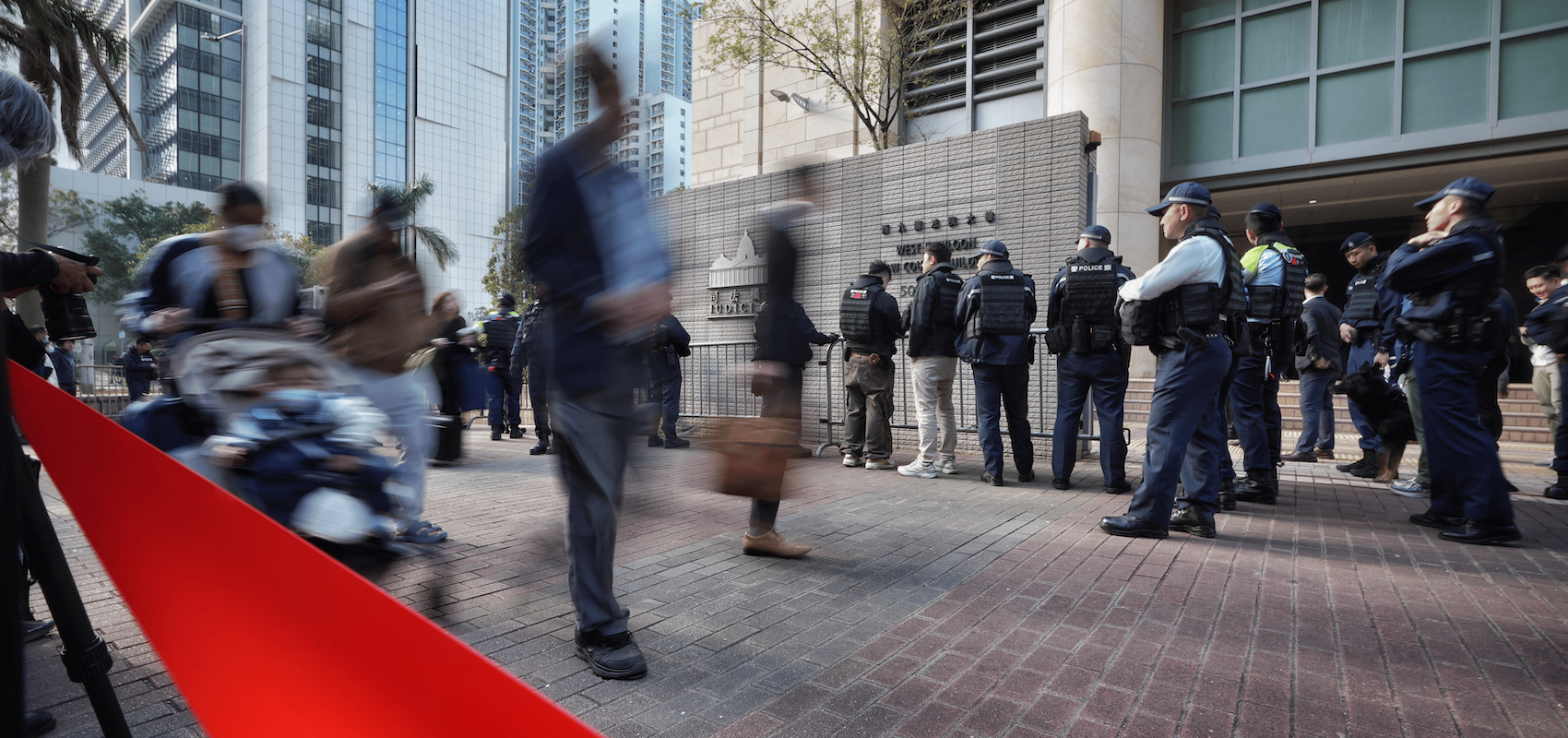
Imagine yourself seventy-eight, diabetic, falsely convicted in a sham trial of threatening national security, imprisoned for over 2,200 days in a maximum-security solitary confinement cell from which you’re only freed for fifty minutes of exercise per day. Could you find it within yourself to respond, when asked whether what you’re enduring is worth it, “Yes, for the glory of God”?
Imagine yourself as that same person, reflecting on how you had gone from billionaire entrepreneur to political prisoner. Could you find it within yourself to write that you had “found prison a holy sanctuary with God”? Could you say that you are “actually most grateful to God for [having] put me through this suffering in order for me to get closer to His presence”? Could you accept your unjust imprisonment as “a joy and treasure for this life and the next”? Could you write that, while “God’s action confounds us, [it] always turns out to be marvelous for us”?
Imagine yourself as that same person, writing to a daughter you haven’t seen for a long time. Could you find it within yourself to write this, having just learned that that daughter has lymphoma:
My dearest daughter . . . be strong and trust the Lord’s salvation to save you from this. This is a trial and God sent you this trial for a reason, a reason beyond our comprehension but we must trust that . . . He must be preparing you to meet something important and good. For God does nothing in vain. . . . Let our Lord’s grace light up your heart [so] that you see the wisdom of this suffering. . . . Do not worry, be sure that God is beside you, looking over you and consoling you.
In brief: Can you imagine yourself as Jimmy Lai?
The word martyr, from the Greek for “witness,” is typically understood today as referring to someone killed “in hatred of the faith.” A seventh-century Irish homily suggests that first-millennium Christianity had a more expansive notion of who qualifies as a “martyr”:
Now there are three kinds of martyrdom, which are accounted as a cross to man, to wit: white martyrdom, green and red martyrdom. White martyrdom consists in a man’s abandoning everything he loves for God’s sake though he suffer fasting or labor thereat. Green martyrdom consists in this, that by means of fasting and labor he frees himself from his evil desires, or suffers toil in penance and repentance.
Red martyrdom, of course, takes its name from the actual shedding of one’s blood in fidelity to Christ. We might even imagine white martyrdom as a preparation for red martyrdom: Think of the Blessed Ulma family, who lived a white martyrdom by putting their security and happiness at risk sheltering Jews during the German occupation of Poland. They were eventually massacred by Nazi stooges in 1944 and beatified in 2023 as red martyrs who had shed their blood for Christ.
Jimmy Lai is Catholicism’s most prominent white martyr today. And given that Chinese dictator Xi Jinping seems terrified by him, Jimmy’s white martyrdom could lead to red martyrdom. For despite efforts by the Trump administration to secure his release, this fearless witness to the truths the gospel teaches about human dignity and authentic freedom might die in prison—a fate he knew was a possibility when he stayed in Hong Kong to fight Chinese communist tyranny rather than relocate to Great Britain, where he holds citizenship.
Intensifying prayer for Jimmy’s liberation from bondage is an obligation of Christian solidarity. So is intensifying prayer for Jimmy Lai’s family, who, like Jimmy, are living a slow-motion white martyrdom with extraordinary courage and grace. It cannot be easy for Jimmy’s wife, Teresa, or their children, Sebastien, Augustine, and Claire. They, too, are suffering greatly. Yet Claire wrote me at the beginning of her rugged chemotherapy, which coincided with Pope Leo’s surgery for lung cancer, that she was praying for the Holy Father’s healing.
Given the clandestine circumstances in which they risked their lives to save persecuted Jews, the Ulma family could not experience the solidarity in prayer their heroism deserved. That is not the case with the Lai family. They have the steady support of another hero of the faith, the indefatigable Cardinal Joseph Zen, now approaching his ninety-fifth birthday; that is a comfort, not least because of the lack of support the family receives from the present bishop of Hong Kong. The local bishop’s default in solidarity can be remedied in part by the prayers of the rest of us in the communion of the world Church, who should be humbled by, and yet proud of, the fact that we share this Catholic moment with Jimmy Lai and his family.
George Weigel’s column “The Catholic Difference” is syndicated by the Denver Catholic, the official publication of the Archdiocese of Denver.
Image by Pakkin Leung via Creative Commons. Image cropped.


YOU MIGHT ALSO LIKE
The Death of Catholic Glasgow
October brought the news that Catholics in Glasgow, the largest city in Scotland, had long dreaded. Falling…
Today’s Global Witness of Christian Martyrs
Within just one week, two massacres of Christians took place that went almost unnoticed. In Jordan, nine…
Inside the Roman Mind
It is seven years since the publication of Dominion by Tom Holland, the much-discussed book in which…
