

♦ Richard Nixon is back. JD Vance championed the thirty-seventh president when speaking at the Nixon Library in June, echoing a belief that is gaining ground among members of the New Right—namely, that Tricky Dick deserves sympathetic reconsideration. I agree. Watergate operates in our national mythology as a morality tale, conveniently tailored to powerful interests. Nixon was an astute politician. He mobilized popular resentment of the excesses of Lyndon Johnson’s Great Society, student unrest, and the upsurge in crime that followed the Civil Rights Movement. The result was a landslide victory in 1972, which Nixon took as a mandate to push the country in a direction very different from the one selected by the liberal establishment. Watergate was thus a godsend to the Democratic Party, which had dominated the national scene for many decades after World War II, only to find its power waning. It was an opportunity not just to be rid of Richard Nixon but, more importantly, to discredit the popular sentiments that powered him to victory. In the fullness of time, those sentiments, now recognized as populist, reasserted themselves. Perhaps the country would be in better shape today if Nixon had been able to serve his full term.
♦ Bishop Erik Varden opened a recent homily with a pungent observation by a late friend of First Things: “The Jesuit Fr Paul Mankowski encouraged people to pray the divine office by telling them: ‘It’s good to have Iron Age words in your mouth every day.’” Varden elaborates, “There’s something about the taste of substantial ancient utterance that trains our palate to appreciate excellence and recognise mush. That’s always been the case; but how much more now, when God-knows-what percentage of the words we take in haven’t even been conceived by a human mind, but churned out by an engine.”
♦ I recently signed the “Pledge Against AI Catholic Content and Text,” an initiative of the online publication Catholic Culture (catholicculture.org). The main thrust of the pledge foreswears AI-generated content: “I will never intentionally use or allow the use of generative artificial intelligence as a direct means of the creation or substantial positive material modification of text presented as original thought.” My only reservation involves “Catholic.” First Things is an ecumenical, interreligious publication. Rest assured that First Things shares a determination to eschew AI-generated content, Catholic or otherwise.
♦ A few months ago, I wrote “The Stench of Corruption” (October 2026). Voters seem to be noticing the putrid smell. In the lead up to November’s midterm elections, a Fox News poll reported record low approval of President Trump’s job performance (36 percent). The top voter concern? Government corruption (60 percent extremely concerned).
♦ Freddie Sayers of UnHerd recently interviewed Iain McGilchrist, who had this to say about the thought of German philosopher Max Scheler:
He had a hierarchy of values, and at the base level there was pleasure and utility. He called them the sinnliche Werte, the sense values. And above that came Lebenswerte: things like magnanimity, courage, fidelity, and so forth. Then came the geistige Werte, which are the spiritual or intellectual values—because in German, interestingly, the word geist means both spiritual and intellectual. And then at the very top of the pyramid is Das Heilige, the Holy, and Scheler saw the other values as really being important because they supported that sense of the Holy. What interests me is that the pyramid has been inverted by the reductive materialists, so that all those things—the sacred, the beautiful, the good, the true—only actually cash out when they have utility.
The pyramid inverted: That image succinctly captures the cultural-spiritual crisis of our time.
♦ Heads up to readers: Iain McGilchrist has agreed to deliver the 2027 Erasmus Lecture.
♦ On October 15, the Minnesota Humanities Center offered an opportunity for K–12 educators to view The Making of America. Here’s the Center’s description of the lesson it hopes these educators will take into their classrooms: “The film explores how Enlightenment-era systems of knowledge—art, science, architecture, and cartography—produced enduring frameworks for racial slavery, territorial extraction, and Indigenous dispossession in what became the United States of America.”
♦ Writing in his fortnightly newsletter, The Jew From Nowhere, J. J. Kimche offers an esoteric reading (of his own making) that plots the symbolic meaning of the four species of plants featured in the festival of Sukkot onto four modern Jewish heretics. His summation of the truths each perverted—that’s always the pattern of heresy—is masterly:
They were produced, however perversely, by a civilisation obsessed with God, justice, law, text, interpretation, and argument. Spinoza was punch-drunk with God. Marx was entranced by a vision of justice and redemption. Freud was possessed by insights about the mind, guilt, and the therapeutic power of speech. Derrida was haunted by the depth and treachery of language.
♦ I’m grateful for all those who donated to our fall fundraising campaign. And to those who didn’t: Worry not! You’ll have an opportunity to give during our year-end campaign. Thanks for your support!


YOU MIGHT ALSO LIKE
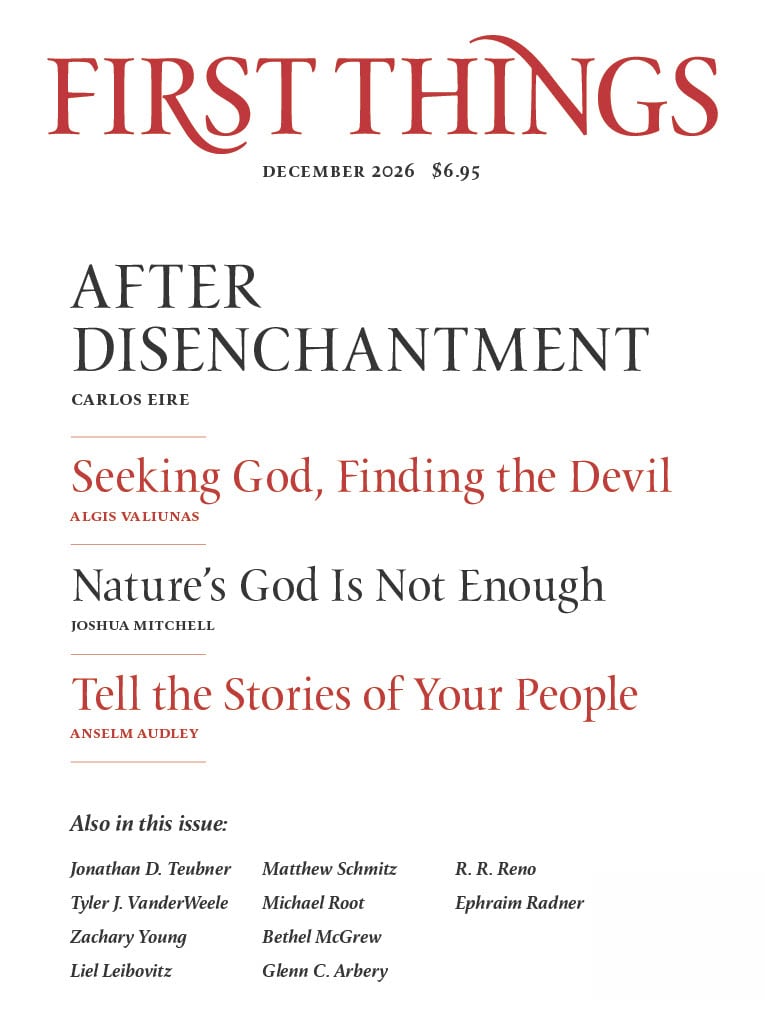
Nature’s God is Not Enough
In the Republic, Plato writes that unless liberated by philosophy, by the awakening of the divine part…
There Is a Season
This brutal winter, ice, and snow, / deer, once again, assault the holly, ...
Time to Ban AI Companions
Imagine a friend who is awake whenever you are, never grumpy, and always interested in what interests…
