
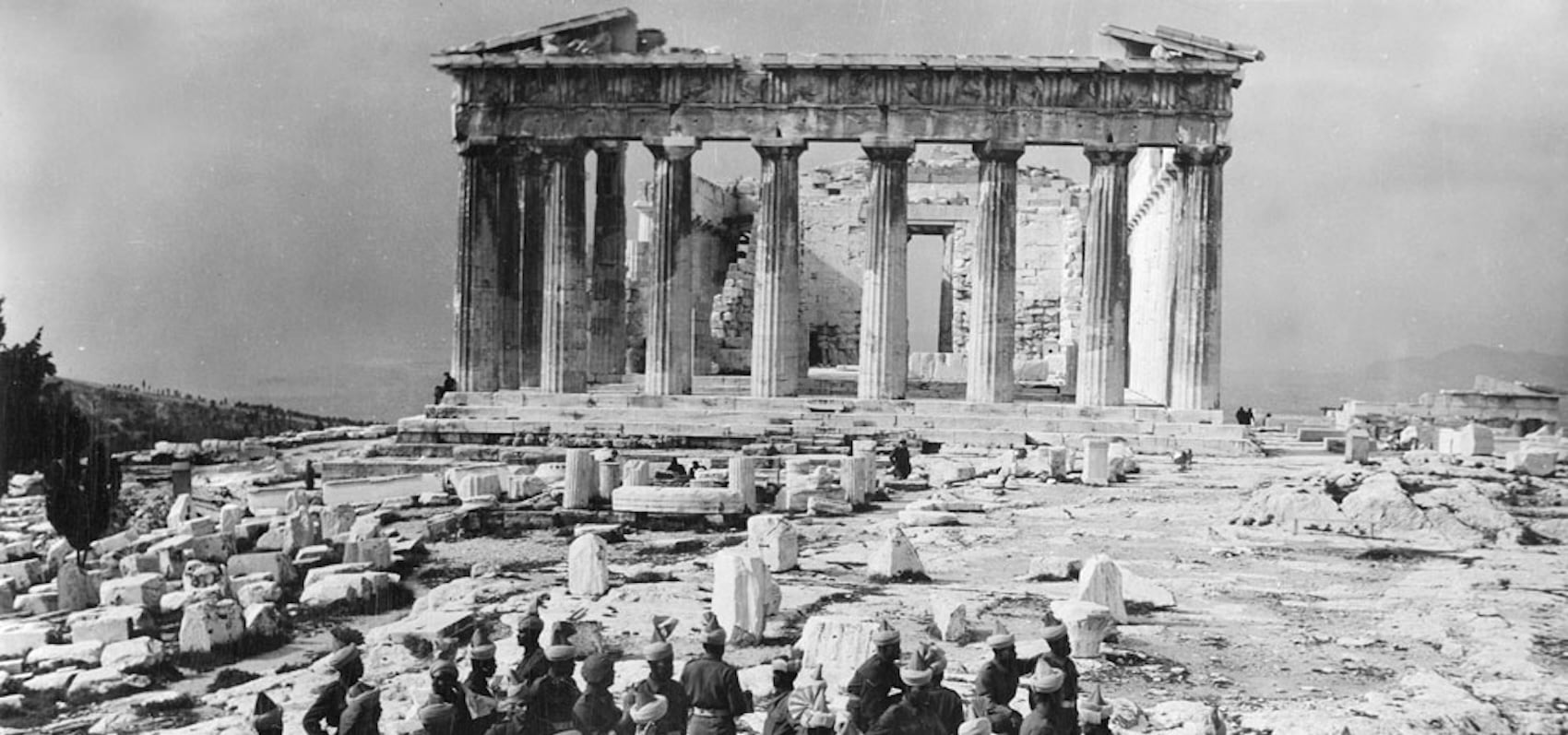
Secretary of State Marco Rubio gave a weighty speech in early October on the Acropolis in Athens, with the striking ruins of the Parthenon behind him. His purpose was ambitious: to rally the West to the task of civilizational renewal.
Rubio began on a sober note. Ruins, he noted, often remind us of societies that achieved great things, but are now extinct, having “long passed beyond living memory.” Think of the great pyramids of Egypt, the eerie atmosphere of Stonehenge, and the mysterious stone heads on Easter Island, which gaze into the remote distance.
The Acropolis is different, Rubio was quick to say. It’s a reminder of the ancient Greek culture that retains “an almost mystical hold on our memory.” Athens, like Rome (and Jerusalem, I would have added), remains a living font of Western civilization. Or does it? Will we carry forward the highest achievements of our inheritance? That was the question Rubio pressed upon his listeners.
Rubio emphasized the striving character of ancient Greek culture. It bequeathed to the West “fierce individuality and relentless ambition; daring exploration and invention; a yearning for discovery, for adventure, risk and glory.” He spoke of “insatiable curiosity” and “an impatience with the notion of impossibility, chafing at all boundaries and limits, straining to peer into the depths of the unknown.”
We can criticize his account of ancient Greece as fanciful. The exquisite proportions of the Parthenon over his shoulder bespeak a quest for order rather than adventure, and Homer’s Odyssey is about yearning to return home rather than trying to transcend limits. But in fairness, Rubio was making a speech, not giving an academic lecture.
His purpose was to set up a contrast with our present cultural consensus. Whereas ancient Greek culture emphasized the pursuit of excellence, which involves risk, “the ideal of many ideologies in our time has, frankly, become a world of perfect safety, devoid of risk or failure, with neither the glory of victory nor the shame of defeat.” Whereas ancient Greeks competed for honor, “we design our standards to ensure no one will lose; we preoccupy ourselves more with the comfort of the worst than the potential of the best. We hold the most exceptional things among us hostage to the average, the ordinary, the mediocre.”
Again, we can balk at these broad characterizations. But Rubio captures an important truth about the present age. A therapeutic mentality seeks to shield us from experiences of failure; it counsels acceptance rather than judgment, affirmation rather than criticism. This mentality mixes with an unmoored egalitarianism. We think it unjust if any aspect of society “excludes” anyone, which, of course, is precisely what criteria of excellence do.
Rubio singled out the Greek concept of thumos. Often translated as “spiritedness,” thumos has a rich meaning. It refers to a burning desire for honor, for victory, for retribution and revenge. It also triggers strong interior emotions, such as empathy for the suffering, awe before great deeds, and feelings of solidarity. A strong thumos makes one fiery, volatile, and passionate, but as Aristotle observed, if well-formed and directed toward noble ends, these qualities can become great engines of achievement.
“Today,” Rubio observed, “too much of the West has forgotten this quality.” I’m not sure “forgotten” is the right word. I would have said “suppressed.”
Thumos is stoked by images of excellence and collective exaltation. A young boy watches the great hitter lift the ball into the upper deck. He thrills as the crowd cheers. In that moment, he feels the rise of thumos—and he wishes to dwell in it, for it makes the world stand still, if only for a moment.
The same holds in civic life. As a child, I stood before the brooding figure of Abraham Lincoln, seated on a throne in his temple-like memorial on the National Mall in Washington, D.C. My grandfather somberly read aloud his immortal words, engraved on the memorial’s walls. I felt an upsurge within, the paradoxically arresting and energizing feeling of awe and admiration. But as Rubio notes, “we in the West came to feel ashamed of the very things that made us exceptional. We felt embarrassed that our achievements set us apart from the rest of the world. Our prosperity somehow became a source of guilt.”
Roger Scruton dubbed this self-hatred “oikophobia,” fear and disdain of home. It reached a crescendo in the summer of 2020. Rubio: “We tore down our monuments; we condemned our own history. And in too many places, we taught our children to be ashamed of the countries they would inherit.” Shame humiliates rather than ennobles; it enervates rather than inspires. There are many reasons why our society has become spiritually flat, but one reason is the deliberate discouragement of patriotic pride and the turn toward endless apology.
“We find ourselves at a crossroads,” Rubio intoned. Will the nations of the West continue down the path of self-denial and demoralization? Or will we recover our civilizational self-confidence?
Within the compass of his speech, Rubio identified a renewed nationalism as necessary for this recovery. He was unequivocal: “The United States has made its choice. We choose the unapologetic pursuit of national power.” Rubio spelled this out in somewhat wonky terms, with reference to supply chains, reindustrialization, defense spending, and technological superiority. The details were not what mattered, however. I was fascinated to hear the secretary of state reject the postwar consensus that nationalism is bad and must always be condemned. Rather than “prioritizing the global community over one’s own people,” America’s leaders recognize “that there was nothing selfish or wrong about loyalty to your nation, nor anything selfish or wrong about fighting to defend its interests above all else.” He urged European leaders to recognize the same truth.
As Rubio drew his speech to a close, he returned to his claim that the West is at a crossroads. “We are at an inflection point—an inflection point not only in the history of my nation, but an inflection point in the whole of our civilization.” That’s stirring language, but it’s not just hyperbole. In my book, Return of the Strong Gods, I explain how the terrible events of the first half of the twentieth century discredited powerful loves and strong loyalties, and I made the case that the resulting “open society” project has gone too far and destroyed too much. Rubio’s speech is best understood as an effort to shepherd the return of the strong gods, for they rouse our hearts and light the fires of thumos. I hope his European audience harkens to his call.


YOU MIGHT ALSO LIKE
Nature’s God is Not Enough
In the Republic, Plato writes that unless liberated by philosophy, by the awakening of the divine part…
Will America Survive the Twenty-First Century?
Last year, the good folks at Canon Press asked me to contribute to a volume: Five Views…
There Is a Season
This brutal winter, ice, and snow, / deer, once again, assault the holly, ...
