
In the Realm of the Last Man
by francis fukuyama
farrar, straus and giroux, 304 pages, $29
Francis Fukuyama is having a moment. With the release of his new memoir, In the Realm of the Last Man, he’s been on a media tour, explaining his ideas and reiterating his career’s overarching trajectory and aims. Fukuyama started off as a neocon but famously defected over the Iraq War, becoming a Wilsonian liberal and spurner of identity politics. His memoir leads us through his books, including the highly influential The End of History and the Last Man, Trust, and Our Posthuman Future: Consequences of the Biotechnology Revolution, while also giving background on his family history and hobbies (building computers, woodworking, photography). He says little about his marriage or present family life, focusing instead on ancestral matters and ideas. It’s breezy and plainly written, appealing to the true Fukuyama fanatics while also offering the beginner a ready portal to his wider oeuvre.
Thanks to this memoir, it seems as if commentators are finally realizing that his famous 1992 work, The End of History and the Last Man, didn’t actually predict that history would end in a tidy transition to universal liberal democracy. In fact, Fukuyama considered it a strong possibility that we would react to the global dominance of liberal democracy by burning it all down out of spite.
By way of Hegel and Hegel’s interpreter Alexandre Kojève, Fukuyama argues that a potential orgy of self-destruction may transpire if liberal democracy fails to meet our need for recognition, to satisfy our innate thymos (the Greek term for “spiritedness”). Unlike political theorists in the tradition stemming from John Locke, Fukuyama holds that we are more than mere biological machines designed to rationally satisfy our selfish desires. We also crave recognition—for ourselves, but also for our higher ideals and for the groups to which we belong. Liberal democracy promises to satisfy this yearning by guaranteeing equal political recognition (what Fukuyama calls isothymia). But the desire for more than equal recognition (megalothymia, another Fukuyama coinage) is a potent driver not only of those with tyrannical aspirations but of anyone who seeks excellence. Without the drive for something beyond equal recognition, we risk becoming like Nietzsche’s Last Man, devoid of the ability to ask greater philosophical and spiritual questions or to look beyond the immediate satisfaction of material desires.
Fukuyama recognizes this is a real problem. Yet it seems almost too large. Consequently, he has turned his attention to the problem of increasing state capacity and improving bureaucratic functionality. This dodges the greater problem of contesting or defending the Last Man’s dominance.
Although perspicacious in so many ways, Fukuyama gives little attention to the role of religion in this search for recognition. In The End of History and the Last Man, he follows Hegel in seeing premodern institutions, including religious institutions and the family, as being necessary for the health of a liberal society and for preserving “the art of association.” He would do well to look at the writings of Hegel’s great antagonist, Kierkegaard, for insights that more directly address the problem of recognition and show that Hegel misses something crucial.
Kierkegaard sees the drive for recognition as leading toward the same mindless mob mentality that resulted in Socrates’s death and Christ’s crucifixion. Hegel, he implicitly argues, has no way to prevent us from seeking recognition by the crowd and, in fact, encourages it. But the crowd, for Kierkegaard, “incarnates untruth.” Even if we’re seeking recognition primarily from an elite crowd, such as a scholarly community, we’re still searching in the wrong way. There is no end to our appetite for recognition, and, as Fukuyama admits, it leads us into history’s darkest places.
According to Kierkegaard, only the particular individual, separated from crowd passions and standing before God, has any chance of attaining recognition in its deepest sense. Only recognition by God can satisfy the deep human need to be known in full. Without God, a shadow falls over all human relations: “For now we see through a glass, darkly.” Recognition bestowed by other humans is mediated by this dark mirror, and, for Kierkegaard and St. Paul, only God can shatter the mirror and lead us to an unmediated experience of knowing and being known—total recognition.
Religion helps redirect our most spirited impulses toward a higher form of recognition than those that condition conflict and keep history going. And yet, our dominant intellectual tendency is to see this higher form as a primary source of mass violence. I suspect this is Fukuyama’s own view (although his father was a liberal Protestant pastor and civil rights activist). When religion is reduced to identitarian competition, it certainly can become a source of conflict. But this is religion at its most superficial.
In 1 Corinthians 9:22–27, St. Paul redirects the search for recognition toward a different end:
To the weak became I as weak, that I might gain the weak: I am made all things to all men, that I might by all means save some. And this I do for the gospel’s sake, that I might be partaker thereof with you. Know ye not that they which run in a race run all, but one receiveth the prize? So run, that ye may obtain. And every man that striveth for the mastery is temperate in all things. Now they do it to obtain a corruptible crown; but we an incorruptible. I therefore so run, not as uncertainly; so fight I, not as one that beateth the air: But I keep under my body, and bring it into subjection: lest that by any means, when I have preached to others, I myself should be a castaway.
Here Paul alchemizes the competitive instinct. Rather than competing to become the master of all, he seeks to become the servant of all—but with the same tenacity and rigor befitting an athlete or warrior. Instead of struggling for recognition by those who are “under the law” or “without the law,” he presents himself to both groups as one of their own members (albeit with divinely subversive intent). Paul’s emphasis on training the spirit like a runner helps transform martial and disciplinary forms into spiritual forms, much as Christian monasticism would later do. He would have us bend the search for recognition toward nonviolent ends.
This is the Pauline and Kierkegaardian contention: Only recognition from God allows one to be seen in full. The “end of history”—an end to war, an end to strife—will never come absent this prerequisite. At the “end of history” envisioned by Hegel, Kojève, and Fukuyama, having provided ourselves with every earthly indulgence and recognition, we will find our state as Last Men unbearable because we do not feel seen in the only way that matters.
This might not be a tragedy. It could even be a great discovery. It would be like waking up.
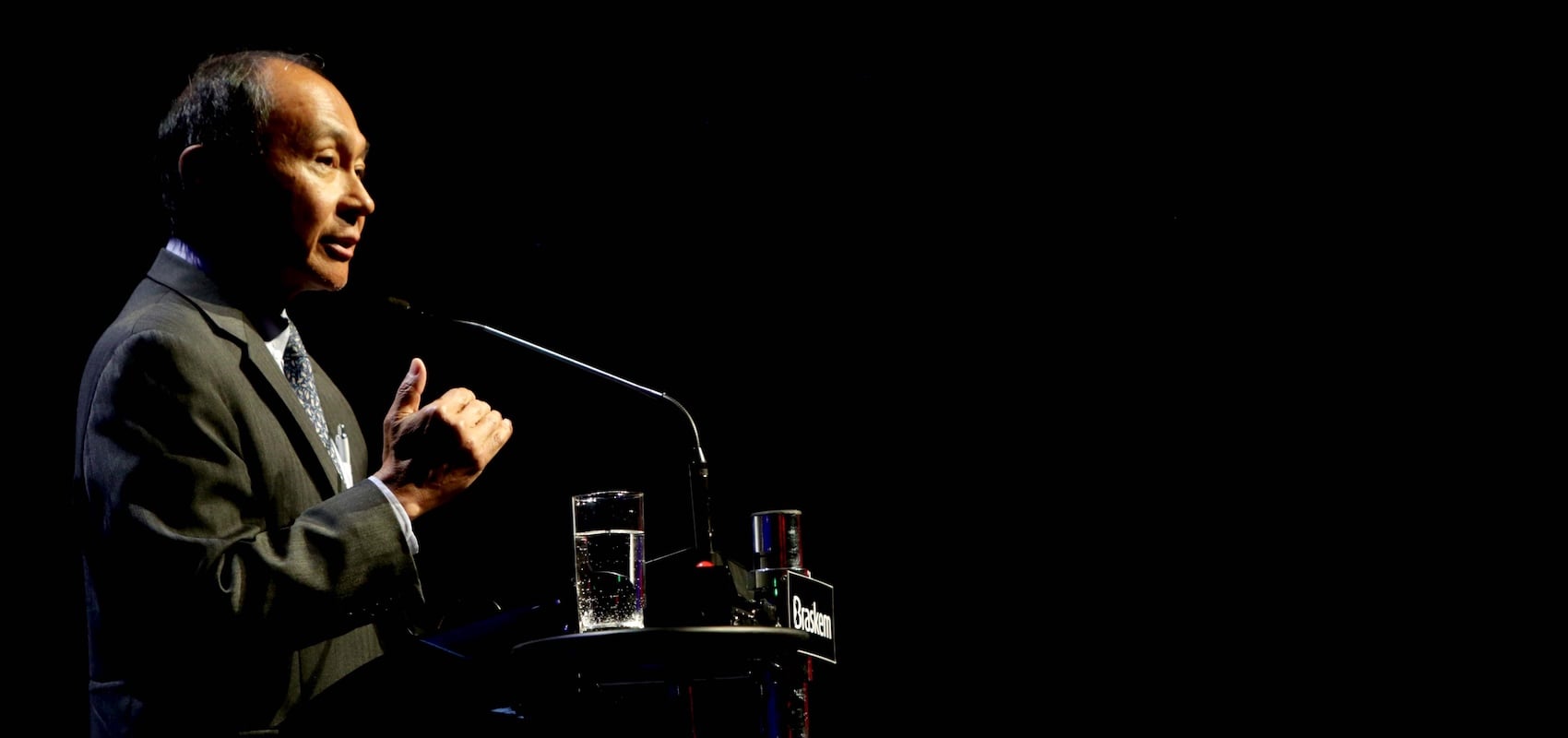
Image by Fronteiras do Pensamento via Creative Commons. Image cropped.

YOU MIGHT ALSO LIKE
The Birth of Free Speech
In the latest installment of the ongoing interview series with contributing editor Mark Bauerlein, Michael Fontaine joins…
The Internet of Almost Everything
The editors discuss Pope Leo’s South America journey and his voting habits, a string of suspicious “cyber-faliures,”…
An Undefined Apocalypse
Science fiction is more successful as a cinematic than as a literary genre. The world-building that requires…
