

Last year, the good folks at Canon Press asked me to contribute to a volume: Five Views on Christian Nationalism. I had already given the topic some thought, which I wrote up and published (“The Case for Christian Nationalism,” March 2026). My essay expressed ideas that were not unique to me. To a great extent, I followed the long-held, often-expressed vision of Richard John Neuhaus, who founded First Things for the purpose of ensuring that our public life would be shaped by biblical truths. However, the editors at Canon Press did not want a reprise of that effort. They assigned very specific questions for me to answer. What is a nation? What are its essential elements? How do nations fit into God’s purposes for humanity? Is the United States a single nation or many nations?
They also forced me to answer very specific questions about the theological principles that should guide the governance of a hypothetical republic in which churchgoing evangelical Protestants constitute a supermajority. Should key Christian claims be inscribed in the constitution? Should there be an established church? Religious tests for public office? Sabbath restrictions? Blasphemy laws? And so forth.
I benefited from the discipline of answering these questions, especially those concerning the hypothetical republic. But I thought readers would also be interested in what I have to say about today’s America—our unity as a people, in spite of our crazy quilt of differences, and whether our union will endure. Here is what I wrote on that point:
As I’ve unpacked the essential features of a nation, I’ve argued that America possesses these elements and is thus a single nation. This fact is evident to foreigners, who marvel at the widespread display of American flags, which fly in front of homes, schools, and government buildings, but also adorn office buildings and church sanctuaries. These visitors recognize a widely evident American personality, and patriotic Europeans often express resentment over the penetration of American media into their countries, which dilute their nations’ distinctive characters with Americanizing influences. The United States colonizes the world’s imagination, which strongly suggests that our country possesses a distinctive and powerful national character.
Dramatic increases in the number of foreign-born residents after the Nationality Act of 1965 have weakened our shared loves. Yet here again, foreign visitors marvel over the absorptive power of the American way of life. In Texas, the children of Mexican immigrants often express the Texas braggadocio characteristic of that remarkable state.
In Albion’s Seeds: Four British Folkways in America, the historian David Hackett Fischer described the regional cultures of colonial America. He argued that these cultures have had an enduring influence, shaping waves of immigrants into one or another form of being an American that dates back centuries.
Perhaps the huge influx of immigrants in recent decades will break down this pattern of assimilation. I allow that there are always limits. A national culture can be overwhelmed by conquest and colonization. I am a proponent of significantly reducing immigration—we need time to digest! Yet I count myself among the American optimists. The newcomers will be naturalized, not just in a legal sense, but in mind and soul.
During the pandemic, some of the migrants that the Biden administration allowed to flood across the southern border made their way to New York City, where I live. Billions of dollars were spent to house them in Manhattan hotels. One day, as I was ordering a cappuccino, I asked the proprietor of the small coffee shop his opinion of this policy. [Regular readers will recognize that I’ve recounted this exchange before in these pages.] Ethnically, he’s Tibetan, although his parents fled their native land with the Dalai Lama as the Chinese cracked down in 1959, and he was born in India, coming to the United States as a teenager. His response was remarkable. With disgust, he said in a heavy accent, “They put these people up in fancy hotels, while our people are sleeping on the streets.”
Our people! He was not referring to Tibetans. The people sleeping on the streets, the people ignored by our progressive moralizers—his people—are native-born Americans. Only a nation can form a man to transcend his ethnic ties—nay, transcend his self-interest and base desire to be free from obligations to others—so that he can express solicitude for people solely because they are his fellow citizens.
In 2026, no reasonable person would deny that the United States is a single nation. It’s a very large nation. It contains ethnic enclaves that operate as quasi-nations in our midst. The Somali community in Minneapolis offers an obvious example. Amish and Mennonites and ultra-Orthodox Jews are more longstanding examples. But their existence is not new to the American experience. From our earliest decades, the United States has recognized, fought, and accommodated Indian nations. In a technical sense, the reservation system made the United States a place of many nations. But not in reality: Since 1865, we have been (and remain) very much a single nation, so much so that America has been able to gather her many resources and powers to dominate the world.
As investment firms are required to acknowledge, past performance is no guarantee of future results. The future of the United States is by no means certain. We may cease to exist as a nation. Perhaps China will triumph and treat America as Rome did Carthage. Or perhaps mass migration will accelerate, and all the nations of the West will disintegrate into mere administrative zones, at best, or endlessly competing neo-feudal clans, at worst.
Having no gift of prophecy, I cannot set aside these possibilities. However, my best guess for the cause of a post-national future is this: America’s perennial temptation to become an empire.
After the end of the Cold War, American leaders set out to construct a global system. One aspect drew upon the liberal tradition of a social contract that protects the rights of individuals and in so doing gains their loyalty and consent. The ambition in the 1990s was to erect a “rules-based” international system that took its moral bearings from a richly elaborated theory of human rights. The purported “ethnocentrism” of nations was to fade away in a liberal Empire of Rights. We were to become citizens of the world.
The other aspect of the global system built in the 1990s drew on the liberal tradition of free markets. This tradition promises widespread material prosperity that will win loyalty and consent. Various trade agreements and innovations on Wall Street (encouraged by Washington) allowed for economic globalization. The free movement of labor, capital, and goods was to supersede the inefficiencies of nation-based economic systems. The supposed small-minded concerns about national interest would become an unproductive anachronism in the Empire of Commerce.
These dreams were never fully realized. But they shaped the moral imagination of Baby Boomers. The dark years of multiculturalism and DEI reflected the ideals of the Empire of Rights. The United States was volunteered to pilot the post-national future. (This role was more explicitly embraced in Canada.) Borders were relaxed. Everyone was to be included, which means that those most deeply imbued with the uniquely American character must be pushed to the margins. Even notions of Western civilization had to be dismantled and dismissed. It was a paradoxical ideal: America would realize its vocation—appointed by History—by transcending mere nationhood and inaugurating universal humanity.
The Empire of Commerce is run by economists and central bankers, not comp lit majors and social justice warriors. Its methods are technocratic. Who can argue against cheaper flatscreen TVs? Or low-cost labor to cut your lawn? To attain these boons, borders were relaxed. Capital ricocheted around the globe. Supply chains lengthened. In addition to prosperity, we were told that economic globalization would bring peace. No country with a McDonald’s would go to war with another country with a McDonald’s! We don’t need a nation: The Empire of Commerce will both feed and protect us.
Both empires are enemies of nations. If you prize shared blood and shared place, the Empire of Rights will denounce you as a racist and xenophobe, while the Empire of Commerce will remind you that both impose inefficiencies on market mechanisms. English-speakers have the advantage that their native tongue is the language of today’s marketplace, but others feel the demands of the Empire of Commerce, which requires linguistic submission to the Master Language. Shared history, mythology, and religion are rejected as “divisive.” This epithet is employed even when these elements of nationhood are widely affirmed and thus the opposite of divisive. But there is no contradiction. Inclusion and diversity are universal ideals, which can only be attained if everyone forsakes his particular loyalties.
Alexandre Kojéve theorized the end of history as the final triumph of the universal over the particular. Our many and various loves and loyalties will dissolve into a universal, homogeneous state, in which there will be no cultural, economic, national, moral, or religious distinctions.
The universal and homogeneous state serves as a limit concept, a dark ideal rather than a foreseeable reality. But we can move in its direction, as Europeans have already done in the establishment of the European Union. The drive toward universality will not take the same form in the United States. But on this continent as well, the United States can cease to be a nation in the twenty-first century. It will happen not as a result of conquest or colonization, but under the auspices of the already well-advanced Empires of Rights and Commerce, which express our own very American desire to transcend human limits. The seeds of destruction are within our own heritage: a hyper-moralistic (perfect equality), post-religious form of progressive Puritanism combined with America’s entrepreneurial genius, unleashed on a global scale.
You can read the rest of my contribution, as well as those provided by Al Mohler, Paul Miller, Joe Rigney, and Douglas Wilson (and our responses to one another, which I found edifying) in Five Views on Christian Nationalism (Canon Press, 2026).


YOU MIGHT ALSO LIKE
Does the West Have a Future?
Secretary of State Marco Rubio gave a weighty speech in early October on the Acropolis in Athens,…
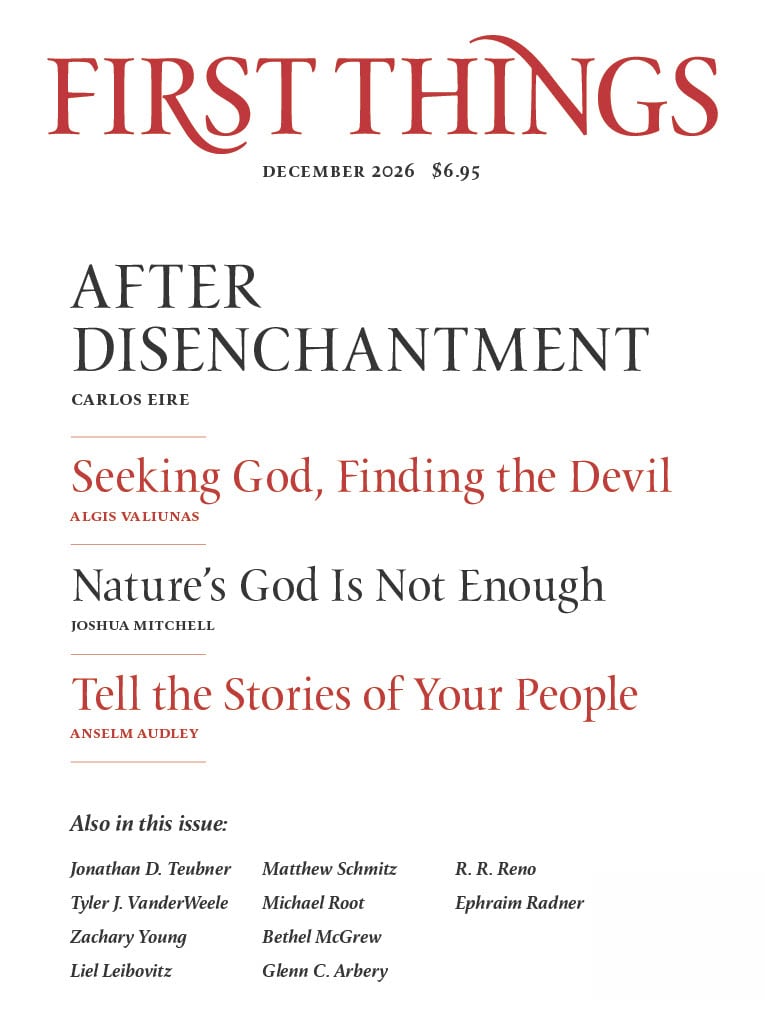
Nature’s God is Not Enough
In the Republic, Plato writes that unless liberated by philosophy, by the awakening of the divine part…
Letters—December 2026
In “The Left Is Right About the Bible” (October 2026), Mark Bauerlein makes a strong case that…
