
An extended family crowds around a well-appointed table spread with a spotless and sharply creased white cloth. Sunlight, diffused by sheer white curtains, brightens every corner. The grandparents, in suit and tie and dress and apron, preside over the gathering; the grandmother lowers a large roasted turkey to the table; the carving knife waits close by the grandfather’s weathered hands. The guests all beam with joy, engaged in lively conversation. In a moment they will say grace, and as they do, they will bask in the material abundance, and the conviviality of family and friends, for which they are grateful.
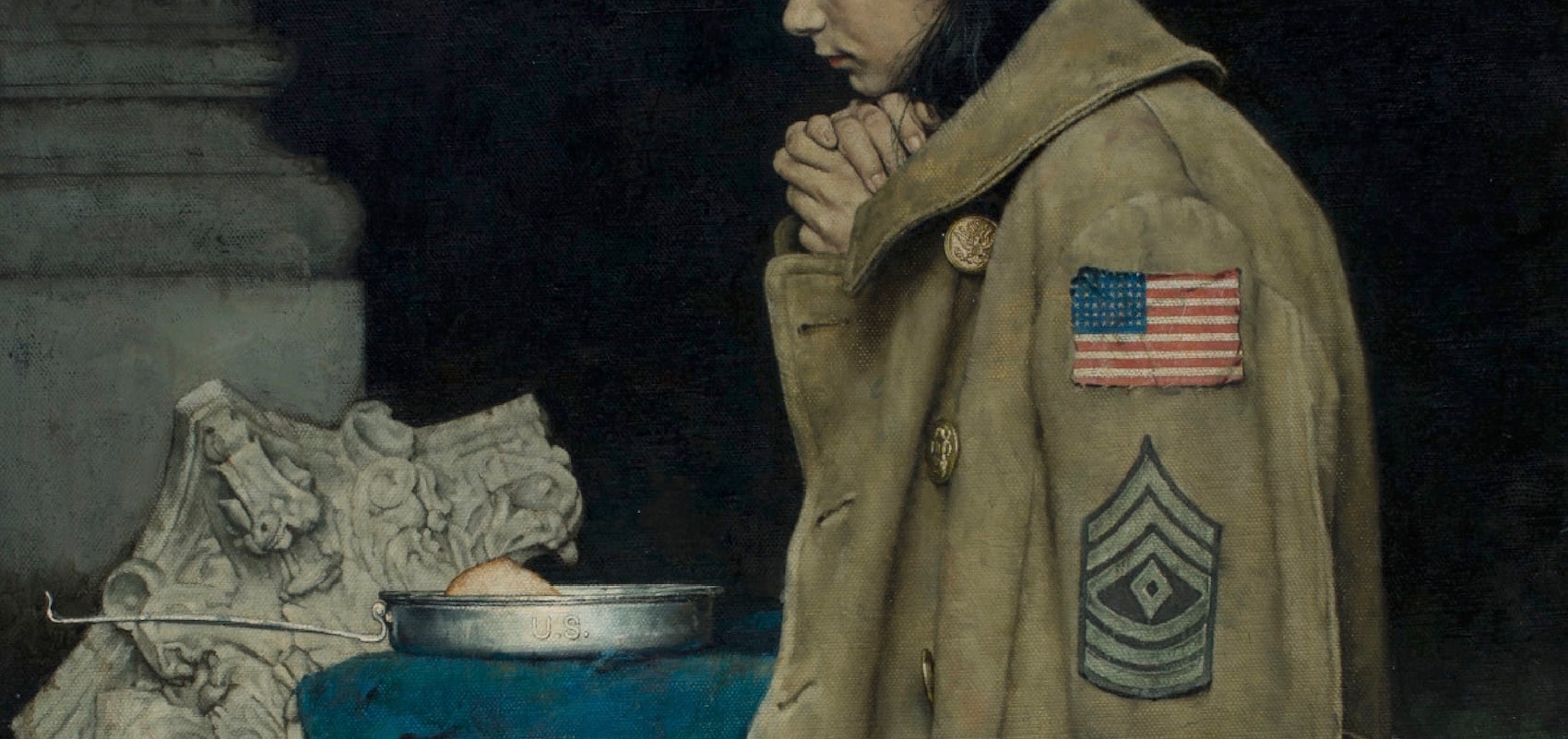
Consider now another scene. A young woman kneels in prayer, eyes lowered, her hands clasped below her chin. A splendid wreckage surrounds her: classical marble columns toppled left and right. But the wreckage is not complete; at least one column still stands, somewhat shrouded in the darkness that surrounds her. Broken chains beside her show she has just been set free. An Army greatcoat around her shoulders warms her, its American flag patch dirty and tattered but still firmly embroidered on the sleeve. An aluminum mess kit containing a hunk of bread, and perhaps some soup, is stamped “U.S.” Her immediate benefactors are obvious, but we see her giving silent thanks not to man but to God.
In these two paintings, Norman Rockwell captured two important aspects of American Thanksgiving. The first, and better-known, is Freedom from Want (1943), illustrating the third of the “Four Freedoms” proposed in Franklin D. Roosevelt’s 1941 State of the Union. Sometimes titled I’ll Be Home for Christmas, it primarily celebrates the home as a joyful place full of family, friends, and food. The holiday, be it Thanksgiving or Christmas, is an occasion to come home and enjoy these human goods. This aspect of the holiday season readily comes to mind for most Americans.
The second, lesser-known painting actually bears the title Thanksgiving. It appeared on the November 27, 1943, cover of the Saturday Evening Post; earlier that year, Allied forces had liberated Sicily and southern Italy but were stopped south of Rome. Mussolini was deposed, but Germany had occupied the remaining territory of Italy to ensure the fight continued. The solitary figure represents the newly liberated population: weary but unbroken; humble, dignified, and grateful.
If Freedom from Want indicates the horizontal and human element of our holiday gatherings, Rockwell’s Thanksgiving perfectly captures the traditional theology of America’s most beloved holiday. It is one that we all would do well to remember, or learn for the first time.
Begun by George Washington, the Thanksgiving proclamation has been issued by every American president since Abraham Lincoln revived it. As I argue in a recent report, the most striking feature of the traditional proclamation is its emphatically vertical and religious focus. All blessings of the year—crops harvested, industries expanded, peace maintained, victories won, trials endured—were identified as having their ultimate source in God, despite the fact that they all result in some sense from human effort.
The relevant theological principle is sometimes called “secondary causality.” God is the ultimate cause of all that is good, but humans act freely as the secondary causes of good. God works providentially through human agents without violating their free will. Hence, the most complete accounting of the good in the world—the business of a Thanksgiving proclamation—must identify God as its ultimate source.
This principle appears in Christian theology as early as Augustine. It is a point of agreement among Thomas Aquinas, John Calvin, and Richard Hooker. It is affirmed by the Westminster Confession of Faith (1646), later accepted by the Congregationalists of Massachusetts and Connecticut, as well as by the London Baptist Confession (1689), later adopted by the Philadelphia Baptists in their 1742 Confession of Faith. Prayers of General Thanksgiving appeared in the 1662 Book of Common Prayer of devout Anglicans such as George Washington; and when American Episcopalians issued their revised 1789 Book of Common Prayer, they elevated these prayers by incorporating them into the regular Morning and Evening Offices.
Secondary causality was an important point of doctrinal unity for American Christians worshipping in many different churches. It could be, and was, taken for granted by the statesmen who established our nation’s political traditions. It defined their practice of issuing national proclamations of religious thanksgiving.
This tradition is strikingly consistent. From Washington and Lincoln through FDR, presidents maintained it without exception, whatever their partisan, philosophical, and denominational differences. It began to fray after World War II, and only recently has it hardened into a partisan divide. Progressive presidents have recast Thanksgiving as gratitude to each other, sometimes omitting God entirely. For Barack Obama and Joe Biden, Thanksgiving was merely a generalized Labor or Veterans Day. Ronald Reagan and Donald Trump reasserted its traditional focus on God as the ultimate source of all our nation’s blessings.
Thanksgiving is commonly identified as America’s most popular, distinctive, and characteristic holiday. Unlike Memorial Day on the one hand, and Christmas on the other, Thanksgiving is simultaneously a national and a religious holiday. It is also one in which our highest political authority—the president—plays a vital role, recounting the blessings we have enjoyed and then exhorting Americans to worship God in thanksgiving. In the words of George Washington, “It is the duty of all Nations to acknowledge the providence of Almighty God,” who is “the beneficent Author of all the good that was, that is, or that will be.”
There is nothing wrong—indeed, there is a great deal right—with gathering around a table crowded with family and bursting with the bounty of good food. But the true nature of this holiday has always insisted that no expression of gratitude is complete until we have thanked God.

YOU MIGHT ALSO LIKE
An Englishman Gives Thanks
Emigration is an odd experience. Having moved to the U.S. in my mid-thirties, I already had a…
The Black Mirror of Recognition
Francis Fukuyama is having a moment. With the release of his new memoir, In the Realm of…
Did Democrats Really Find a Religious Left?
Democrats won a string of midterm victories across the country, many of them unexpected. One popular narrative…
