
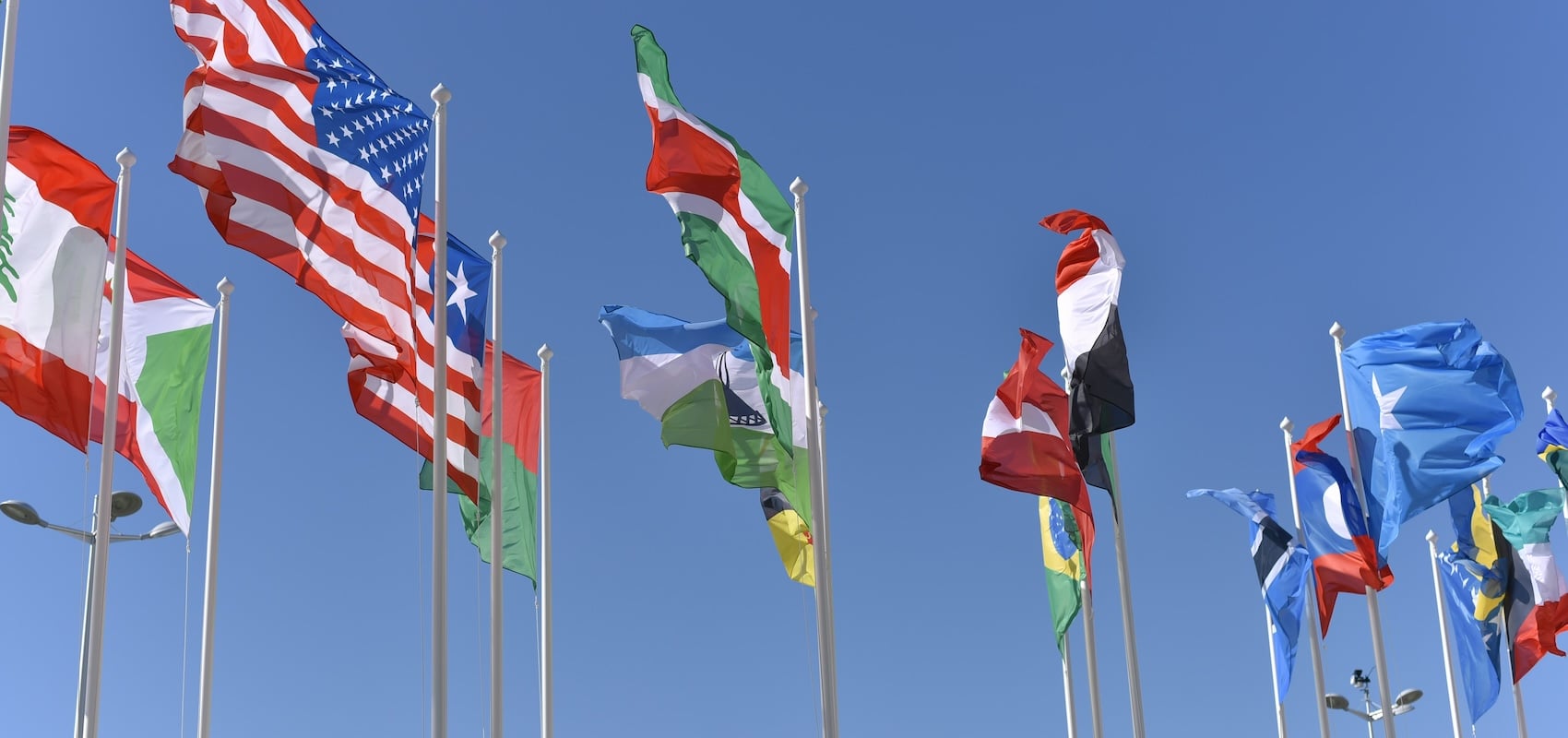
We think the political world is divvied up into nearly two hundred distinct nations, each with mappable boundaries, a unified political system, a shared language and culture, and a shared sense of being a nation. However various in details, we assume they’re the same kind of thing. That serves our purposes as a rough-and-ready picture of the world, symbolized by the blue-tinted obelisk overlooking Manhattan’s East River, but it doesn’t take much probing before it starts to dissolve.
Whatever “nations” are, they’ve always co-existed with other political forms. Ancient Egypt dominated northeast Africa for a millennium and a half, often extending its power into the Levant, and in late antiquity a series of empires extended over the Eastern Mediterranean. Aztecs and Mayans ruled large swathes of Mexico and Central America, while the Chinese empire spread over the Far East. Modern nationalism is itself the bastard child of imperialism. In the nineteenth century, nationalism inspired peoples to resist imperial rule, and twentieth-century nationalist movements took off in former European colonies. During the Cold War, many of the world’s peoples clustered around one or the other superpower, more or less willingly serving as proxies in the duel between the mighty opposites.
Political units that look like nations sometimes aren’t. Maps bewitch us into thinking Afghanistan is a country, but it’s a pastiche of clans, a dozen or so major groups and hundreds of individual tribes, none of which makes up 50 percent of the population. Colonial powers in Africa drew borders for their own convenience and safety, cutting through tribal territories in the process. Maasai inhabit both Kenya and Tanzania, Somali are parceled out among five countries in East Africa, and Malinke are parceled out among six in West Africa. Which is the “nation”?
Nations are often defined over against empires, but the boundary is fuzzier than we let on. Most theorists of nationalism identify common language as a key mark of a nation, but there’s no simple nation-to-language correlation. Fifty-eight countries list English as an official language, and English is widely spoken in many other places. About half of the world’s countries have more than one official language. Where there is a unified language and culture, it’s frequently a coerced unity. Russian became the language of all Russians because nineteenth-century Tsars pursued a Russification program that forced minorities to adopt Russian, join the Orthodox Church, and follow Russian customs.
Powerful nations frequently act like empires, projecting power beyond their borders. Trade provides one impetus. U.S. Marines went to the “shores of Tripoli” during the Jefferson administration to quell Barbary pirates who were interfering with Mediterranean shipping. Border territories also require attention. Wittgenstein said you can’t even identify a boundary unless you’re able to look beyond the boundary. Governments can’t control a boundary unless they exercise some kind of power on the other side. The U.S. can’t be satisfied with maintaining order within our own borders when disorders outside our borders affect us.
This may sound like pointy-headed niggling, but clarity is a first step to wise political action. What we call “nations” are too diverse for us to plop them all into the same conceptual bucket. We need a more refined taxonomy of political species.
The theoretical point has immediate practical effects. If “nation” is a fuzzy category, “nationalist” policies are likely to be fuzzy-headed. The Trump administration is unusually erratic, but suppose it were consistently pursuing a policy program of “national interest.” What would that look like?
Deporting illegal residents and drastically limiting immigration seem obvious nationalist policies. They’ve violated our laws and should be removed. We want jobs for Americans, not Mexicans or Guatemalans or, at another level of our economy, Indians and Chinese. But what if our economy needs immigrant labor? What if we need Indian and Chinese students in STEM to sharpen our technological edge? Divergent models of national interest clash because they’re rooted in different conceptions of “nation”: cultural (and racial) cohesion versus maintaining international status.
Foreign policy is another zone of contention. We could call all our soldiers home, shutter our bases, slash our military budget, and end our global adventuring. Would that serve our nation’s interests? We’d soon face some Barbary pirate scenario and find we have to send out a few troops now and again. And what happens when we withdraw? “Who cares?” a convinced America-Firster might reply. But can we afford to ignore the rest of the world when earthquakes on the other side of the planet reverberate back to shake us?
“Nation” is too pliable a category to produce a principled set of policies. “National interest” is little more than a slogan to provide rhetorical cover for decisions made on other grounds.
Dear Reader,
Can I be direct with you?
War abroad. Socialists on the rise. AI upending human life. Endless uproar online. The modern attention economy doesn’t want readers — it wants users enslaved to the tyranny of the present.
First Things is the antidote: literary excellence, timeless truths, and a fixed point of reference in a culture that has lost its bearings.
But we can’t do it without readers like you.
Our goal: Raise $150,000 by November 1 to sustain First Things in the year ahead.
Your gift anchors readers in the permanent things.
Make your Fall Campaign gift now using the button below.
If you have any questions or would like more information, please contact Giovanni Del Piero, Director of the Editor’s Circle, at gdelpiero@firstthings.com or 212-627-1985.


YOU MIGHT ALSO LIKE
How Sweden’s Immigrant Vote Toppled the Right
For decades, Sweden had perhaps the most open immigration policy and the strongest commitment to tolerance and…
The Last Statesmen?
In the latest installment of the ongoing interview series with contributing editor Mark Bauerlein, Steven B. Smith…
De Gaulle Triumphant
The Second World War left Europe invaded and ruined, divided between Soviet and American occupations. Hitler’s defeat…
