
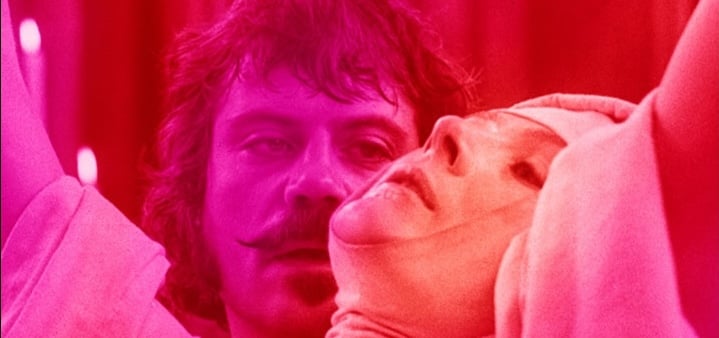
In 1971, critics called Ken Russell’s The Devils a “grand fiesta for sadists and perverts” that “might have been written and filmed by Nero and the Marquis de Sade.” Fifty-five years later, the uncensored director’s cut of the film has been re-released in theaters. This time, it is being hailed as a triumph over censors, prudes, scolds, and all things authoritarian.
The film draws on Aldous Huxley’s The Devils of Loudun, a 1952 history of the case of Urbain Grandier. In that telling, Grandier was a womanizing parish priest who made powerful enemies, including Cardinal Richelieu. When the local Ursuline convent claimed to be possessed, Richelieu seized his chance to dispose of a troublesome critic. Grandier was accused of using black magic to corrupt the nuns and burned at the stake.
Russell believed the medium of film would encourage viewers to see their own political troubles reflected in seventeenth-century Loudun. And indeed, our silver-screen intelligentsia finds the re-release morally prescient for our own moment. The once up-in-arms Los Angeles Times found that the film’s “morality involves speaking truth to power and resisting authoritarian control,” which “makes it shockingly relevant right now.” Even National Review argued that the film “resembles the progressive chicanery we recently experienced” during the Biden years. That “makes Russell’s period piece a startling, very necessary examination of decadent power.”
As a cautionary tale about church-state authoritarianism, The Devils falls short. The film is ultimately not a warning against overzealous faith in political-theological doctrines. Rather, it promotes a competing doctrine. Adrian Vermeule identifies this doctrine in his essay “All Human Conflict Is Ultimately Theological”:
Liberalism is incapable of respecting . . . constraint because to do so would betray its inner nature, which is to publicly and conspicuously celebrate its great liturgy, the Festival of Reason, the dynamic overcoming of the darkness, superstition, and slavish authoritarianism of the irrational past. That is a benchmark which necessarily changes with each celebration of the liturgy, requiring new enemies to play the part of the villain.
The Devils is best understood as a celebration of liberalism’s liturgy. It revives a perfectly hypocritical authority, a sectarian French state whose clerics and officials are comically incompetent when not excessively corrupt and sadistic, and celebrates Grandier’s resistance to that authority. Through implied parallels, it invites viewers to cast whatever authority they resent today as the new villain to be overcome.
Russell, who died in 2011, argued that censoring the film’s most notorious scene broke its central contrast. In that scene, the nuns, whipped into a frenzy by Richelieu’s exorcists, hold a Dionysian orgy in the church and tear down the crucifix from above the altar. Grandier, meanwhile, worships in the wilderness, celebrating God, goodness, and nature far from the shadowy corruption of the state. He is the embodiment of libertine resistance to deranged forces that seek to repress him into blind submission.
The irony is that a film attempting to hold a mirror up to authoritarian religious fervor is consumed by a liberal religious fervor of its own. Such fervor does not stay on screen. The re-release has been staged as a liturgy, a much-celebrated final victory over the censors who once deprived the audience of such excitement. Warner Bros. planned a one-week release; when demand kept the film in theaters indefinitely, the studio announced: “You have spoken.” Its next teaser promised: “You will blaspheme.” Film critic Mark Kermode, who helped assemble the director’s cut, said that Russell “always wanted audiences to have exactly the reaction they’re having now.” The film’s disturbing content and the deconstruction of boundaries were Russell’s aims. In pursuing them, he was every bit the radical partisan that the film’s conniving Cardinal Richelieu is.
The Devils warns against social control yet is itself ultimately a form of social control: an anti-authoritarian parable encouraging its audience to see every boundary as a prison and every authority a jailer. But the audience is left with no idea what its sought-after freedom is for.
The film’s final scene depicts Madeleine, the bride Grandier secretly married, climbing over Loudun’s ruined walls into a desolate landscape. The Devils leaves us abandoned, like Madeleine, with no idea where such freedom will lead.

YOU MIGHT ALSO LIKE
Nature’s God Is Not Enough
In the Republic, Plato writes that unless liberated by philosophy, by the awakening of the divine part…
A Verse Epic for a Post-Christian England
For all those who feel that something in our art is missing, that we cannot create as…
Vance Vance Devolution
The editors discuss the Jensen Huang scandal, the uncertain future of the “new right,” and whether the…
