
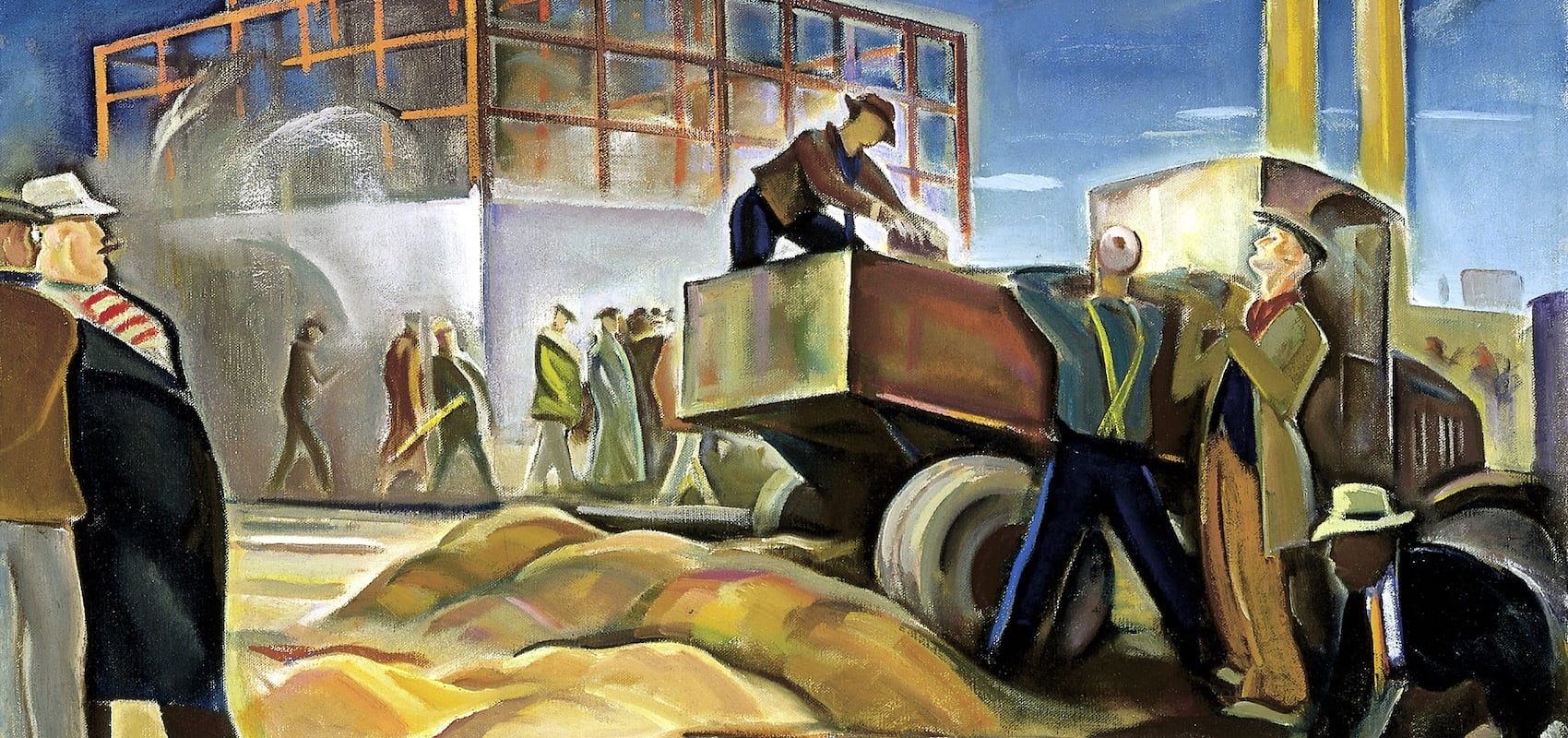
Economic populists often tell a version of this story: In the working-class heyday that was the post–World War II economic model, a man could put a roof over his family’s head and food on the table on just a single income. Our elites deliberately traded that reality, we hear, for a mess of pottage—jobs went overseas in exchange for cheap toasters, and women were caught in the “two-income trap” of being forced into paid work just to make ends meet.
This story contains elements of truth, but it’s incomplete. The mid-century might of the U.S. industrial base was due in no small part to our being the only global power to emerge unscathed by the devastation of World War II. Jobs were outsourced and offshored, but the transition away from an industrial economy was less a sudden jolt than a long, gradual decline driven by the fact that American workers are more productive (and, thus, more expensive) than the armies of cheap labor found abroad. Women entered the workforce not solely out of economic necessity, but also because increasing levels of female education, rising wages, and lower levels of discrimination made work more appealing.
Getting that history right is important. Because if policy choices didn’t undermine the male breadwinner model, policy changes won’t restore it. Instead, as new data underscores, the underlying economic factors that have pushed the labor market in a more feminized direction run deeper than heavy-handed economic interventions and trade barriers can reach. And the Trump administration’s promises of an imminent “golden age” of male-skewed economic growth may be fueling a disappointment that could cost Republicans in the midterms and beyond.
In its most recent annual report on income statistics, the Census Bureau found that median earnings for a full-time, year-round male worker hadn’t changed from the year before. For comparable female workers, median earnings rose by 3.2 percent. Women are also keeping the U.S. labor market afloat. On net, essentially all new jobs created during the second Trump administration have gone to women, a fact noted by President Trump with his trademark brio: “No wonder they like me!!!”
That the White House’s economic playbook has revived pink-collar rather than blue-collar jobs may dismay some champions of the sweeping “Liberation Day” tariffs meant to bring manufacturing back to America. When the tariffs were first imposed in April last year, populist commentator Batya Ungar-Sargon suggested they could combat our “crisis of masculinity” by reviving the kind of industries where men could “work with their hands for a living, and rely on brawn and physicality.” To date, the revival is still largely rhetorical.
Other conservatives have proposed more direct remedies. American Principles Project president Terry Schilling has called on Republicans to take the economic challenge of family formation seriously, perhaps by restoring the idea of the “family wage,” which would give married men a boost in their take-home pay. Some have gone further, openly entertaining employment and wage discrimination in favor of men. During the first half of President Trump’s first term in office, women also filled the vast majority of jobs created. “Isn’t it time,” suggested Helen Andrews, “to focus on helping male workers specifically, their wages and their industries?”
The concern behind these proposals is legitimate. It is not good for the American way of life, to say nothing of our economic fortunes, if men, especially men without a college degree, face permanently declining prospects. But the fact that this decline is a recurring feature of recent economic growth, rather than an idiosyncrasy of any one president or his policies, suggests that there are shifting tectonic plates at work. America is getting older and wealthier, and as such is choosing more healthcare and elder care services, so female-dominated jobs like personal care aide, not factory line worker, will be among the fastest growing in the years to come. No amount of tinkering with trade or immigration flows can fundamentally alter the inexorable math of basic demography.
Some left-leaning observers, like Richard Reeves of the American Institute for Boys and Men, suggest equipping young men for jobs in the “care” professions. But that push is unlikely to succeed—only a select few young men have the interest in or aptitude for what we might call “inside voice” fields. Other commentators have emphasized the need for working-class men to adapt to the changing preferences of modern women; given that the man’s role as sole economic provider is less important than in years gone by, interpersonal agreeableness and willingness to help out at home may play a larger role in what makes an attractive mate.
But that’s not enough to give men stability and purpose. Rather than trying to fight the tides of globalization, a more effective working-class agenda for men would focus on freeing up industries that can’t be outsourced or easily automated, such as homebuilding, energy extraction and processing, and, yes, even data center construction.
If politics were only about “the economy, stupid,” Republicans in Congress might feel confident heading toward election night this November. Despite the past few years’ headlines and headwinds, the job market remains steady, household incomes continue to rise, and people who own homes or 401(k)s have very little to complain about. But macro-level good feelings can’t conceal the psychic gut-punch of seeing a gallon of unleaded selling for $1.30 more than at this time last year, not to mention the various crypto schemes, overaggressive immigration actions, and unnecessary entanglements in the Middle East. And when you’re elected on a promise to bring prices down, it’s not surprising that fueling inflation will make you unpopular.
No small part of the frustration may come from young men who cheered the “vibe shift,” only to find themselves treading water as the economy kept drifting away from industrial work. Polls suggest young men in particular have swung back leftward heading into November. The Trump administration has taken some steps toward freeing up new building and infrastructure during its second term. But if the forecasts for November prove accurate, those steps won’t have been nearly enough.
Dear Reader,
Can I be direct with you?
War abroad. Socialists on the rise. AI upending human life. Endless uproar online. The modern attention economy doesn’t want readers — it wants users enslaved to the tyranny of the present.
First Things is the antidote: literary excellence, timeless truths, and a fixed point of reference in a culture that has lost its bearings.
But we can’t do it without readers like you.
Our goal: Raise $150,000 by November 1 to sustain First Things in the year ahead.
Your gift anchors readers in the permanent things.
Make your Fall Campaign gift now using the button below.
If you have any questions or would like more information, please contact Giovanni Del Piero, Director of the Editor’s Circle, at gdelpiero@firstthings.com or 212-627-1985.

YOU MIGHT ALSO LIKE
How Sweden’s Immigrant Vote Toppled the Right
For decades, Sweden had perhaps the most open immigration policy and the strongest commitment to tolerance and…
The Last Statesmen?
In the latest installment of the ongoing interview series with contributing editor Mark Bauerlein, Steven B. Smith…
De Gaulle Triumphant
The Second World War left Europe invaded and ruined, divided between Soviet and American occupations. Hitler’s defeat…
