
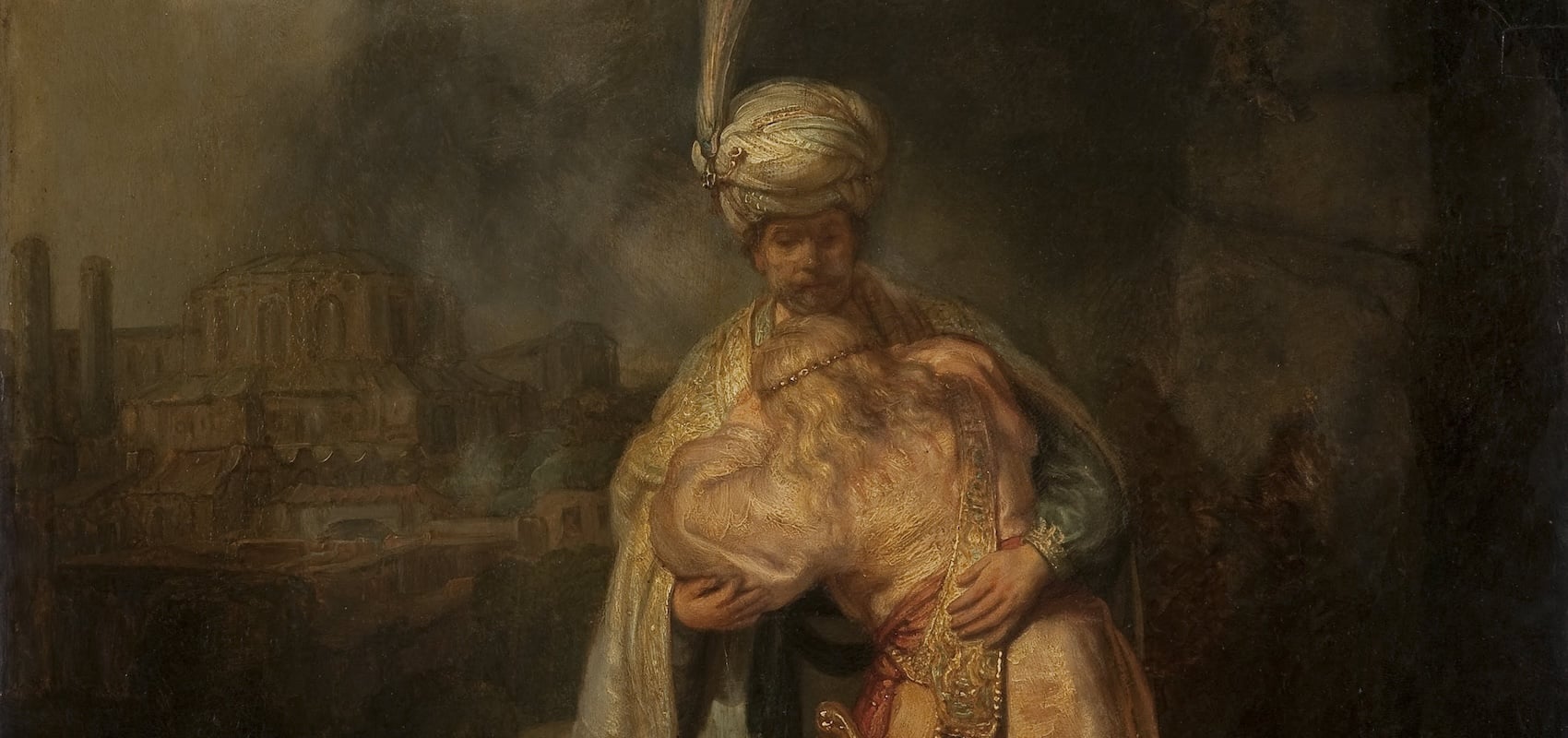
The books of Samuel begin and end with portraits of kings. When Israel asks for a “king like the kings of the nations,” Samuel presents the case against monarchy (1 Sam. 8). Yahweh gives Israel what they say they want, a king who takes, seizes, and confiscates, who imposes blasphemous tithe-level (10 percent) taxes, who drafts Israel’s sons into his military and Israel’s daughters into his court as “bakers” (wink, wink).
In its penultimate chapter, 2 Samuel records the “last words of David” (2 Sam. 23). Kings who rule with justice in the fear of the Lord shine “as the light of the morning when the sun rises, a morning without clouds, when the tender grass springs out of the earth, through sunshine after rain.” A sun king gives the light and warmth that enable the kingdom to thrive and exposes evil hidden in dark places. The people are no more than grass that grows today and tomorrow is thrown into the fire, but they’re the king’s meadow, a dew-drenched lawn jeweled by the rising sun.
Between these texts, two kings, Saul and David, take up the bulk of the book. Neither is quite as bad as Samuel’s prophecy, nor quite as good as David’s poem. Saul starts well but is overwhelmed by envy at David’s success, and ends his reign consulting a witch and committing suicide on Mount Gilboa. David sins, yet Yahweh commends him as a king after his own heart. It’s high praise, coming from the divine King. What kind of royal virtues win the Lord’s accolades? Perhaps not the virtues we expect.
For much of his young adulthood, David is on the run, ducking into caves, rushing along mountain passes, and eventually fleeing to the Philistine city of Gath (hometown of Goliath) to keep out of Saul’s way. Saul has no good reason to hate David, because David does nothing but good for his lord the king. David’s early heroics—killing Goliath and “ten thousands” of others—save Saul’s kingdom from the Philistines. During his Philistine exile, David stays loyal to Saul, conducting clandestine raids on Israel’s enemies, which is to say, Saul’s enemies. Even when Saul breathes down his neck, even when he has opportunity to strike, David refuses to fight back or take vengeance. If you’re looking for a biblical portrait of the Pauline principle “Never return evil for evil, but overcome evil with good,” you need look no further than the young David. David’s rise to kingship proves the political efficacy of the Beatitudes, for meek David inherits the land and the throne.
Saul and his son Jonathan fall on the same day on Mount Gilboa. David chants a lament for them, expressing his sincere grief not only for his beloved friend but for Israel’s once-heroic king. When Joab murders Saul’s erstwhile commander, Abner, David mourns again for a former adversary. David understands the symbolic weight of these gestures. Mourning for his Benjamite predecessors dramatizes David’s innocence and helps heal the wounds of intertribal rivalry. Both episodes also offer a political illustration of the New Testament command to “love your enemies and do good to those who spitefully use you.”
David’s treatment of Jonathan’s son, Mephibosheth, is remarkable. On the day Saul and Jonathan died, Mephibosheth’s nurse dropped him, permanently crippling him. Lame though he is, Mephibosheth belongs to a fallen royal house and could become a rallying point for a Benjamite effort to restore the house of Saul. It would be politically prudent for David to eliminate him. Instead, David brings him into his own house and gives him a permanent place at the king’s table. “Keep your enemies closer,” perhaps, but the narrator describes David’s act as “lovingkindness” (hesed) and loyalty to Jonathan, mimicking the lovingkindness of Yahweh.
At times, David’s magnanimity turns destructive, especially after his adultery with Bathsheba and murder of her husband, Uriah. David does nothing to restrain his sons as his house collapses into a flurry of incest, murder, and rebellion. Even when Absalom seizes his kingdom, David treats him so gently that he earns a harsh rebuke from his commander, Joab: “If Absalom were alive and all of us were dead today, then you would be pleased.” Joab himself is one of David’s glaring failures. Joab implements David’s plot against Uriah, murders Abner, kills Absalom against David’s direct orders, guts his replacement, Amasa, and later joins David’s son Adonijah in a last-minute coup to steal the throne from Solomon. On his deathbed, David tells Solomon to get rid of Joab. He would have saved himself grief if he had done it himself, and much sooner.
In Sunday school and on Netflix, David is a swashbuckling warrior—courageously facing down the Philistine giant, leading Saul’s armies and then his own, conquering Jerusalem and territories surrounding Israel. He does all that, but 1–2 Samuel offers a realist portrait of power, which is not all swordplay and bravado. In his successes and failures as king-elect and king, David gives political expression to the divine Name declared to Moses: “compassionate and gracious, slow to anger and abounding in lovingkindness and truth; who keeps lovingkindness for thousands, who forgives iniquity, transgression and sin; yet he will by no means leave the guilty unpunished.” A king after God’s own heart indeed.


YOU MIGHT ALSO LIKE
The New Benefit of Clergy
On November 9, Russell Brand was sentenced to over ten years in prison for one count of…
Immanuel Loyalty
I am not a particularly virtuous person, and I have squandered many gifts and hopes. But one thing…
Nature’s God is Not Enough
In the Republic, Plato writes that unless liberated by philosophy, by the awakening of the divine part…
