
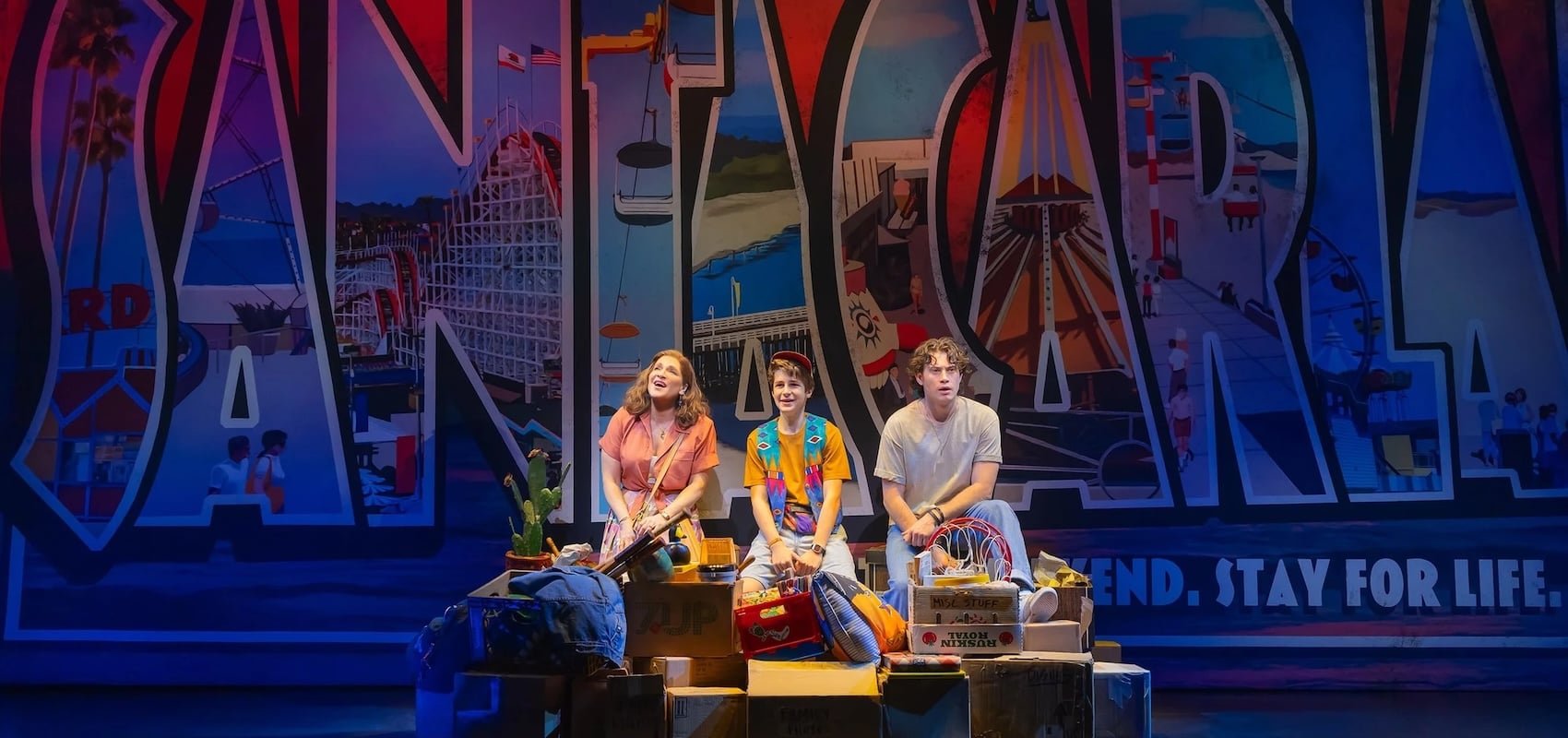
The Lost Boys, a Broadway musical adapted from the 1980s vampire flick, opens with a flickering specter. A doomed cop is searching a condemned warehouse when a TV suddenly brightens. On the screen is Ronald Reagan, delivering a Christmas speech on family values:
It’s in the family that we must all learn the fundamental lesson of life. Right and wrong, respect for others, self-discipline, the importance of knowledge, and, yes, a sense of our own self-worth. All of our lives, it’s the love of our families that sustains us when times are hard.
The cop, briefly spooked, turns the TV off, saying, “That’s enough of that.” When I saw the show on Broadway, the quip drew cheers and clapping from the New York City audience. Shortly after, the cop was dead at the hands of the show’s glam-rock vampires, and the kinetic energy never let up. Reagan was out of the picture, but his speech turned out to be an explicit framing of the show’s themes.
I doubt the show’s creators are crypto-conservatives, but The Lost Boys is a fascinating portrait of how far certain truths have to be distanced from their speakers to be believed. The audience that recoiled at explicit appeals to family values settled in for a thrilling show about father wounds and the dangers of seeking belonging in the wrong places. Telling the truth in a pluralistic, fractured world requires a little circumlocution.
Vampires and musicals fit together naturally because both genres are good tools for telling heightened stories. Musicals allow a character to pause and explore a doubt or a choice for much longer than naturalistic dialogue could sustain. Vampire stories (and stories of other supernatural horrors) allow the storyteller to externalize certain fears or existential questions.
When Joss Whedon created Buffy the Vampire Slayer, he thought of the show as telling the truth about how high school felt—it’s a time when your body is changing, when sleeping with a guy you trusted could reveal him to be a predator. It’s just that, on the show, the threats were more literal—your body was changing because now you’re a werewolf; your boyfriend turns out to be a soulless vampire.
In The Lost Boys, the guitars and gore let the creators tell a story of personal wounds at epic scale. Michael (L. J. Benet), the protagonist of The Lost Boys, is a seventeen-year-old, still bearing the bruises of his father’s beatings. His mom (Shoshana Bean, Tony winner for Best Featured Actress in a Musical) has gone on the run with him and his little brother, trying to build a new life—one with, as the opening song says, “no more monsters.”
Michael is glad to have escaped his father, but he wants to escape his family too. His abusive father stripped him of the safety that authority, rightfully exercised, should offer a child. He doesn’t want to grow up to be a man in his turn—he won’t even help his mom unload their moving boxes. He’s one of the demoralized, driftless young men spotlighted by a recent report from the Institute for Family Studies. While many of those Michaels try to muffle their unhappiness with porn, drugs, and gambling, Michael of The Lost Boys faces a supernatural temptation.
On the night he first encounters the vampires, Michael is looking for oblivion. He’s in a mosh pit, singing “Get me into the crowd / Make it mean, make it loud / Drown out the voices with the noise / And make me lose myself here.” Although it’s a girl who first catches his eye (Maria Wirries as Star, a little underwritten), the real love story is between Michael and David (Ali Louis Bourzgui, Tony winner for Best Featured Actor in a Musical), the magnetic leader of the vampire band. The boys’ bond is charged with eros, but the yearning isn’t for a romantic or sexual consummation. When Michael chases the vampires, he isn’t looking for power—he wants a place where he can be powerless. He wants the ecstasy of being dissolved in something larger than himself.
After his vampiric transformation, Michael has the best number of the show, the ballad “Belong to Someone,” his big “I want” number: “To be part of something real / To be half of a whole / To be truly connected / To surrender control / Oh, I need a family that’s gonna stand up for me.”
You have to be careful who you invite in, in a vampire story or in real life. Becoming a vampire allows Michael to fly and erases the bruises his father gave him, but what Michael asked for is to become smaller, not larger. His yearning is tainted by self-hatred. He drinks David’s blood, without fully understanding the consequences, because he knows he wants one thing David is offering: the chance to leave his family behind and be chosen by someone else.
The Lost Boys isn’t a show that fully explores the dark inversion of the eucharistic banquet in the vampiric legend, but all vampire stories are stories about the danger of misdirected hunger. Michael isn’t wrong to think he needs something outside his family to help him understand what he should grow up to be. He’s not even wrong to ask for a love and authority that could be worthy of real submission. But to save his family and win his freedom, he has to refuse to accept what is unworthy of this yearning.
By the end of the show, Michael turns away from David and back to his duties to his family. Meanwhile, his mother is on a parallel journey. She wishes she could restore all that her boys have lost, but, like Michael, she has to reject the temptation to satisfy this yearning with something unworthy of her hunger. While Michael falls under the spell of David, she faces her own seductive vampire, Max (Paul Alexander Nolan), who wants to subsume her family into his vampiric brood. Her boys would have a father with real authority, and his wayward young vampires would have the civilizing influence of a mother.
The final boss vampire is conservative-coded. He is tweedy, in contrast to the glam-rock teens, and he claims to be a fan of Barry Goldwater. For the jeering audience, he might look exactly like the specter of “family values” that they booed at the start. Every family needs a dad, any dad, no matter how bad he is. But social conservatives should be the first to reject attempts to make the family less than what it truly is. When Michael’s mother rejects Max’s offer, she stakes him with a crucifix. The Son who was truly and fully obedient to his Father is what dispels the man who demands to be treated like a god.
Social conservatives trying to evangelize a skeptical culture must take their openings where they can. The natural law remains written on the human heart, so there will never be an end to artists wrestling with truths they can’t quite bring themselves to trust. Like Michael, many young men know they are not happy, and are yearning for something that will distract them. They leave the door open—inviting in something that could destroy them. Our task is to earn back their trust and give them hope that their hunger has an object and can be satisfied. But to tell that story, social conservatives may need to keep finding new disguises.

YOU MIGHT ALSO LIKE
Serial Liar, Serial Comma
How would you write a public letter that you know will become front-page news? Would you write…
Shakespeare Under Stalin’s Shadow
”We wish that we could pass this play over, and say nothing about it. All that we…
Roger Scruton’s Eternal Youth
In this episode, First Things senior editor Dan Hitchens joins R. R. Reno on The Editor’s Desk…
