
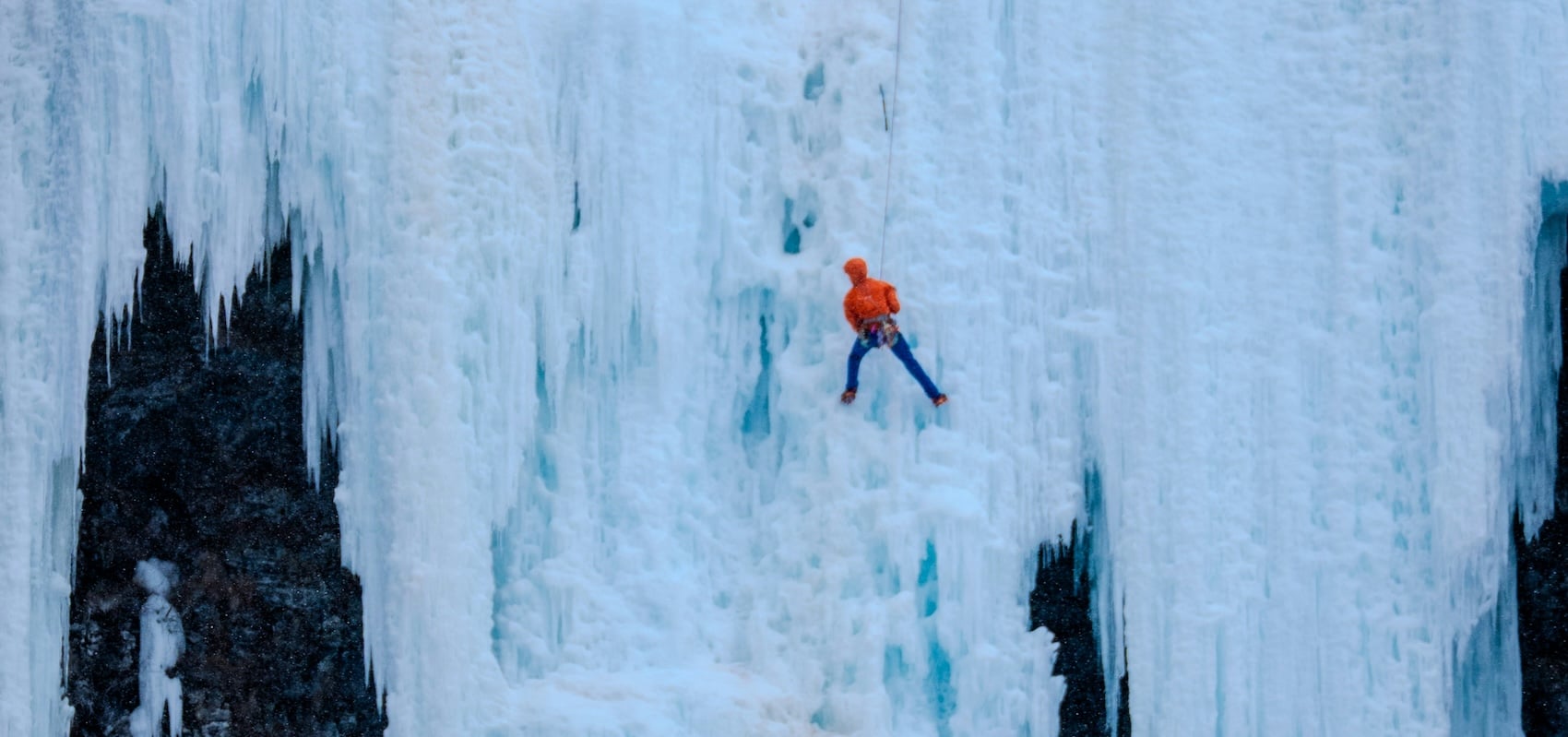
I’m working on a memoir of my long-standing passion for climbing. Last spring, I shared a section, one from my youthful adventures in Yosemite. Here’s another snippet, this time in ice-covered mountains rather than on sheer granite cliffs.
Neal climbs up to join me at the belay. Moving quickly, he kicks the front points of his crampons into the gray alpine ice and swings one of his ice axes like a framing hammer. The pick bites deeply. He then grasps the other axe on its metal top and jabs it into the ice. We’ve reached the top of the long ice face that stretches two thousand feet below us.
After Neal arrives in the mid-morning gloom of a deeply overcast day, we take a minute or two, looking up and talking through the next and most difficult section of the route, which goes up a band of rotten shale that has shed tiny black pieces of rock that fleck the ice below.
I hate shale. It’s a dark and soft sedimentary rock that forms in thin layers that tend to fracture and disintegrate. Climbing on shale is unnerving. It crumbles easily, and its structure is so compact that the usual devices that climbers use to gain a degree of protection are almost always useless. In most circumstances, these unpleasant characteristics are moderated by the fact that bands of shale in the mountains erode quickly, which means that their slopes are often gentle. I’ve scrambled up many.
But our situation is different. Eighty or a hundred feet above the shale looms a large protrusion of bulletproof limestone. The indomitable limestone—another sedimentary rock, but one that can be very hard, solid, and enduring—has protected the shale below, which at this point in the mountain’s long life has become a vertical abscess of decaying rock.
It’s the first day of September. A summer’s worth of warm temperatures has melted some of the ice and snow in the steep couloir above the bulging limestone. Seeping their way downward, drips of moisture have formed a thin ribbon of ice in a shallow corner of the ink-black shale.
Neal puts me on belay. The tube of ice is six inches in diameter and fragile. I do not swing my ice axes. Like an archeologist exposing a precious artifact, I tap the ice carefully to gain purchase. I kick my left boot gently. The crampon’s front points barely bite into the ice. With my other foot I stem to the right, my crampon scraping the shale, seeking a stable edge. I begin to engineer my way up.
The ice in the corner gets thinner, becoming for a span little more than small pockets frozen in the rotten shale. I move higher and higher. Twenty feet above Neal. Forty feet. Sixty feet. I feel my exposure. Concentration redoubles. Time contracts. I lose awareness of Neal below and the rope that connects us. I’m entirely inside myself, thinking only of the next move.
Neal and I are attempting the Grand Central Couloir on the north face of Mount Kitchener, a route in the Canadian Rockies. The glacier we traversed to get to the climb has dangerous crevasses to cross. The rock on the face is friable and prone to cut loose. The cornice on the summit can break off and sweep the face. To complete this long and difficult climb, we need to move quickly, not just to get to the top before dark, but to minimize exposure to danger. We can’t afford much in the way of food or gear. Our packs need to be as light as possible: Speed brings safety. There’s no margin for extra precautions. The route is at the limit of our abilities. If we take gear for an emergency bivouac, we won’t be able to do the route in a long day, as we planned. To prepare for misfortune will bring misfortune. We need simply to make the commitment: Yes, we can do this.
We were not reckless. Neal and I had honed our ice-climbing skills on winter weekends in New England. We had done other routes in the Canadian Rockies. On the evening before the climb, after establishing a bivouac on the glacier at the base of Kitchener’s north face, we were confident. Only a fool attempts an extreme climb without a reasonable expectation of success. But our confidence was also dogged by worries about the consequences of failure. Only the naive imagine that nothing can go wrong.
That morning, we crawled out of our sleeping bags in the darkness and left our bivouac at 2 a.m. Soon, we crossed the bergschrund and began climbing the ice face in pre-dawn darkness, alone in the small pools of light cast by our headlamps. We were exposing ourselves to the possibilities of bad weather, bad conditions, bad decisions—and bad luck. We were entering the zone of commitment. We climbed together without protection, front-pointing up the ice as quickly as possible, our doubts and worries overcome by heavy breathing and the burning muscles in our thighs and calves, until, toward the top of the ice face, as the angle steepened and the ice hardened, we took out the rope for the final two or three hundred feet.
The rotten shale and thin pockets of ice end underneath an overhanging bulge of limestone. I see a crack in the rock above my head. I place a piece of climbing gear, solid and reassuring. As I clip in the rope, a powerful wave of relief sweeps through me. The aperture of my consciousness widens. Neal gives out a happy hoot below. There’s technical climbing for the next fifty or sixty feet, but I’m no longer on the razor’s edge.
I move up, wedging my ice axe in rock cracks and scraping the limestone with my crampons. I reach the point where the bulge of limestone eases, and the soaring upper couloir that gives the route its name begins. Nearly out of gear, I am relieved to discover two aluminum ice pitons pounded into a wide crack in an improbable but effective combination. According to climbing lore, the party that made the first ascent more than a decade earlier was also running out of gear and improvised this remarkable solution. Thank God the legend is true!
I belay Neal up. Breathing heavily when he reaches me, he sputters, “That was f—ing crazy.” There’s no time to celebrate. We start the long series of steep ice pitches that will take us to the top. It’s more demanding than we had anticipated. The weather worsens. It begins to snow. We’re buffeted by spindrift avalanches that sweep down the couloir every few minutes. The fine snow dust penetrates through the slightest opening in our protective clothing. We press upward. There are no ledges, no places to stop and rest. The afternoon wanes. The mountain is enveloped in clouds as the storm rushes in from the west. The upper couloir seems endless. We shiver at belays. We feel the onset of exhaustion.
Finally, we reach the summit cornice. I muscle upward in steep, viscous snow and chop a tunnel through the north-leaning visor of the summit ice cap, through which I shimmy to emerge on the flat mountain top, which is covered with snow and ice from the Columbia Icefield that surges up the gentle southwestern slope of the mountain. Neal follows. The storm is gathering force. The temperature has fallen well below freezing. We lean against powerful gusts of driving snow. No time to celebrate. We’re cold. The day is far gone. Darkness is crowding in on us. We hasten down the east ridge of the mountain, moving quickly through the fresh snow.
It’s night by the time we reach the glacier at the mountain’s base. Somehow, amid the thin shadows cast by our headlamps, we recognize the rocks and ice blocks among which we had bivouacked. We’re too exhausted to eat, too exhausted to take off our climbing suits. It’s only a deep instinct for survival that drives me to scrape the newly fallen snow off my sleeping bag and climb in.
From a certain angle, the entire enterprise of climbing isn’t just inexplicable; it’s irresponsible. I was twenty-nine years old when I climbed the Grand Central Couloir on Mount Kitchener. My wife was waiting in a nearby campground, pregnant with our first child, her worries compounding as the stormy weather rolled in. Why subject her to this trial of anxiety? Why court the dangers? Why press to the limits of endurance?
These are difficult questions to answer. There’s the naivete of youth. Although Neal and I were nearly thirty, we retained our adolescent illusions of invincibility. We lacked the wisdom to understand that life itself would deliver great difficulties, even to the healthy and fortunate. What I suffered when my son was killed in a car accident decades later was far greater than what I endured on Mount Kitchener. The venture of love exposes us in terrible ways. The wounds to the heart cut more deeply than those in the flesh.
And yet—is the adventure of climbing entirely foolish and irresponsible? I look back on my years on cliffsides, frozen waterfalls, and mountain faces not just with delight, but with gratitude as well. To this day, I go climbing.
Aristotle once defined happiness as unimpeded activity. This involves more than simply doing something well. It requires unity of purpose. In most activities, we’re susceptible to distraction. Our minds attend to a task. Perhaps we are playing a Beethoven sonata on the piano. But somewhere on the edges of our consciousness, other concerns bubble and churn: a girlfriend, work, tomorrow’s appointments. The activity goes on. We keep playing, perhaps very well. But the activity is subtly impeded. We are not entirely at one with the task at hand.
Our instinct for survival is strong. We’re hardwired to avoid danger, risk, and peril. But there’s a luminous gift in the darkness of fear. The musician mounts the stage. The audience is hushed. He feels the pressure of performance and fears the possibility of flubbing, the shame of failure. To sit at the piano in Carnegie Hall is to entertain risk—which, though painful to endure, motivates intense concentration. It’s no longer practice. Everything is on the line. The performance requires his entire self.
Extreme adventure sports, especially climbing, amplify the pressure of performance by adding the element of mortal danger. On steep cliffs, our minds intuitively recognize the unforgiving law of gravity. With experience, a climber becomes aware of his competence and attains knowledge of the objective circumstances of his position. In most instances, this knowledge offers assurance, allowing the mind to relax. The weather is clear; the route is evident; the rock is solid. But the game of climbing emphasizes pushing standards and testing limits. Like the concert pianist walking onto the stage, in his boldest endeavors the climber assumes a greater risk of failure. In these moments—which on long and difficult climbs accumulate into significant stretches of time—I’ve experienced the joy of self-possession. I’ve shed the distractions of my peripheral self. Only the core remains. I am entirely at one with the task before me, the task I must perform if I’m to fend off peril, if I’m to make the narrow passage.
Yes, I was selfish to leave my pregnant wife at a campground that late-summer day in 1989. God bless her for not judging me to have been so! She knew me well. Could I have done otherwise? I longed for those lightning flashes of self-possession, for the tremendous concentration of will that comes from knowing you’ve given yourself a thin margin for error.
Too many of my friends and climbing partners have died on rock cliffs and in the mountains. And I’ve already mentioned my son, whom I could not protect on that fateful day. But even if we cannot save others or be the authors of our own immortality, we can refuse to live under death’s dominion. On Mount Kitchener, Neal and I were saying to death, You think you can have your way, but you can’t—not now, not with us! We were courting danger to affirm life, to feel the fullest intensity of our desire to live.
As Neal and I were attempting the Grand Central Couloir, the park rangers were tracking us through powerful binoculars, driving to the campground where my wife was waiting to give her updates. By mid-afternoon, as the storm engulfed the mountain, our guardian angels held their breath. Late the next morning, Neal and I emerged from the wilderness. Happenstance put us directly in front of the park rangers’ living quarters, which erupted in welcome. Cups of fresh coffee were thrust into our hands. Someone radioed a ranger on the road: “Tell Reno’s wife that he’s safe and with us.” The good man did more than that. He piloted his pickup truck into the campground and drove my wife to the ranger station. As I saw her open the truck’s door and run to embrace me, the aperture of my mind narrowed. My consciousness contracted. The world around me fell away. “You bonehead!” she exclaimed, as she threw her arms about my neck.



YOU MIGHT ALSO LIKE
Job and Her
It is said that Job lost everything, but she has lost more. All her possessions—the money, the…
A Culture of Parricide
I learned a new word the other day: déploration. It’s the French, directly from the Latin, for “lament.”…
Who Killed the Clancy Children?
After a Massachusetts jury failed to convict Lindsay Clancy of strangling her three small children to death…
