
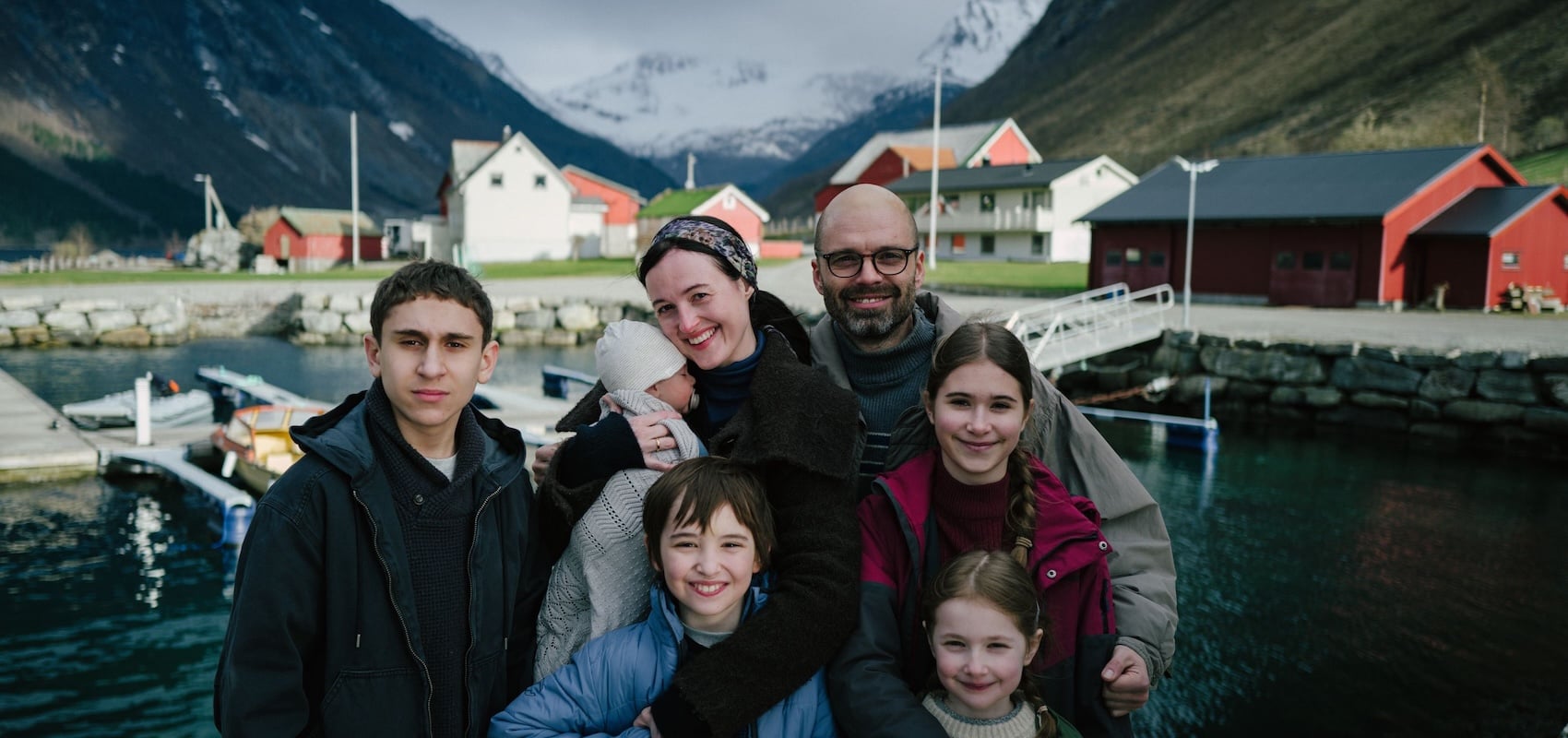
Fjord, Romanian director Cristian Mungiu’s Palme d’Or–winning film, is the kind of movie you desperately want to have a happy ending. Based on a true story, the film follows a Romanian-Norwegian couple in rural Norway who find themselves in a legal battle against child-protection authorities seeking to remove their five children, partly because of their evangelical Christian beliefs.
You want the judge to slap down the sneering prosecutor who takes digs at the Bible under the guise of cross-examining the father, Mihai Gheorghiu (Sebastian Stan), over a charge of physical abuse, the technical reason for dragging him into the courtroom. You want the nice but militantly secularist school headmaster, Mats (Markus Tønseth), to admit he made a mistake in prejudging the family (“We don’t do evangelizing at schools”). Most of all, you want the Gheorghius to win their case. Norway’s government-run child-welfare apparatus, the Barnevernet, is so creepily appalling in this movie, its iron fist sticky with the syrupy therapeutic rhetoric that its functionaries—social workers, teachers, lawyers—use to mask the absolute power they wield over the hapless parents who have fallen within their purview.
Frida (Lisa Loven Kongsli), one of the kids’ teachers, and Gunda (Ellen Dorrit Petersen), a Barnevernet bureaucrat, pay a surprise home visit to Mihai’s Norwegian-born wife, Lisbet (Renate Reinsve). They inform her that any effort to block the immediate placement of all five children—including Lisbet’s six-month-old son—in foster homes will be viewed as an effort to cover up alleged abuse. When Lisbet protests that she and Mihai love their children and would never physically harm them, Gunda’s response is: “All parents say that.” Frida informs Lisbet that even before the suspicion of abuse, she had reported the Gheorghius to the Barnevernet after their seven-year-old daughter was overheard telling a classmate that homosexuality violated God’s laws. In Norway, Frida tells Lisbet, children have “a right to their gender identity.” (As of 2016, Norwegian children as young as six, with parental consent, can change the sex designations on their identification papers via a simple application form.)
As for Mihai, he gets a visit from the police. It seems that the Gheorghius’ teenage daughter, Elia (Vanessa Ceban), was overheard on the school bus talking about a “punishment” she had received from her parents, while at the same time displaying bruises that she said she had gotten from falling down a flight of stairs. There is apparently no such thing in Norway as a Miranda warning, and soon enough, Mihai, whose Norwegian isn’t that great, admits that he sometimes gives his children a “slap” on the rear when they’ve gotten out of hand and signs a statement confessing that he has been “hitting” them. The Gheorghius’ goose is now cooked, for Lisbet has made a similar admission to Gunda while being recorded: that she pushed Elia after some roughhousing in the kitchen between Elia and her brother resulted in a kettle of boiling water being knocked over and nearly scalding the baby. Norway was one of the earliest adopters, in 1987, of a law criminalizing the corporal punishment of children, and in 2010 it amended the law to include even the mildest spankings.
This is a country where playing a few bars of “Amazing Grace” on the school keyboard wins you shuddering disapproval—but school officials have no problem displaying the animistic religious symbols of Norway’s reindeer-herding Sámi people. That’s cultural diversity. Fortunately for the Gheorghius, Mia (Lisa Carlehed), Mats’s lawyer wife, comes to their defense. Mia is a thoroughly secular liberal like her husband, but she is fond of Lisbet, who has been caring for Mats’s aged and depressed father. The high-handed treatment of the Gheorghius offends her belief in freedom of religious expression. She goes to work in the courtroom and wins the parents temporary custody—although Lisbet is required to take a class in parenting and Mihai a class in anger management.
But this doesn’t mean that the story ends happily. One of the biggest obstacles is Mihai himself, who, thanks to Stan’s superbly nuanced performance, reveals himself as a father who is obviously devoted to his children but also deeply flawed. He really does have a hair-trigger temper, and he is his own worst enemy during the court proceedings. You can share his fury at the Barnevernet’s tentacles reaching into every corner of family life, even as you wish he could control his frequent verbal outbursts. He decides, against Mia’s advice, to marshal the support of the Romanian embassy and Norway’s small but vocal evangelical community. The shouting, placard-waving crowd outside the courtroom alienates the secularized Norwegian majority, used to regarding any display of zeal, much less Christian zeal, as a species of extremism. And although I never believed for a minute that Mihai uses violence against his children, he is shown as an awfully strict father, enforcing household discipline (no phones, no video games, no YouTube) with punishments, and requiring quite a bit of Bible memorization as the family catechist.
Fjord ends with sad irresolution as the Gheorghius decide to return to Romania. It’s a tragedy, first, of a seemingly irreconcilable cultural clash: a socially and religiously conservative minority pitted against a homogeneous Scandinavian society that presents itself as liberal and tolerant of all lifestyles but in fact demands rigid conformity to its own consensus values. It’s also a personal tragedy, because everyone involved is human and thus far from perfect. Mia, her good deed done, declines to represent the Gheorghius in their more serious and complicated criminal proceedings, where both have inadvertently made damning admissions. The Gheorghiu children have bonded with their secular schoolmates. Elia especially has struck up a close friendship with Mats’s rebellious teenage daughter—a friendship of which Mihai doesn’t approve. All the Gheorghiu children have been exposed to the more relaxed regimens of their Norwegian foster parents, and the seeds are already planted for future generational conflicts.
This is an unforgiving movie, but it is also a beautiful movie. The harsh and treeless landscape of the western Norwegian coastline, its fjords and glaciers and ocean and lonesome clapboard houses, the glittering ice-blues and snow-whites—all these are skillfully captured by cinematographer Tudor Vladimir Panduru. It’s a landscape that tells all. At the tiny town’s center is a vintage white church, probably Lutheran, whose steeple reaches to a sky as blue as the glaciers. It’s a church that you know hardly anyone attends.

YOU MIGHT ALSO LIKE
After Disenchantment
What does the phrase “disenchantment of the world” mean? Disenchantment is easy to identify and even easier…
Form vs. Monsters
The nature and aims of Catholic fiction have been a matter of debate for generations now. What…
Seeking God, Finding the Devil
On the wedding night of his second marriage, August Strindberg (1849–1912), the Swedish writer, painter, polymath, and…
