
We live, writes Italian economist Luigino Bruni in his The Economy of Salvation, in an exhausted age in which “words are tired” and “worn out,” when “old things have passed away . . . and there is a yearning desire for something new.” In such a time of fatigue and transition, the Bible that “nurtured and inspired our civilization” can revive our language and our souls. Its “generative words” return us to our “narrative patrimony.” The Bible is especially relevant to economics because many of the fundamental concepts of that discipline have theological origins—the invisible hand, debt and debt relief, even the concept of oikonomia itself, which Scripture and the Christian tradition use to describe God’s wise management of the household of creation. An advocate of civil economy, Bruni looks to the Bible to fill out his notions of pact, reciprocity, personal relation, and gratuitousness, all essential to economic health.
Genesis records the beginnings of creation, hence also the beginnings of economy. “In the beginning,” Bruni writes, “there is no Cain.” Bucolic Adam, not violent Cain, was the first man, which implies earth and humanity originate in Edenic goodness and beauty, realities that remain, even in our broken condition, earth’s “deepest and truest vocation.” Genesis thus provides an antidote to cynics and nihilists who believe the fratricide of Cain speaks “the first and last word about humans.” Since humanity isn’t essentially Cainite, we have grounds to hope for brotherhood.
Bruni gives sustained attention to the economic import of the Abraham narrative. Yahweh’s call highlights the profound difference between vocation and contract. Contracts are designed to shield us from surprise and frustrating contingencies. Every vocation, by contrast, involves “a radical act of trust in a ‘voice.’” A man pursuing a vocation, whether religious or entrepreneurial, faces unanticipated disappointment, pain, dismay, as well as “forgiveness, and the possibility to start over.” Abraham’s initial surprise is the condition of the promised land. When he enters, he finds it forbidding, as unfertile as Sarah’s womb and populated by vicious Amorites. Abraham proves himself righteous by trusting the Voice, even when nothing is as he expected. A righteous man lives in hope, able to see a future land of milk and honey in the midst of famine and to expect children as numerous as stars from his wife’s barren womb.
Genesis 23 offers the Bible’s first glimpse of money, the market, and price negotiation, when Abraham buys a plot of land for Sarah’s tomb. It’s a more-than-economic transaction. The land’s value isn’t merely utilitarian, but bound up with the covenant, Abraham’s hopes for his progeny, and the conversion of undeveloped land into a sacred place. Abraham’s haggling unfolds within a market of honor. Price becomes “an almost marginal detail inside a conversation in which generous offers, praises and recognitions of dignity and honour are exchanged.” Genesis 23 reminds us that words are always the “first merchandise” in every trade.
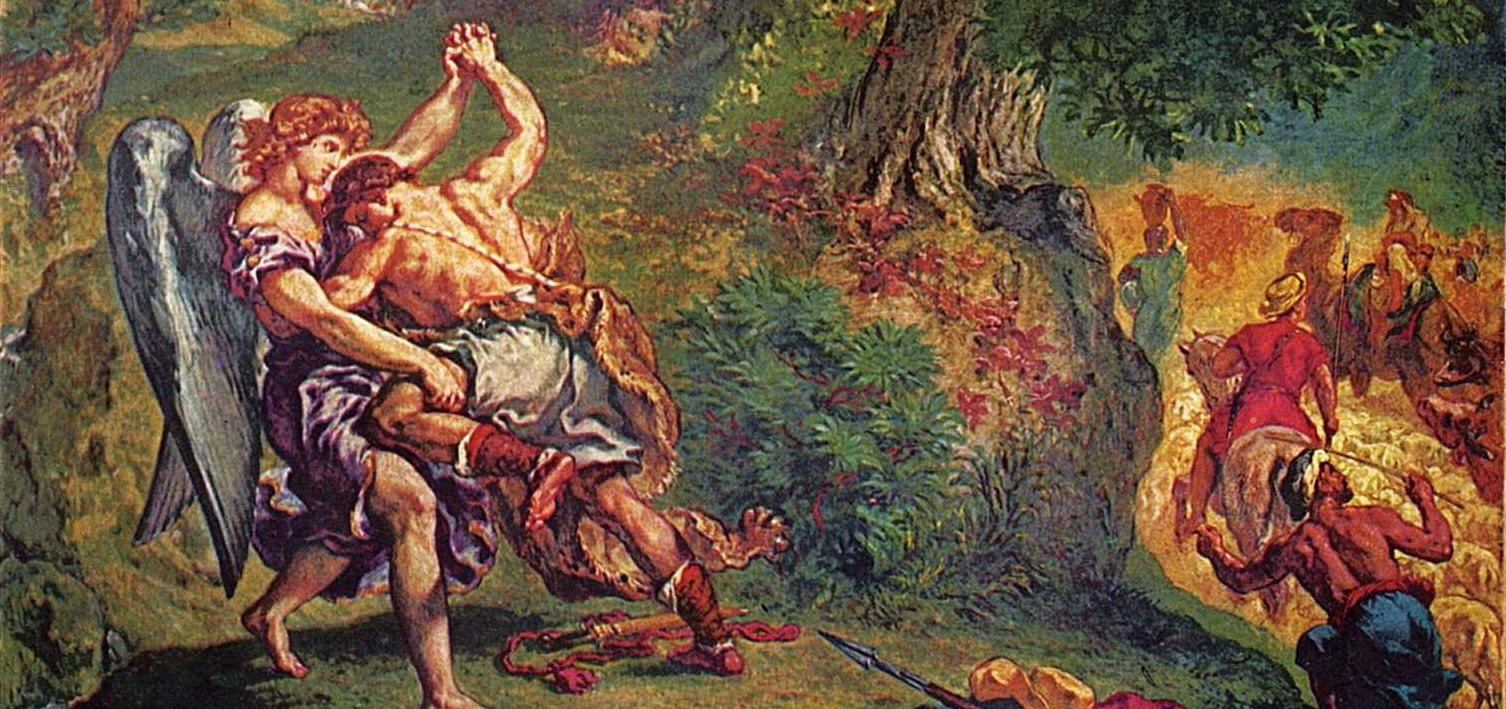
That personal dimension is foundational to a biblical vision of economics. And that implies that economic life cannot avoid trauma and injury. Taking his cue from the account of Jacob wrestling with the angel (Gen. 32), Bruni observes in The Wound and the Blessing that we experience the blessing of personal relation only if we also accept the risk of being wounded. Unfortunately, modern economic theory, and the markets constructed in accord with theory, ignore or inhibit the wounding relationships that make for deep and lasting happiness. Contracts and markets are essential to civil economy. Absent these institutions, the strong exploit the weak with impunity. (Of course, the strong also manipulate contracts and markets to their advantage, but Bruni thinks they can be neutralized.) But modern economic theories and systems recoil from trauma and promise a utopian social life without sacrifice or pain, whether through frictionless market transactions or technocratic management. I might experience pain because of a vexing moment at a retail counter or with a customer service bot, but only if things go wrong. The system is set up to facilitate smooth, impersonal exchange beyond the possibility of harm.
If the market were confined to one sector of social life, this might be tolerable. Impersonal market mediations certainly have their advantages and efficiencies. But, as Bruni points out, the dynamics of the market haven’t stayed put. Market logic has become “the principal means of organizing community life,” permeating “the whole of civil society from health care to schools, from child care to elder care.” No wonder we’re both insanely wealthy and acutely unhappy. There’s a “tipping point” when an impersonal society cannot help but produce loneliness and dissolve the bonds that sustain our souls. Bruni thinks we are at or past that tipping point.
And so we come full circle. Our way of doing economics has contributed to our cultural malaise, which can be healed only if we’re willing, like Jacob, to be wounded. To that paradoxical cure, Bruni proposes, the Bible can make a signal contribution.
Dear Reader,
Can I be direct with you?
War abroad. Socialists on the rise. AI upending human life. Endless uproar online. The modern attention economy doesn’t want readers — it wants users enslaved to the tyranny of the present.
First Things is the antidote: literary excellence, timeless truths, and a fixed point of reference in a culture that has lost its bearings.
But we can’t do it without readers like you.
Our goal: Raise $150,000 by November 1 to sustain First Things in the year ahead.
Your gift anchors readers in the permanent things.
Make your Fall Campaign gift now using the button below.
If you have any questions or would like more information, please contact Giovanni Del Piero, Director of the Editor’s Circle, at gdelpiero@firstthings.com or 212-627-1985.


YOU MIGHT ALSO LIKE
Foucault’s Idol of Nothingness
Today marks the 100th anniversary of the birth of Michel Foucault. He was influential in his lifetime,…
Why the Death Penalty Is a Sore Point for Papal Authority
Pope Leo XIV marked World Day Against the Death Penalty, observed on October 10, with the following…
Forget Odysseus. Aeneas Is the True American Hero.
Who is our Odysseus? Or more precisely, who is the most Odyssean hero of American film? Matt…
