
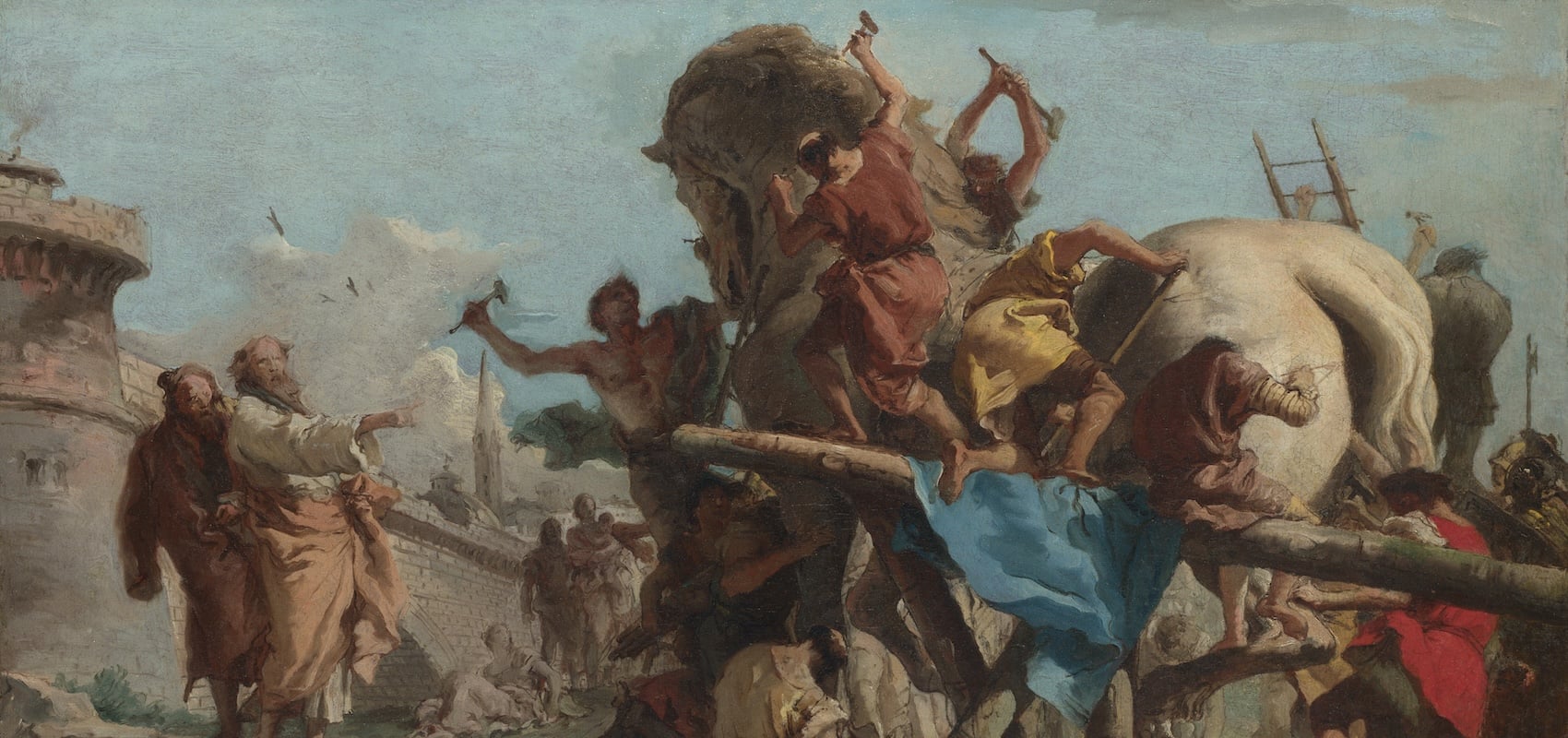
Tourism makes fact seem fiction. I feel confident Leonardo da Vinci painted the Mona Lisa, and I believe it is a great portrait, until I get to the room where it is kept and see an army of tourists trying to snap photos of it; then I’m convinced the whole thing is a sham. The Colosseum, the Sistine Chapel, the David of Michelangelo—all these things seem fake to me if there are enough people bovinely milling around them. Nothing seems real in the presence of such purposelessness. On the other hand, when I am alone with the wonder of it all, then even things I guess must be fiction take on a reality I cannot explain.
One time my family and I were driving in the south of Italy, way down in Calabria, where there are no tourists and fiction becomes fact all the time. We had just left the little town of Sybaris and got into farm country. That was when the two-year-old in the back told me she had to go to the bathroom now. Her twin brother agreed: They both needed a bathroom immediately.
My whole life I had never had anyone urinate on the seats of my rental car, and I wanted to keep my streak going. But there were no businesses. There wasn’t even room on this narrow country road to pull over.
A mile down the road was a battered yellow sign: Zona Archeologica. I turned. Half a mile farther was another sign. We sped up a dirt road, which ended at a modern farmhouse. I cut the ignition and jumped out to unbuckle the kids. “John, this is someone’s front yard,” my wife said. “This is their driveway.”
“No, I see a sign over there for the archaeological area,” I said, getting one kid out and working on the other. “And anyway, this is as good as we’re going to get.”
I took the kids behind a big bush to do their business. A dirt path led off past an old stone wall into the dry Mediterranean chaparral. As far as the kids were concerned, we were at our destination, and they took off down the path once they had their pants on again. Catherine got the baby out and followed after the kids, leaving me all alone with what I quickly found out was a tomb. It was the Tomb of the Man Who Built the Trojan Horse.
In my mind I capitalized it, like a title, a piece of fiction rather than a fact you would expect to see on a plaque summarizing an archaeological dig. But the archaeologists working at the site had drawn their conclusions: This was the tomb of Epeus. He’s mentioned in the Aeneid as “ipse doli fabricator Epeos”—Epeus, the fabricator of deception himself. He’s in the Iliad and the Odyssey too. He not only built the horse (which was Odysseus’s idea) but chose the other twenty-nine men who would hide in it with him. Later he led an expedition from Greece and founded a town near Sybaris, where he built a temple to Athena. There, according to the Mirabilia attributed (probably falsely) to Aristotle, were the tools he used to build the Trojan Horse.
I was staring at the town’s cemetery. Boulders, each about the size and shape of a basketball, were strewn over the area. This was clearly a primitive site: no cut stone. The stones formed little outlines, each a tomb: a large central one and smaller ones surrounding it, as if the dead wished to huddle close in the coldness of the grave. Archaeologists found a temple complex just above, with a votive inscription to Athena. They excavated the great central tomb and found a dagger and a suite of tools—a hammer, a chisel, and more, whose Italian names did not mean much to me: “suspension rings” (anelli di sospensione) and “wire spirals” (spirali di filo). These aren’t the things you normally find in prominent ancient tombs.
Catherine and the kids were coming back down the path. Of all the stories about the Trojan War, the Trojan Horse sounded like the least factual of all. And yet here before me was the classic form of a heroön—a shrine to a hero, where later generations would wish to be buried in the shadow of the great man. But this great man’s tomb held not swords and shields and gold. It held a few old iron tools. It seemed like the kind of thing that should be a sensational archaeological discovery. But no one cared. Look up “tomb of Epeus” on the internet and you’ll get nothing. It wasn’t much to look at, of course; no mask of King Tut here, no lapis lazuli and gold, just the tools of an old carpenter marked by a circle of stones. I bent down to touch the dirt that covered old Epeus. He didn’t seem like fiction at all. He seemed as real as I was.
That this happened in Calabria should be no surprise. Calabria is where fiction becomes real. We stayed in Cosenza, and learned that Alaric the Visigoth, loaded with spoils from the sack of Rome, suddenly grew sick and died here; the Visigoths diverted a river, buried him in the channel with his riches, and then ran the waters back over his grave to keep grave robbers away. Was this true? Does Alaric sleep with the fishes?
In the mountains above the tomb of Epeus, we stayed in San Lorenzo Bellizzi. This town of old stone houses was 80 percent abandoned, and fully a third of the houses had collapsed in on themselves. As we arrived at our Airbnb, three little blond children in tow, two dozen old people came out to watch us pass by. Despite my greeting them in Italian, they said absolutely nothing. This too seemed like fiction.
Yet to me the most miraculous of all the fictions I cannot disbelieve are the stories of the Trojan War. Every time I find myself alone with them, they fill my imagination with something that feels like reality: Walk from the site of Troy down to the beach, sit alone and watch the waves work the abandoned sands, and it will seem real to you. Sit alone on the headland of Sounion, and you can almost see the beacon-fire light in the distance, announcing the fall of Troy. Make a wrong turn in Calabria just looking for a bathroom, and a forgotten, neglected grave may make the mythic seem real.
Dear Reader,
Can I be direct with you?
War abroad. Socialists on the rise. AI upending human life. Endless uproar online. The modern attention economy doesn’t want readers — it wants users enslaved to the tyranny of the present.
First Things is the antidote: literary excellence, timeless truths, and a fixed point of reference in a culture that has lost its bearings.
But we can’t do it without readers like you.
Our goal: Raise $150,000 by November 1 to sustain First Things in the year ahead.
Your gift anchors readers in the permanent things.
Make your Fall Campaign gift now using the button below.
If you have any questions or would like more information, please contact Giovanni Del Piero, Director of the Editor’s Circle, at gdelpiero@firstthings.com or 212-627-1985.

YOU MIGHT ALSO LIKE
Foucault’s Idol of Nothingness
Today marks the 100th anniversary of the birth of Michel Foucault. He was influential in his lifetime,…
Forget Odysseus. Aeneas Is the True American Hero.
Who is our Odysseus? Or more precisely, who is the most Odyssean hero of American film? Matt…
The Last Statesmen?
In the latest installment of the ongoing interview series with contributing editor Mark Bauerlein, Steven B. Smith…
