
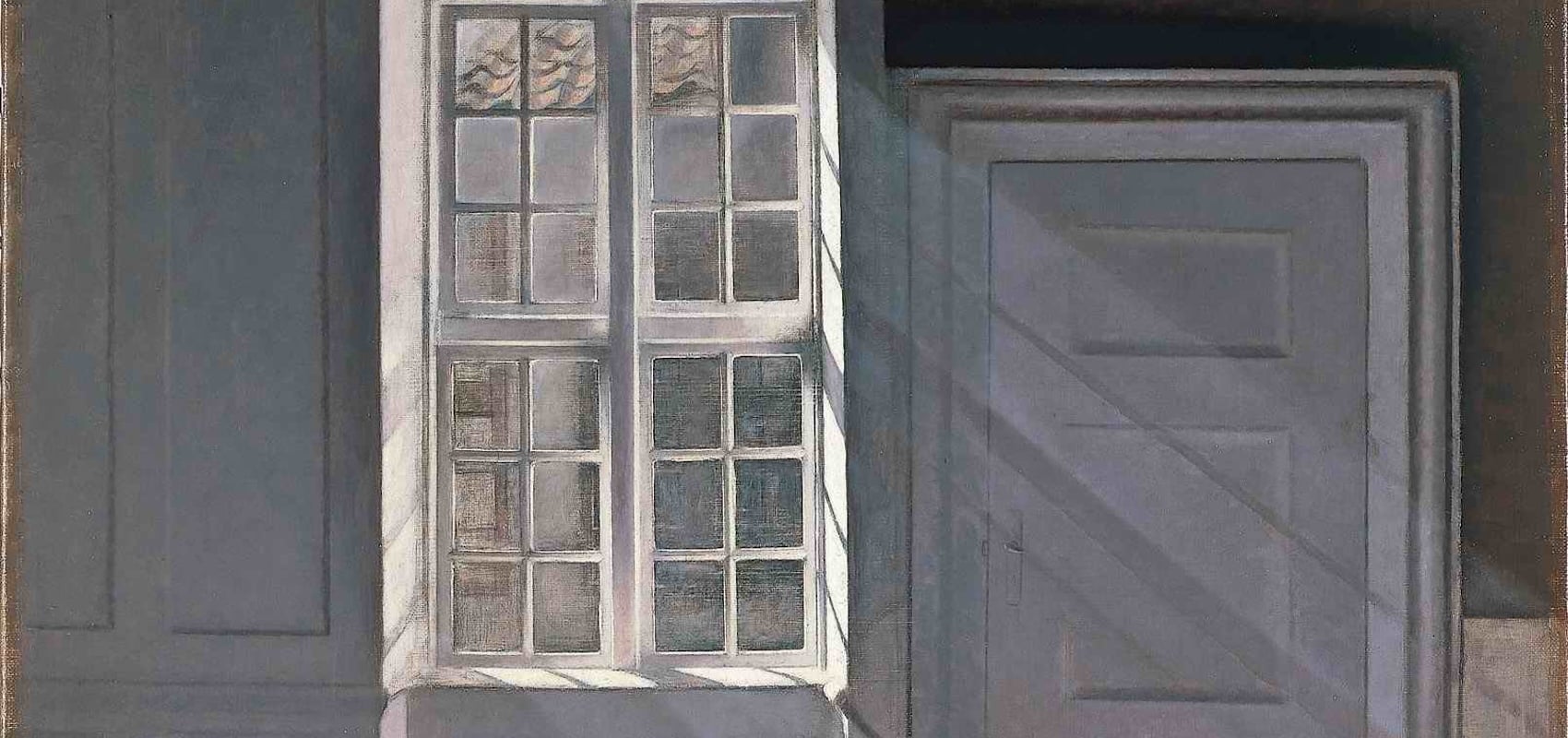
The music of Estonian composer Arvo Pärt has been described as spiritual, transcendent, Eastern, angelic, ethereal, mystical, ascetic, tranquil, otherworldly. Jeremy Begbie adds “escapist” to the modifiers, criticizing Pärt for constructing a “cool sonic cathedral” while ignoring the ragged plane of history that includes the Incarnation and the Cross. Many celebrate Pärt for much the same reason.
As Peter C. Bouteneff argues in his Arvo Pärt: Out of Silence, these portrayals describe, at best, only one facet of Pärt’s deceptively simple music. Start with the notion that Pärt’s music is “Eastern,” as in “Eastern Orthodox.” The composer is himself Orthodox, but his music is, on his own account, more indebted to Western music than anything distinctively Orthodox. In a 2014 interview, he commended the “rich” liturgical life of Orthodoxy, but added, “my musical education was formed mostly on the basis of Roman Catholic church music.” In “Credo” (1968), a wild piece of musical bricolage and the last of his serial compositions, snatches of Bach’s “Prelude in C Major” periodically break through twelve-tone instrumental passages and feroce choral cacophony. As he emerged from a period of relative silence, Pärt renounced the “sterile democracy of serialism” and rejuvenated his soul by listening to Josquin, Dufay, Palestrina, and Gregorian chant. Pärt perches between East and West, as befits a man of Lutheran-Orthodox parentage.
Listeners who stress Pärt’s mysticism appear to believe the old adage that music picks up where words fail. To be sure, silence is essential to his art. Silence provides the “fertile soil” into which a composer plants the “seed” of his creative act. “The most sensitive musical instrument is the human soul,” he said in a 2014 commencement address at St. Vladimir’s Seminary. “One must purify the soul until it begins to sound.” To create, the artist must free himself of outer distractions, but must also cultivate a silence of soul, “more crucial but more difficult to achieve.”
For all his attention to silence, Pärt’s work is infused with John 1:1: “In the beginning was the Word.” “Without the word,” he has said, “nothing would exist.” That Johannine declaration “should not only be conveyed in the text, but in every note of the music as well, in every thought, in every stone.” For Pärt, the “roots of our skill” lie buried in the priority of the word. Sound is a composer’s language but “sound should also speak of what the Word determines.” Silence isn’t permanent but preparatory: “Before one says something,” Pärt has observed, “perhaps it is better to say nothing.” Silence resembles the “‘nothing’ from which God created the world,” but the nothing exists in order to yield to something.
John 1:1 isn’t merely a passive backdrop to Pärt’s music. It’s his method of composition. When creating music to accompany a text, he follows “syllabic” rules, defined by Bouteneff as attention to a text’s syllables, stresses, and punctuation, which “dictate the shape and rhythm of the melody.” In composing Kanon Pokajanen, Pärt says, “I wanted the word to be able to find its own sound, to draw its own melodic line.” The “Orthodox” quality of the music arises from the language, not from any deliberate attempt to mimic Slavonic chant. Pärt realized “how much the choice of language predetermines the character of a work,” such that the “entire structure of the musical composition is subject to the text and its laws.”
Composing a setting for St. Silouan’s Adam’s Lament, Pärt tried to “remain as close as possible to Silouan’s words and, as far as I could, to entrust myself with them, to internalize them.” In his Passio, he followed the phrasing and arc of sentences to determine the length of each note—long notes for words at the end of a sentence, medium-length tones before a comma or at the beginning of a sentence, short notes everywhere else. The length of notes changes as speakers change, with Christ’s words having the longest duration, being the weightiest words in the text. “The words write my music,” which means the music consists of “translations of the text.” Pärt doesn’t adorn words, but renders them freshly in a new, musical language. Listeners say they learn nothing essentially new when they discover a text behind an instrumental composition, a sign that the music successfully transposed the text into sound.
All this goes some way to parrying Begbie’s complaint: A music so dedicated to the Word as creation’s arche can hardly avoid engagement with time. But the best response may be the experience of listeners. Again and again, they speak of the “consolation” they receive from Pärt—from the juxtaposition of a steady, repetitive piano triad with an aching violin melody in Spiegel im Spiegel, or from the bell-like tones in Für Alina, or from the dissonant scream of the violin in Fratres, calmed, anchored, harmonized by deep and dependable piano chords. There’s no escapism, no flight from suffering, but resolute hope in the midst of pain, befitting a composer convinced that beyond and behind all is neither silence nor chaos but the Word.
Dear Reader,
Can I be direct with you?
War abroad. Socialists on the rise. AI upending human life. Endless uproar online. The modern attention economy doesn’t want readers — it wants users enslaved to the tyranny of the present.
First Things is the antidote: literary excellence, timeless truths, and a fixed point of reference in a culture that has lost its bearings.
But we can’t do it without readers like you.
Our goal: Raise $150,000 by November 1 to sustain First Things in the year ahead.
Your gift anchors readers in the permanent things.
Make your Fall Campaign gift now using the button below.
If you have any questions or would like more information, please contact Giovanni Del Piero, Director of the Editor’s Circle, at gdelpiero@firstthings.com or 212-627-1985.


YOU MIGHT ALSO LIKE
A Culture of Parricide
I learned a new word the other day: déploration. It’s the French, directly from the Latin, for “lament.”…
The Chariot Burials
Wheeling through the clotted earth, / Bronze, bone, and leather clumped in clay...
William of St. Thierry
“Where love and understanding join, hearts are tranquil, / They rise above the turmoil of this world…
