
In his June 2 Wall Street Journal column, Jason L. Riley noted a disturbing trend in our American moment: “According to the Department of Labor, 1 in 3 men were neither working nor looking for a job in April.” That sad state of affairs is multicausal, to be sure. The hard fact, though, as Jason Riley argued and Nicholas Eberstadt demonstrated in his book Men Without Work, is that “the long-term rise in male joblessness doesn’t stem from an inability to find employment. It results instead from an unwillingness to search for work.”
And that bespeaks spiritual distress. For as Pope St. John Paul II, himself a veteran of manual labor under awful conditions, explained in his 1981 encyclical Laborem Exercens (On Human Work), through our work we don’t just make more or earn more; we become more. Work is our participation in God’s ongoing creation of the world, and mastering work’s hardships is our participation in Christ’s ongoing redemption of humanity. Men without work—even worse, men refusing to seek work—are spiritually malnourished.
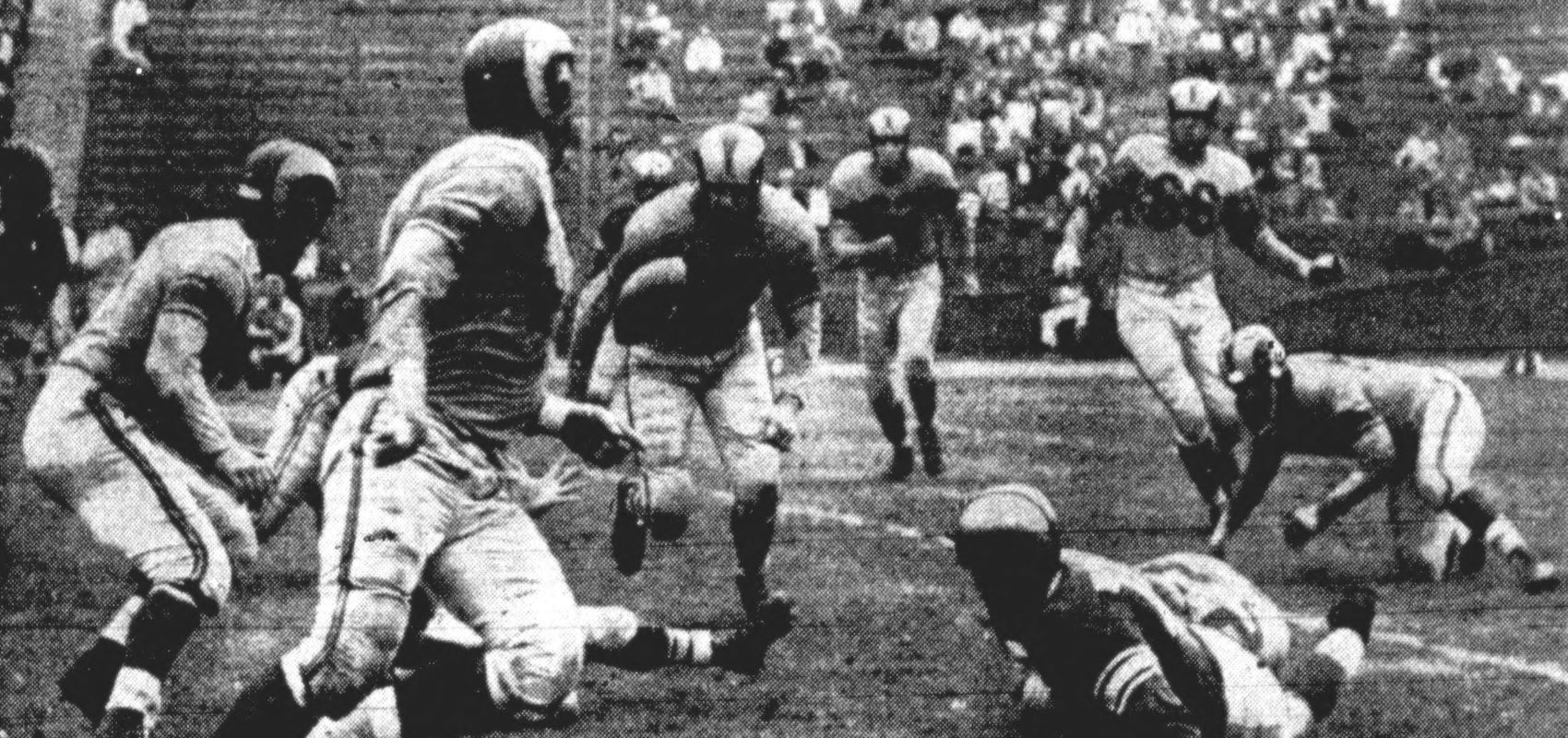
Which brings us to the embodiment of the work ethic: Baltimore (not Indianapolis) Colts split end Raymond Berry, who died on May 25 at age ninety-three.
A twentieth-round draft choice, Berry should never have made it in the National Football League, much less the Pro Football Hall of Fame after setting a record for career pass receptions. He was extremely myopic and, while nimble, would never be confused with today’s hypersonic burners. One of his legs was shorter than the other, and he wore a back brace to minimize chronic pain. What made Raymond Berry great—what made him, with quarterback John Unitas, the men who changed the way America spends Sunday afternoons, thanks to their heroics in the 1958 “Sudden Death” NFL championship—was a fierce work ethic. So in his own way, Berry embodied what John Paul II taught in Laborem Exercens: Through our work, we become more the person we were created to be.
Berry and Unitas practiced pass routes and sideline catches for hours after team practices were over. To watch Berry stop a pass pattern at the brink of the sideline and then, with body outstretched parallel to the ground, catch a perfectly aimed Unitas pass was to watch football as ballet. Raymond Berry was also a student of his craft. On December 27, 1958, the day before that epic championship tussle with the New York Giants, Berry walked over every inch of the frozen Yankee Stadium gridiron, strategically surveying soft spots so that he could tactically adjust his routes the next day. That kind of intense preparation for work resulted in what is certainly an unbreakable record: one fumble in thirteen NFL seasons. (Berry insisted the referee called the play incorrectly.)
A gentleman who would no more spike a football in the end zone than swear, drink, or smoke, he was hardest on himself in measuring his efforts. Berry once made a study of the so-called “hundred percent effort.” As he later put it, “people who say they’re giving a hundred percent—they usually say ‘a hundred and ten percent’—don’t know what they’re talking about. They don’t realize how difficult it is to overcome human weakness. Even while doing dramatic things, your concentration can stray. I used to pore over the game films . . . [and] graded myself on each play as ruthlessly as I could.”
The highest grade he ever gave himself was eighty-seven.
Raymond Berry was also a thoroughly decent human being whose conversion story speaks volumes about the man. Sitting by himself immediately after the Colts won the 1958 championship in overtime, thanks to a miraculous comeback he and Unitas had engineered in the game’s last minute and a half, Berry said he became “totally aware that what just happened was the work of God . . . that was a revelation—and I didn’t know how to say thank you.” Shortly afterward, he became a devout evangelical and a leader in the Fellowship of Christian Athletes.
Speaking at John Unitas’s funeral Mass in 2002, Berry bore eloquent witness to “the truth of Scripture—to be absent with the body is to be present with the Lord.” From his current station in the Communion of Saints, I hope Raymond Berry is interceding for all those men without work—men who are being denied, or who are denying themselves, the chance to become more, to be more, through honest labor. And I hope those men learn something about the beauty of the work ethic from the example of the unforgettable #82.
George Weigel’s column “The Catholic Difference” is syndicated by the Denver Catholic, the official publication of the Archdiocese of Denver.
Dear Reader,
Can I be direct with you?
War abroad. Socialists on the rise. AI upending human life. Endless uproar online. The modern attention economy doesn’t want readers — it wants users enslaved to the tyranny of the present.
First Things is the antidote: literary excellence, timeless truths, and a fixed point of reference in a culture that has lost its bearings.
But we can’t do it without readers like you.
Our goal: Raise $150,000 by November 1 to sustain First Things in the year ahead.
Your gift anchors readers in the permanent things.
Make your Fall Campaign gift now using the button below.
If you have any questions or would like more information, please contact Giovanni Del Piero, Director of the Editor’s Circle, at gdelpiero@firstthings.com or 212-627-1985.


YOU MIGHT ALSO LIKE
Foucault’s Idol of Nothingness
Today marks the 100th anniversary of the birth of Michel Foucault. He was influential in his lifetime,…
Forget Odysseus. Aeneas Is the True American Hero.
Who is our Odysseus? Or more precisely, who is the most Odyssean hero of American film? Matt…
The Last Statesmen?
In the latest installment of the ongoing interview series with contributing editor Mark Bauerlein, Steven B. Smith…
