
The Elizabethan commonplace comparing creative production to pregnancy and birth is baked into the English language. We “conceive” an idea, though some prove “abortive.” A new project or business venture is a “brainchild,” the “issue” of a “fertile” mind, but before we announce it publicly, it needs a period of “gestation.” In early stages, it’s all “embryonic,” and can be “delivered” only through painful “labor.”
Poets squeezed out everything they could from the analogy. George Turberville modestly offered his sonnets as “the unripe seeds of my barraine Braine,” and Edmund Spenser sent his anonymous Shepheardes Calendar into the world as an orphan “child whose parent is unkent.” Thomas Dekker distinguished the begetting of children from the begetting of books: “Bookes speake so soone as they come into the world, and give the best wordes they can to al men.” Shakespeare’s characters are quite taken with the metaphor. Iago’s diabolical “Muse labours / And thus she is delivered.” Mercutio is “the most fertile of storytellers” and tells Romeo, “I talk of dreams / Which are the children of an idle brain.” The dispute between Titania and Oberon yields a “progeny of evils,” and at the end of A Midsummer Night’s Dream Theseus famously declares that poet, lover, and lunatic display an imagination that “bodies forth / the forms of things unknown.” One scholar describes this as the “male motherhood” theory of authorship, and it persists into the nineteenth (Balzac) and twentieth (T. S. Eliot, C. S. Lewis) centuries.
Earlier writers give it a theological gloss. In his 1586 Treatise of Melancholy, Timothy Bright writes of the Spirit hatching and breeding living things out of the chaos. Philip Sidney claims the poet, inspired by “divine breath,” grows “in effect into another nature: in making things either better than nature bringeth forth, or quite anew, forms such as never were in nature.”
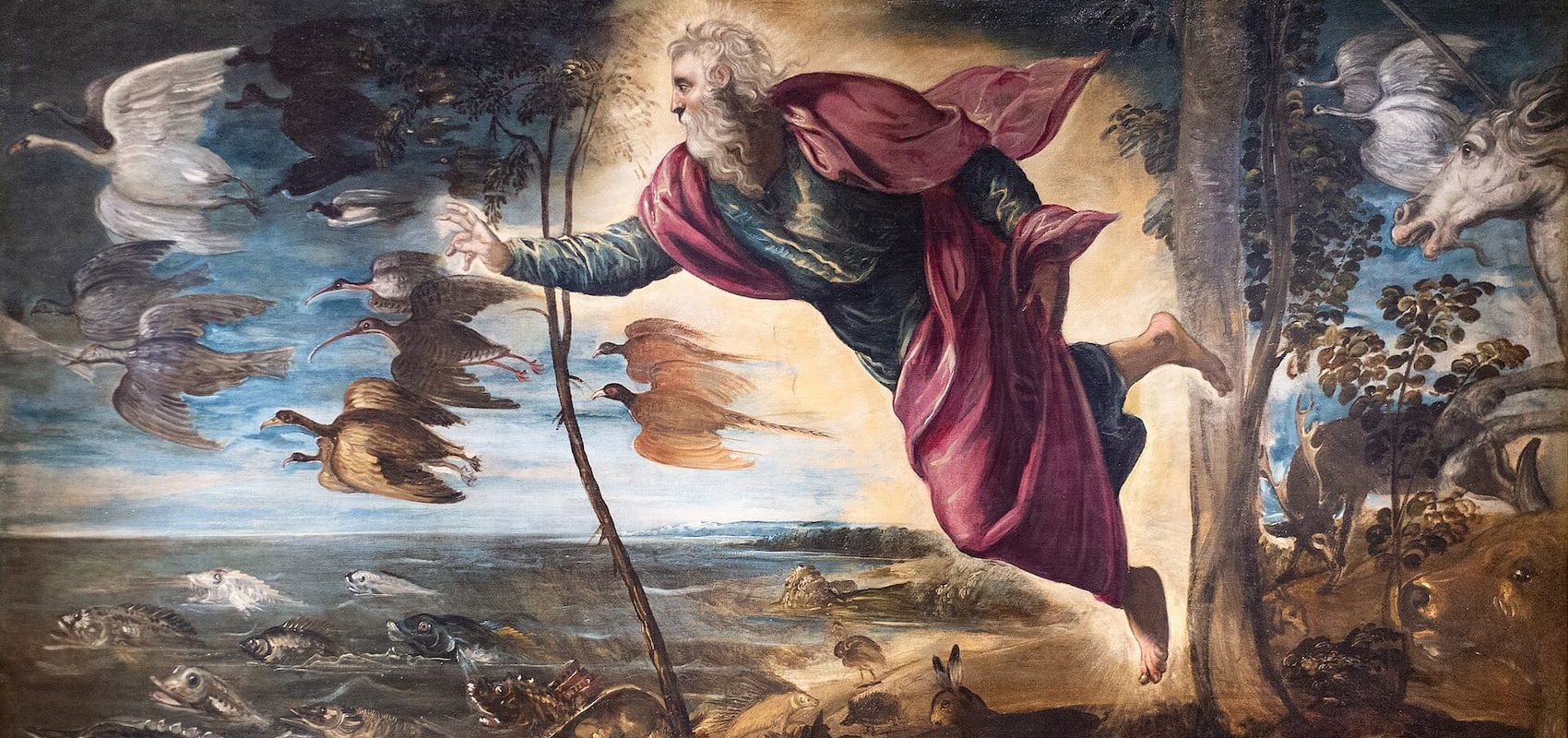
They have biblical precedent. “Before the mountains were born,” Psalm 90 begins, “you writhed in labor [chul] with the earth and the world.” In Isaiah 42, Yahweh shouts a war cry and also gasps and pants like a laboring mother. The juxtaposition isn’t as far-fetched as it may seem. Warrior and mother are both in danger, both encompassed—the woman by her own labor pains, the warrior by enemies. Warriors sometimes bleed, mothers always do. For all her vulnerability, a laboring woman may experience euphoric triumph as she groans or shrieks a new human into the world. Gloria Steinem probably wasn’t thinking of Isaiah, but she captured the sense: “Childbirth is more admirable than conquest, more amazing than self-defense, and as courageous as either one.” Unlike idols, Yahweh demolishes “former things” so he can give birth to “new things,” and his labor repeats the first fiat of creation, shining light from darkness (Isa. 42:16). He births new things by his breath and voice, as the Spirit and Word once formed the shapeless emptiness into the ordered cosmos. The Creator’s labor is labor, and, because we’re made in his image and likeness, so is ours.
How does this illumine human work? As the Elizabethans knew, all work begins with conception—a scholarly insight, an artistic or entrepreneurial inspiration. Here there are no virgin conceptions. Fruitful labor begins in grateful receptivity, a receptivity choked off by pride and haughty isolation. Once conceived, a conception grows in secret. Deep creativity needs time to gestate. Premature babies often die, and our impatience may result in stillbirth. We bring our conceptions to birth in anguish, uncertainty, fear. There’s a cross at the center of all productive work. Once labor starts, there’s no reversing it; you have to persevere until you hear the cry of new life.
The French philosopher and feminist Luce Irigaray points out that all human life begins with exile from our cozy first home. From the time he takes his first breath to the moment of his last, a newborn is on his own, an independent human being. Birth anticipates all life’s later departures, from home, from singlehood, from the land of the living. Our products and projects are likewise prodigals, wandering away as if they have a life of their own, beyond our capacity to manage. They have to learn to breathe on their own. Trying to manage or control them only leads to tyranny or jaded frustration. Raise your “babies” to leave home, because they will and so, eventually, will you. As Hannah Arendt observed, human birth is unlike animal birth. Each new animal is merely a new instance of a species, but each new human is an unprecedented, unrepeatable person. What Arendt called “natality” gives human beings our distinctive character, our capacity for new beginning. Every newborn alters the entire web of human plurality. All our “babies” enter the world with the same transformative potency and express our uniquely natal power.
“All labor is labor” isn’t a strained poetic conceit. Like all great metaphors, it illumines, and perhaps shapes, what it names.


YOU MIGHT ALSO LIKE
SlutCon’s Emotional Void
The tech-rationalist phenomenon “SlutCon” caused quite a stir online, perhaps predictably. SlutCon was a multi-day retreat and…
The Boys on the Brink
In the latest installment of the ongoing interview series with contributing editor Mark Bauerlein, Leonard Sax joins…
Serial Liar, Serial Comma
How would you write a public letter that you know will become front-page news? Would you write…
