
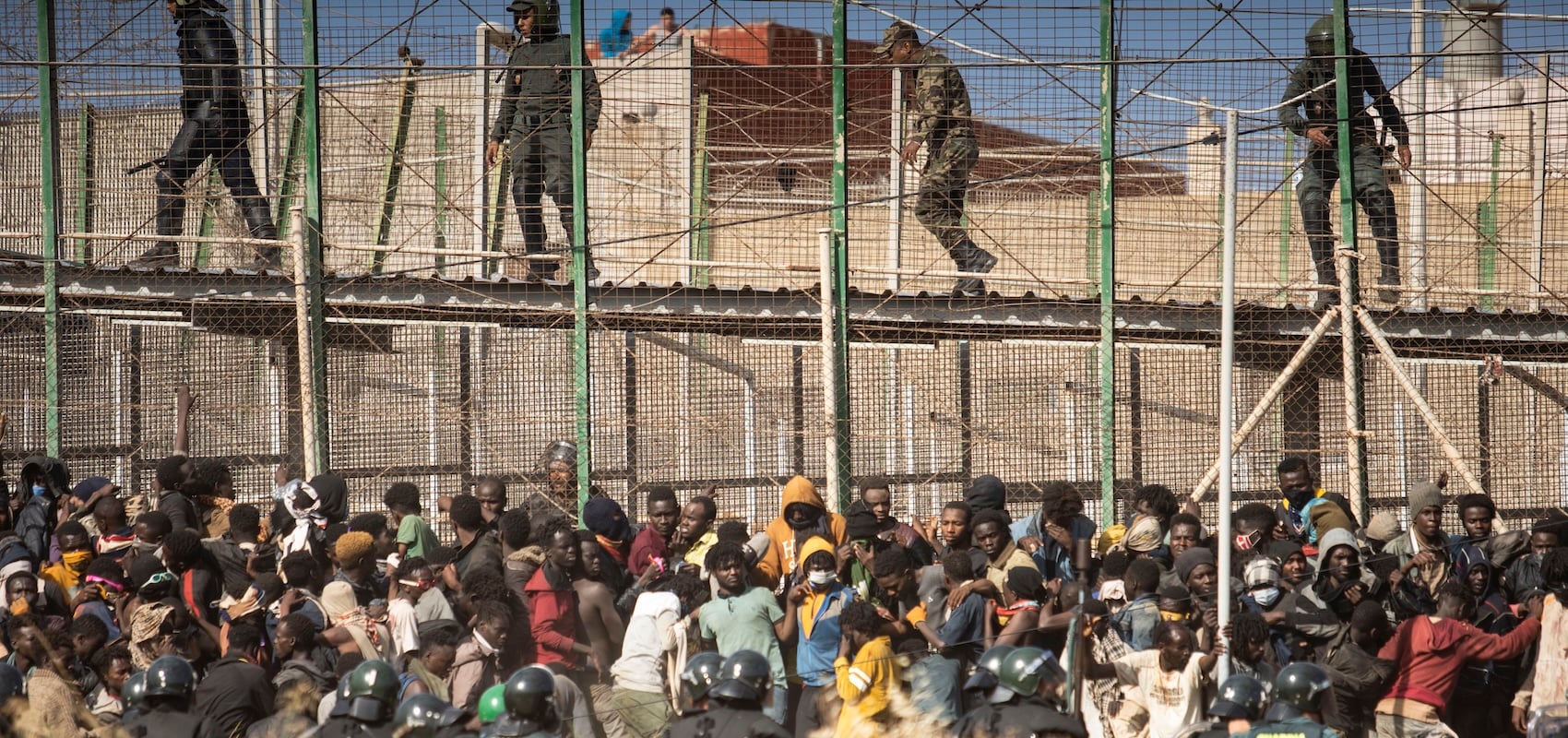
Last week, some 70,000 African migrants invaded Ceuta. A coastal town of 84,000 people, Ceuta is the last remnant of Spanish presence in North Africa, along with the town of Melilla further down the Moroccan coast and several other islands. Still, it’s ancient Iberian land. The Portuguese took control of Ceuta in 1415. A few decades later, it became de facto Spanish, and in 1668, the Portuguese formally ceded it to Spain, which has controlled the area ever since. Hence the seriousness of last week’s crisis.
The migrants were overwhelmingly young men. They stormed into Ceuta by land and sea, overwhelming security barriers and marching through the town, stealing and looting. It’s exactly the kind of scene that Jean Raspail imagined in his 1973 dystopian novel The Camp of the Saints, cementing that once-marginalized and sometimes-banned novel into the mainstream of public discourse. But the novel’s relevance does not come from narratives of migrant delinquency. It comes from anticipating the West’s abdication of responsibility.
In Ceuta, the migrants came as raiders, not conquerors. After a few days, hungry and driven out of the supermarkets, many returned to Morocco. Spanish law enforcement is now arresting and deporting the remainder, though thousands are still in the hills. Because most have left, the Spanish government of Pedro Sánchez can breathe a sigh of relief. Threats from other countries to suspend the Schengen Agreement with Spain have dissipated into familiar calls for more European solidarity to handle migrant influx. The war of words against Morocco for allegedly stoking the crisis has subsided. For Spain’s interior minister Fernando Grande-Marlaska, “there doesn’t necessarily have to be anyone to blame.”
That’s an extraordinary statement. Sánchez has enticed migrants to come, presenting himself as the global champion of pro-migrant progressivism. Earlier this year, his government approved a plan to grant amnesty and social benefits to 500,000 illegals. Spain spends over €1.8 billion per annum on support for migrants and only €60 million on stopping illegal entry. It funds pro-migrant, progressive NGOs in Morocco. In Spain, Sánchez has boosted funding for hosting unaccompanied minors. And in July, when the Spanish Supreme Court made it more difficult to expel migrants caught trying to swim into Ceuta and Melilla, the Interior Ministry ignored intelligence warnings about the impending swarm.
Grande-Marlaska’s evasions of responsibility find a ready parallel in Raspail’s novel. The Camp of the Saints recounts a million migrants setting out in a rickety flotilla from the Indian subcontinent to France. The governments of the migrants’ countries of origin “disclaim any and all responsibility” for whatever happens. The French government, moved by humanitarian principles, proposes to roll out the welcoming committee for the migrants. But balking at the cost, the government invites other countries “to share responsibility for the burden of generosity,” maybe even placing the fleet under U.N. protection. Other countries aren’t eager to participate. Leaders avoid confronting the hard choice of turning the migrants away, hoping that more food, aid, or storms will stop or sink the rickety fleet and save them from making a difficult decision. That doesn’t happen.
With the imminent arrival of the fleet on French shores, the president of France must finally act. “I have ordered our national army to use force to resist their landing, for I clearly state, cowardice in the face of weakness is one of the most potent, most subtle, and most deadly forms of cowardice,” he declares in a national address. But then he falters, abandoning his script: “Killing is difficult.” And so he releases “every soldier, every police officer, every gendarme, every officer” from his duties. Each can decide for himself what to do. That formula is the ultimate abdication of political responsibility. Authority has negated itself. “With the France of the Enlightenment brought to her knees of her own accord,” writes Raspail, no other Western government “will now dare take responsibility in its own name.” And so with that act, before the migrants have yet landed, France and a whole civilization have committed suicide.
The reason mass migration into Europe has become a political crisis since 2015 is blindingly obvious. Europe’s elites provide generous asylum provisions that make entry simple and deportation difficult. Lawful and unlawful entrants alike enjoy an individual juridical procedure; while the migrants wait, they enjoy legal, welfare, and NGO support at taxpayer expense. But Europe’s elites believe that system is necessary to purify themselves from the stain of the Second World War. It incentivizes more migrants to risk the journey.
It’s also more novel than it appears. In the early 1990s, during the breakdown of Yugoslavia, a newly reunified Germany was overwhelmed with migrants. Its postwar constitution invited that. Article 16 of the Basic Law of 1949 promised generous asylum provisions so that the Federal Republic of Germany could serve as a refuge from totalitarian countries—namely, those behind the Iron Curtain. Millions of Yugoslavians made the trek through other countries to reach that promise of German asylum. Germany recognized that with the collapse of the Iron Curtain, the world was changing and Article 16 invited a humanitarian crisis. It swiftly changed its constitution to restrict asylum applications.
Decades later, such an adaptation to circumstances would be unthinkable. The thirty-two-year-old European Union imagines itself in continuity with the postwar era. But it has subtly changed the laws to match moral mythmaking. Aspirational migration for a better economic life blurs with legitimate refugee and asylum claims. Europe has the same humanitarian obligations to accept them all, because otherwise Europe would be creating another Auschwitz. Call it the ideology of postwar-ism.
Postwar-ism thrives for two reasons. First, the open-ended humanitarian obligations and moralism of “never again” hide recent legal changes. It’s customary to hear that because Spain is a First World, “developed” country, minors can’t be deported back to Morocco. The Spanish state must pay for them; the alternative would be morally reprehensible. Never mind the dubious premises that minors can’t be returned to relatives in their country of origin or that their country of origin can’t meet their needs. In 2000, Spain passed a law regulating, not banning, the return of unaccompanied minors. The law provided a pathway to negotiate bilateral return agreements. In 2007, Spain and Morocco signed such an agreement. But in 2024, the Spanish Supreme Court overruled that. Now, Morocco wants its minors back but has no legal recourse to ask for them; Spain keeps them and raises them at taxpayer expense. The Sánchez government encourages more of this. Earlier this week, it promised an additional €25 million to Ceuta to support, lodge, and educate the 862 unaccompanied minors—young men—currently counted. There’s also a whole legal apparatus standing ready to help them resettle throughout Spain, regularizing their status and becoming citizens. Those young men are here to stay. Their relatives will follow.
Second, postwar-ism thrives because it deflects responsibility for fulfilling humanitarian obligations onto other countries and institutions that aren’t bound by the laws the E.U.’s elites are so proud of. The migrant crisis of 2015 came to an end when Europe began paying the Turks to keep migrants there. NATO provides another deflection. Since 2016, vessels of European countries have been patrolling the Aegean Sea under NATO supervision, because E.U. law concerning asylum claims and deportations does not operate in the same way for vessels under NATO flags. This has enabled expeditious identification and clearing of migrant boats from the Aegean (where the Turks, members of NATO but not the E.U., can scoop the migrants up, ensuring they never reach E.U. jurisdiction).
The Turks are well rewarded for their efforts. Other, less powerful countries have different bargaining strategies. Morocco weaponized migration in 2021, sending a few thousand into Ceuta, to get the Spanish to take the Moroccan side in the old territorial dispute over the Western Sahara. It worked. The E.U. now provides Morocco with millions of euros to help with border control. The Moroccan government says the grants are too small, and it has a point. Black African migrants are not making the journey through the Sahara because they want a sojourn in Casablanca; they are doing it because they are awaiting the right opportunity to take advantage of the E.U. and Spain’s lax legal environment. While they wait, they become Morocco’s headache.
And when the right opportunity to enter the E.U. appears, migrants easily mobilize. If there’s one thing that forces the ideologues of postwar-ism to reckon with the consequences of their creed, it’s the digital revolution. An ambiguous judicial decision or speech instantly spreads on social media, stoking rumors among millions that instant entry into Europe is possible. Activists and people smugglers help coordinate movement, mobilization, and entry strategies. Automated accounts spring up, which spread messages that the frontiers are open.
Spanish and European lawmakers bear responsibility for encouraging the whole cycle. The inability to face up to the incentives bad law creates means that European states and the E.U. must pay other countries to hold Europe’s migrant problems at bay. That gives those border states—or factions within them—immense leverage.
In last week’s crisis, the Moroccan government may have stood aside in the initial migrant mobilization. Yet there are reports that they warned the Spanish government to expect a surge. And they have cooperated to remove the migrants without any geopolitical bargaining. This suggests that while the affair was not a premeditated strategy of disruption, it may have been exploited by a faction within the state. Zineb Riboua argues that it is part of an Islamist campaign to weaken the legitimacy of Morocco’s monarchy, timed for next month’s elections.
The unwillingness to enforce border control, deter entry, and narrow the channels for asylum claims in the new technological environment creates vulnerabilities that Europe’s adversaries exploit. But instead of confronting the weakness of border control, Brussels has an answer: blame disinformation. This is another way to evade responsibility, insinuating that Russian or American actors are spreading lies.
So as Brussels hesitates to enforce border control, it plans to extend its model of information control beyond its frontiers. Thierry Breton—the mastermind of the Digital Services Act, whose proposals to censor U.S. companies brought the sanction of the Trump administration—has proposed that if Morocco wants to keep receiving E.U. assistance in border control, it would need to accept the dominion of the DSA. Making grants conditional is a familiar strategy to grow the E.U. information empire.
It’s typical to read materialist explanations of the migrant crisis. Europe needs cheap labor. It needs new taxpayers to buttress ailing welfare states. Other explanations blame poor economic conditions in the Third World. These solutions cast the migrant crisis as a technical problem in search of technocratic solutions. Impersonal bureaucracies must throw more money around and pledge more for foreign aid abroad; at home, they either need to cut social benefits or innovate. More growth will make all these problems go away. The United States has a similar discourse. None of these material explanations grasp the post-2015 realities of mass migration. The Camp of the Saints helps us see that at the root of the crisis is not a material question but a spiritual sickness. While Europe’s elites congratulate themselves on their pursuit of moral purity, the burden and cost for that worldview is shuffled off onto others. And the laws that could defend the real needs of Europe’s cities and communities go unpassed.
In the meantime, the migrants keep coming. “They’ve closed everything down so that we can’t buy anything to eat, to force us to return to our country,” said one migrant in Ceuta, twenty-three-year-old Mohamed Hatri. “But even if they close it down . . . we’re round to stay here, whether we’re hungry or not.” Between his resolution and European abdication lies our post-Western future.
Image by Javier Bernardo via AP.

YOU MIGHT ALSO LIKE
SlutCon’s Emotional Void
The tech-rationalist phenomenon “SlutCon” caused quite a stir online, perhaps predictably. SlutCon was a multi-day retreat and…
The Boys on the Brink
In the latest installment of the ongoing interview series with contributing editor Mark Bauerlein, Leonard Sax joins…
Roger Scruton’s Eternal Youth
In this episode, First Things senior editor Dan Hitchens joins R. R. Reno on The Editor’s Desk…
