
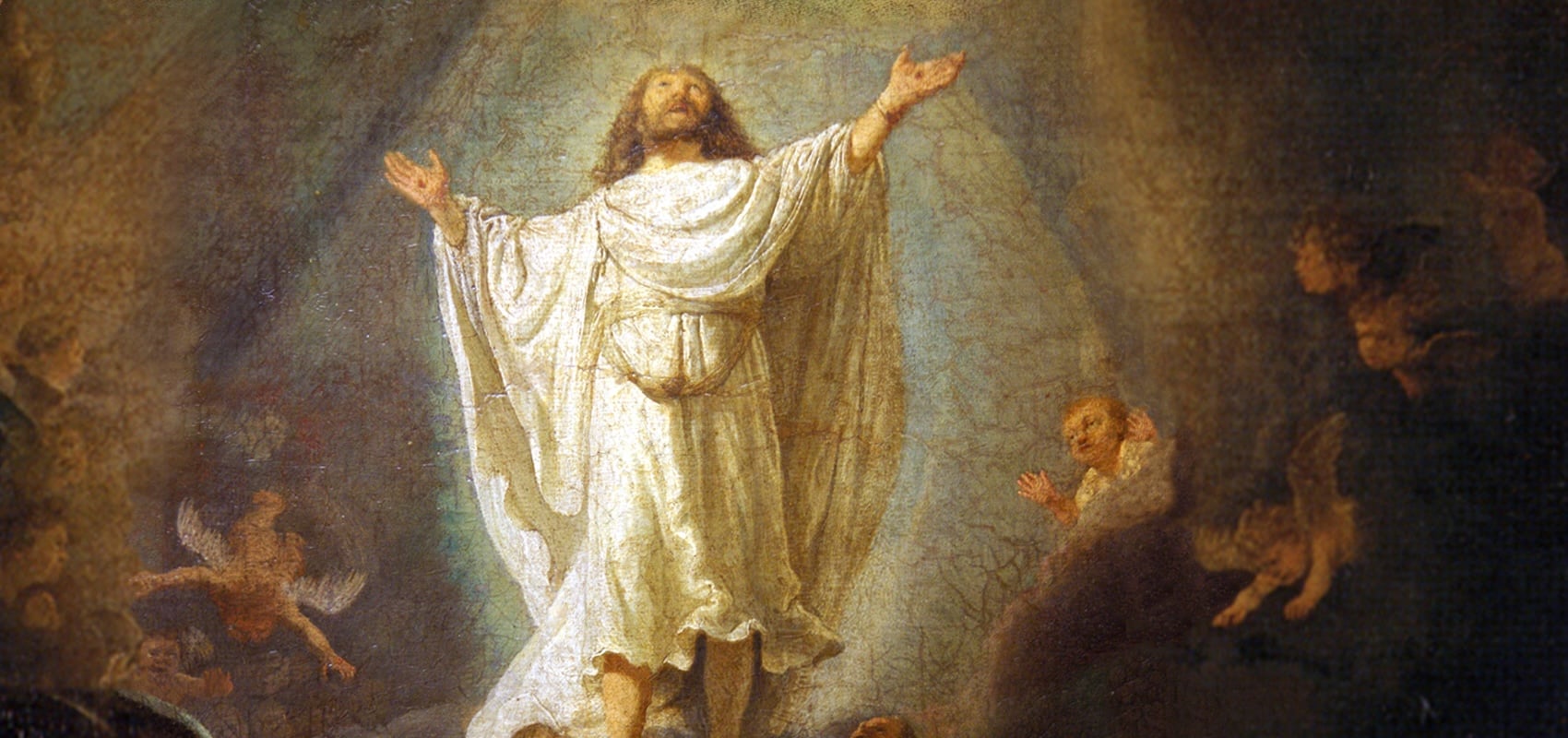
Ascension Day, celebrated by the Western Church on May 14 this year, is the neglected stepchild of the Christian year. Advent has its calendars and its wreaths; Christmas its carols and ivy, its trees and gift exchange; Epiphany its king cakes and magi; Lent its fasts, sobriety, and silence; Palm Sunday its processions with palms; Holy Saturday its vigils and bonfires; Easter its lilies and its fresh clothes. On Pentecost, many dress in Spirit-fire red. Whatever traditions once attended Ascension Day have been abandoned by many churches. This festival often passes without a word, much less a worship service.
That’s a theological tragedy, for without Jesus’s ascension the biblical story lacks closure. Christopher Wordsworth, nephew of the Romantic poet, captured the breadth of Ascension Day in his hymn, “See the Conqueror Mounts in Triumph.” For Wordsworth, the Ascension is King Jesus’s procession into his heavenly palace and accession to his heavenly throne, after he has by death “vanquished sin and Satan” and “spoiled his foes.” Ascending through the thundering “hallelujahs” of myriads of angels, Jesus is Aaron raising his hands in blessing and entering the heavenly sanctuary, Enoch translated to “his everlasting home,” Joshua entering Canaan, Elijah riding his fiery chariot, the Last Adam who raises “our human nature on the clouds to God’s right hand.”
Worse, neglect of the Ascension distorts the gospel itself. As Joshua Jipp points out in Christ Is King: Paul’s Royal Ideology, Paul’s message is good news about Jesus, who is son of David by flesh and proclaimed Son of God by resurrection (Rom. 1:1–4). The gospel is a royal announcement of the King’s resurrection and ascent to his throne.
Jipp shows that the New Testament is royal theology from start to finish, revealing Jesus as the ideal king. As perfect king, Jesus’s reign is “totalizing,” that is, “its supremacy, power, benefactions, and justice brook no rivals.” The relation between Christ and earthly rulers isn’t simply antithetical, Christ versus Caesar. To set Jesus in opposition to human rulers suggests Jesus’s authority is bounded, as if he reigns only where others don’t. On the contrary: Jesus reigns even where others do, encompassing all authority in heaven and earth and incorporating it into his reign.
In the Old Testament, the king is portrayed as a lover of Torah (Deut. 17; Ps. 1–2). Jesus goes one better: He’s the “living Torah,” and so transforms the law of Moses into the “law of Christ” (Gal. 6:2). He fulfills Torah by obeying it perfectly. His self-sacrifice is the supreme act of neighbor-love, and his presence by his Spirit empowers us to follow his example of Torah-keeping. United to the living Torah, the body fulfills the just requirement of the law (Rom. 8:1–4).
A gospel of kingship is a gospel of justice. Paul uses dik– (“just-”) terms sixty-three times in Romans, and introduces God’s dikaiosune (righteousness, justice) in the theme verses of the letter (1:16–17). Romans is an epistle about the King’s multi-dimensional justice. God acts justly in punishing evil. The wrath Paul warns about in Romans 1–2 is a royal action, the risen King’s judgment against injustice. All humanity stands accused in his court, Jews and Gentiles alike “under sin” (Rom. 3:9–18), with the righteous King Jesus the only exception. But Jesus’s exaltation is the primary unveiling of God’s justice. Humanity condemned itself in condemning Jesus and cannot be saved unless the injustice of the cross is overturned, unless the Anointed One is acknowledged as King. To save us, God must do justice by raising and enthroning the executed King, who then enforces his Father’s justice from his throne at his right hand.
Paul serves as herald of this royal gospel to “bring about the obedience of faith [eis hypakoen pisteos] among all the nations [ethne]” (Rom. 1:5). The verb hypakouo, the root of the word for “obedience,” contains akouo, the command that begins Israel’s declaration of faith in the one God: “Hear, O Israel [akoue Israel]” (Deut. 6:4, LXX). Which is to say, Paul preaches to fulfill Yahweh’s promise to Abraham by opening Gentile ears, which in turn will open Gentile mouths to confess Israel’s God as God. As Jipp summarizes it, the substance of God’s justice is the “resurrection of his royal son from the dead and the enthronement of this son to a position of powerful lordship over the nations.”
Without the Ascension, we risk shrinking the gospel to a private message of eternal life, which may or may not have public import. When Ascension Day is given its proper due, the gospel shines as public truth, a fundamentally political message of the royal Conqueror that has decisive import for both nations and individuals.
Dear Reader,
Can I be direct with you?
War abroad. Socialists on the rise. AI upending human life. Endless uproar online. The modern attention economy doesn’t want readers — it wants users enslaved to the tyranny of the present.
First Things is the antidote: literary excellence, timeless truths, and a fixed point of reference in a culture that has lost its bearings.
But we can’t do it without readers like you.
Our goal: Raise $150,000 by November 1 to sustain First Things in the year ahead.
Your gift anchors readers in the permanent things.
Make your Fall Campaign gift now using the button below.
If you have any questions or would like more information, please contact Giovanni Del Piero, Director of the Editor’s Circle, at gdelpiero@firstthings.com or 212-627-1985.


YOU MIGHT ALSO LIKE
Why the Death Penalty Is a Sore Point for Papal Authority
Pope Leo XIV marked World Day Against the Death Penalty, observed on October 10, with the following…
Candace Owens and the Sin of Anti-Semitism
According to the online Encyclopedia Britannica, Sir Moses Montefiore (1784–1885) was “an Italian-born businessman who was noted…
The Myth of St. Francis
At the beginning of his 2020 encyclical, Fratelli Tutti, Pope Francis speaks of “an episode in the…
