
The measure of Magnifica Humanitas cannot be taken today, so soon after its release. We won’t know for many years what sort of legacy it might have. But if it does have a legacy, it just may be the salvaging of the Church’s “social doctrine.”
“Salvaging” is a strong word, but even one of Catholic social teaching’s most thoughtful and sympathetic interpreters describes it as a mess. Russell Hittinger has noted that the mode of the teaching is not systematic, neither obviously doctrinal in its content nor ordered in its presentation. Though the label “Catholic social doctrine” suggests something clear and definitive, it feels haphazard and ad hoc. Hittinger has described its characteristic mode of presentation as “juxtaposition,” lacking the coherence of argument, synthesis, or even narrative.
The Second Vatican Council is vulnerable to a related criticism. The nature of its teaching is hard to pin down. As George Weigel has noted, unlike previous councils, it did not produce its own hermeneutic key, neither a creed, nor a catechism, nor a set of canons. Its documents make statements short of defining doctrines or anathematizing heresies, so they don’t preclude but actually generate arguments—arguments that sometimes seem to constitute the post-conciliar Church. Are modern popes themselves the de facto interpretive key? If so, they risk being received as partisans, or potential partisans, in the disagreements that constitute the modern Church.
Magnifica Humanitas was anticipated as “the AI encyclical.” But it is really an encyclical that uses AI as an occasion to characterize the Church and its role in the world. Just as Rerum Novarum was not only about labor (and capital and socialist ideology) but founded social teaching as a mode of engaging the world, Magnifica Humanitas is not only about AI (and digital technology and transhumanist ideology); it refounds and ratifies social teaching as a primary mode of the Church’s engagement with the world.
The patience of some knowledgeable early readers has been tried by the first two chapters, a history of the Church’s social doctrine and a summary of its central principles. Seventy-three prefatory paragraphs out of 245 can feel superfluous in a world eager for bullet points and bottom lines.
Helping new readers unfamiliar with Catholic social teaching is a good enough reason to include these chapters. But they are not merely introductory, and they are especially valuable for those who think they know Catholic social teaching. The apparent superfluity of chapters 1 and 2 disappears once one realizes that the encyclical is not about AI, but about social doctrine itself, and about how to interpret social doctrine as a teaching distinct from more straightforward instruction on “faith and morals.”
Chapter 1 begins: “I intend to present synthetically how the Social Doctrine of the Church has taken shape in the recent Papal Magisterium and in the Second Vatican Council, in order to demonstrate its dynamic character.” Leo here does more than offer a history of previous social interventions. He offers a “synthetic” account of what the Church does when it offers those interventions: It theorizes social teaching.
The language here emphasizes active engagement; in addition to “dynamic,” key words include “process,” “discernment,” “listening,” and “dialogue.” Those seeking doctrinal firmness have found this unsettling, but neither the Church’s authority to teach, nor the fact that it has something to teach, is in question. What is in question is how the Church teaches: by offering to participate in “shared discernment.” Leo characterizes Catholic social teaching as “a theology of communion in history.”
In this section, and generally in the Augustinian image of two cities, Leo may be offering implicit criticism of more crude, “integralist” views of ecclesial authority. But more explicitly, and in its very structure, Magnifica Humanitas offers itself as a theory of social doctrine and a hermeneutic key to Vatican II. Specifically, it interprets Catholic social teaching as a necessarily active and developing engagement with the world. It finds continuity, rather than rupture, in Vatican II (and by extension, finds continuity in the papacies of John Paul II, Benedict XVI, and Francis) by interpreting the council as part of the history of Catholic social teaching, positioning the Church to play a particular kind of role as a teacher accompanying man in history.
I have elsewhere described Catholic social teaching as “cultural risk management,” helping to address the way historical developments, especially technological, magnify the scale of the consequences of sin. This helps make sense of why Catholic social teaching is concerned with “social structures” and has made the Church comfortable talking about “structures of sin.” It also helps make sense of how Catholic social teaching is often summarized in terms of some very general principles—like “subsidiarity,” typically articulated only when a once taken-for-granted good is made fragile by new economic, political, ideological, or technological circumstances—while the real burden of Catholic social teaching, and its dynamic character, is in the prudential application of those principles.
Most of the commentary on the encyclical will focus on the details of Leo’s suggestions, and a great virtue of the document is how often it offers very specific, practical advice—action items, criteria for discernment, recommended policy principles. Magnifica Humanitas models what it theorizes, seeking to accompany the world in the face of new, historically situated challenges of technology and ideology. But from a theological perspective, what it theorizes may be its more significant contribution.
Plato, in the Laws, gives special attention to the rhetorical dimension of governance. The imagined city has philosopher kings, as in Republic. And they don’t just know what to legislate, they know how: by preparing the citizens to receive the law. Plato describes at length how a law needs to be prefaced by a kind of reasoning that will address the need for a law, a “prelude.” For the good of the city, such rhetorical preparation or framing may be longer, and functionally more important, than the composition of the law itself.
John Paul II was a philosopher, Benedict XVI a theologian, and Francis a pastor. All of them contributed to the interpretation of Vatican II and the history of Catholic social teaching. And yet, in the diversity of styles, many Catholics continued to find dissonance and incoherence in their contributions.
It is early to say yet, but so far it seems like Leo XIV has taken the posture of a governor. In his first encyclical, he shows his leadership to the Church by helping it to understand its role in the world, finding harmony among his predecessors specifically on the development of social teaching. In so doing, he likewise offers much to the City of Man, which, in the course of history, is increasingly hungry for leadership.
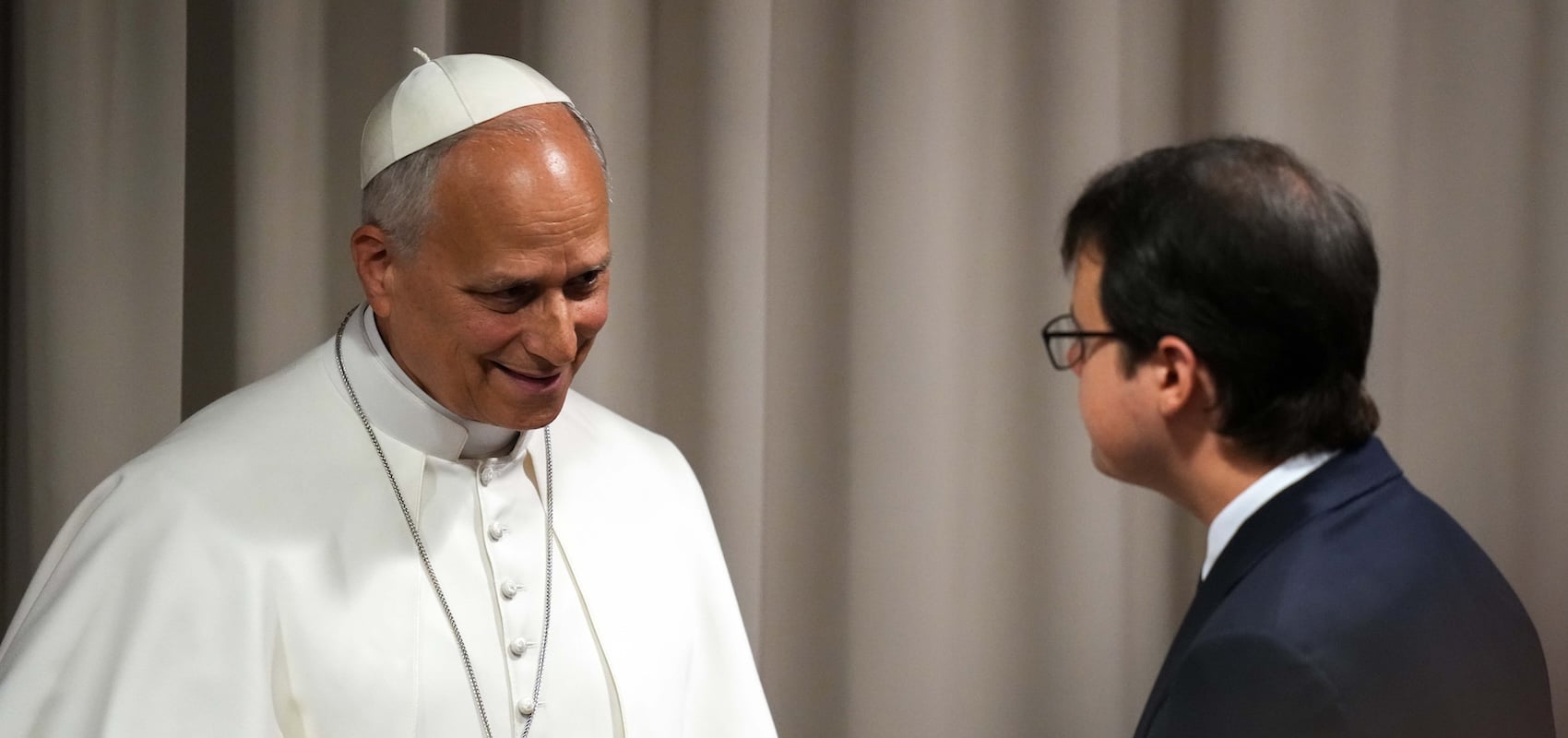
picture alliance / Gomez / Vatican Pool / Spaziani
Dear Reader,
Can I be direct with you?
War abroad. Socialists on the rise. AI upending human life. Endless uproar online. The modern attention economy doesn’t want readers — it wants users enslaved to the tyranny of the present.
First Things is the antidote: literary excellence, timeless truths, and a fixed point of reference in a culture that has lost its bearings.
But we can’t do it without readers like you.
Our goal: Raise $150,000 by November 1 to sustain First Things in the year ahead.
Your gift anchors readers in the permanent things.
Make your Fall Campaign gift now using the button below.
If you have any questions or would like more information, please contact Giovanni Del Piero, Director of the Editor’s Circle, at gdelpiero@firstthings.com or 212-627-1985.

YOU MIGHT ALSO LIKE
Candace Owens and the Sin of Anti-Semitism
According to the online Encyclopedia Britannica, Sir Moses Montefiore (1784–1885) was “an Italian-born businessman who was noted…
The Myth of St. Francis
At the beginning of his 2020 encyclical, Fratelli Tutti, Pope Francis speaks of “an episode in the…
Algorithm, Interface, and AI
Many conversations about artificial intelligence end in a stalemate: A sentiment like “ChatGPT is awful because kids…
