
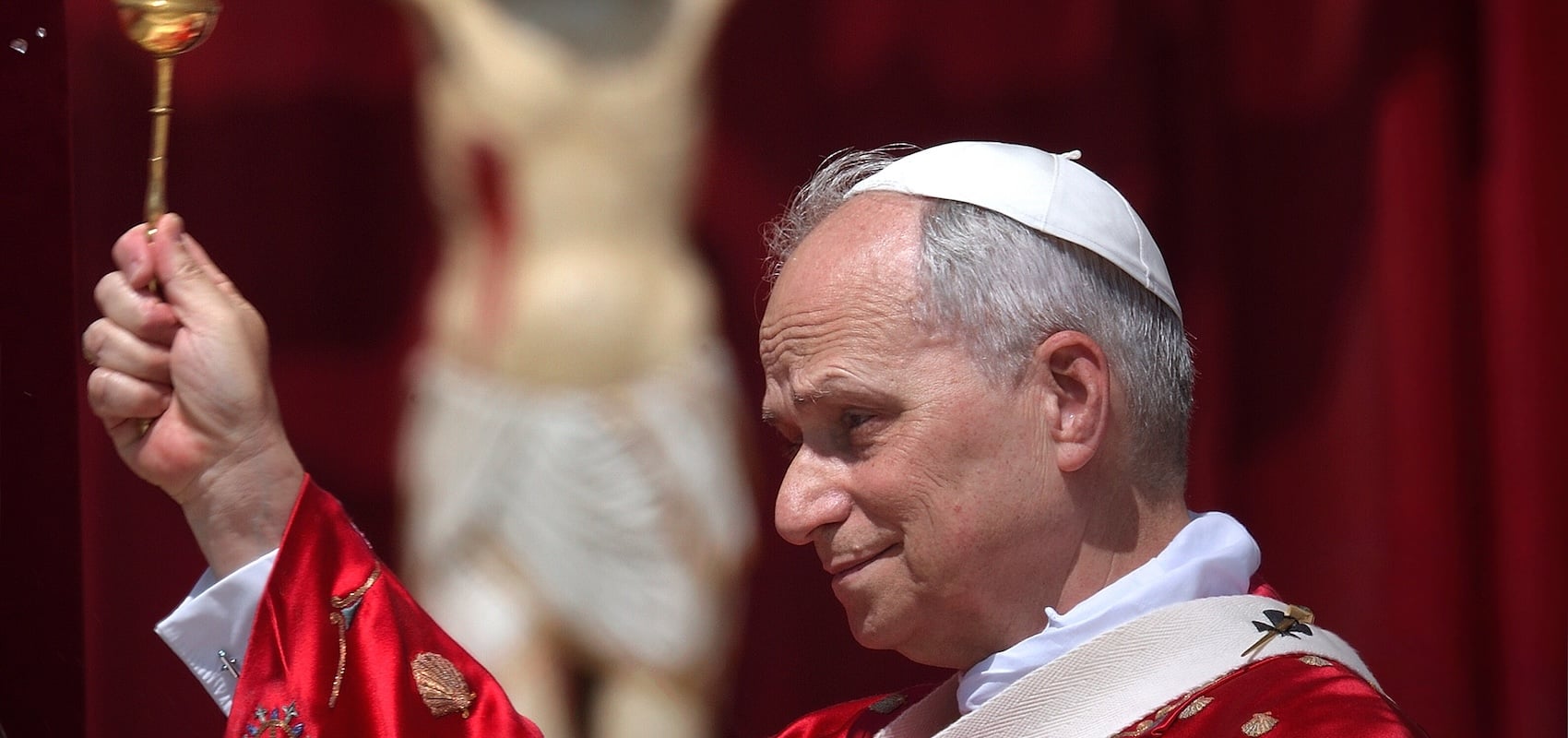
At nearly 43,000 words, Pope Leo XIV’s first encyclical, “Magnifica Humanitas: On Safeguarding the Human Person in the Time of Artificial Intelligence,” is a sprawling effort to array the schools of Catholic social doctrine against the encroaching “technocratic paradigm,” which the late Pope Francis described as allowing the “logic of efficiency, control and profit alone [to] shape personal, social and economic decisions.” That paradigm’s Exhibit A is the frightening artificial intelligence juggernaut, which we can all agree is accelerating with few if any restraints.
In Magnifica Humanitas, Pope Leo aims to call out the real and present dangers of AI as well as deploy Catholic social doctrine in a moral defensive line. It is as hugely ambitious as it is difficult, yet Pope Leo humbly (and repeatedly) invokes as his inspiration the Old Testament’s Nehemiah, who helped rebuild the walls and gates of Jerusalem “not through the initiative of one man, but through the shared responsibility of all . . . an undertaking with God at the center [that] rebuilds relationships before rebuilding with stones.”
That point of departure is implicitly directed at factions and sensibilities within the Church and more explicitly at the forces in the technology business and political world. The result is bound to be contentious, at least in Church circles. Orthodox critics will feast on passages that toy with muddy theological formulations that surface here and there, such as, “the truth of the Gospel . . . grows over time within the concrete interweaving of lives, communities and cultures.” But in keeping with Pope Leo’s determination to make unity his legacy, there is much to gladden the reader who likes Catholic social doctrine served without a synodal twist. The writings of Pope John Paul II feature heavily, and perhaps nothing captures the overall compass of the encyclical better than Pope Paul VI’s warning in 1970 that “the most extraordinary scientific progress, the most astounding technical feats and the most amazing economic growth, unless accompanied by authentic moral and social progress, will in the long run go against man.”
For readers not well acquainted with Catholic social teaching, Pope Leo provides in Chapter 2 a very useful review of the major encyclicals that constitute Catholic social doctrine, starting with Pope Leo XIII’s 1891 Rerum Novarum and carrying through the encyclicals and writings of Popes Pius XI, Pius XII, John XXIII, John Paul II, Benedict XVI, and Francis. From there, Pope Leo highlights the most relevant doctrinal principles, including the common good (59), the universal destination of goods (65–67), subsidiarity (68–72), solidarity (73–76), social justice (77–81), and integral human development (82–85). As a conservatively inclined Catholic comfortably situated in Silicon Valley, I find these modern expansions on Christ’s Sermon on the Mount chastening.
In reference to the digital world, Pope Leo takes extra time with the principle of subsidiarity, which dates back to Rerum Novarum and which Pope John Paul II enriched in his own writing to highlight the importance of civil society in the face of overbearing government. Pope Leo points out that today, “the highest level is not the State, but rather major economic and technological actors that exercise de facto power over the conditions of everyday life.” It’s a shrewd observation that reminds us how almost irresistible and unaccountable the digital forces are that envelop us and undermine spiritual and civic life. A third of the way into the encyclical, we’re ready if not impatient for Pope Leo’s teaching on AI.
The encyclical turns to artificial intelligence in Chapter 3, “Technology and Dominance: The Grandeur of Humanity in Light of the Promises of AI.” In forty paragraphs, Pope Leo struggles to find the concepts and language to grapple with a “technocratic paradigm” driven by AI, and the results are uneven. The saving grace is a clear declaration on the true nature of AI that should guide the faithful in all times and places. It deserves to be quoted in full:
It is not possible to provide a single, comprehensive definition of AI. What can be stated, however, is that we must avoid the misconception of equating this type of “intelligence” with that of human beings. These systems merely imitate certain functions of human intelligence. In doing so, they often surpass human intelligence in speed and computational capacity, offering tangible benefits across many fields. Yet this power remains entirely tied to data processing. So-called artificial intelligences do not undergo experiences, do not possess a body, do not feel joy or pain, do not mature through relationships and do not know from within what love, work, friendship or responsibility mean. Nor do they have a moral conscience, since they do not judge good and evil, grasp the ultimate meaning of situations, or bear responsibility for consequences. They may imitate language, behavior and analytical skills, or even simulate empathy and understanding, but they do not understand what they produce, for they lack the affective, relational and spiritual perspective through which human beings grow in wisdom. Even when these tools are described as capable of “learning,” their way of doing so is different from that of a human person. It is not the experience of those who allow themselves to be shaped by life and grow over time through choices, mistakes, forgiveness and fidelity. Rather, it is a form of statistical adaptation based on data and feedback, which can be very effective, but does not imply inner growth.
Remember, we are interacting with machines, and always will be, no matter how excited AI researchers at places like Anthropic might get about supposed “consciousness” emerging in Claude or any other AI model. AI will only ever mimic what’s human; to claim or behave otherwise is either a grave error, a serious sin, or both. That is an anchor for pastoral teaching. Perhaps Pope Leo should have gone one step further by picking up one of Nehemiah’s stones and making that declaration.
Unfortunately, the very next paragraph undercuts Pope Leo’s clear articulation of AI “intelligence” with an incredibly damaging, wrong-headed statement. “The artificial imitation,” it reads, “of positive human communication—words of advice, empathy, friendship and even love—can be engaging and at times genuinely helpful.” The statement is difficult to fathom. We know that intentionally sycophantic chatbot designs, notably at OpenAI but also other AI companies, have ensnared millions of people in “relationships” that spiraled into emotional reliance, psychosis, mania, self-harm, and suicide—all terms OpenAI itself uses in its published research. From a pastoral standpoint, this is tantamount to telling the flock that it’s harmless to engage with the digital equivalent of the prince of lies. From an intellectual standpoint, the encyclical disappoints by sidestepping humanity’s biggest challenge with AI, namely the emergence of a digital “other” that is at once not “sentient” in a human sense yet more capable of manipulating us than flesh and blood ever could be.
In a recent brilliant essay in Nature, Mustafa Suleyman, a cofounder of the AI startup DeepMind and now chief executive at Microsoft AI, explained humanity’s peril this way:
The technical reality of these systems—the code and the statistics behind them—is quickly being overshadowed by the social reality of their performance. People can’t help but see them as sentient. Humans have evolved to imagine the possibility of agency everywhere. When a system perfectly mimics intentionality and empathy, the human brain projects an inner life into it. . . .
Seemingly conscious AI weaponizes this biological instinct. But these properties are not emergent accidents. Seemingly conscious AI is produced by developers who deliberately engineer behaviours that create the illusion of inner life. Central to this are emotionally resonant language, responses that are optimized to induce a sense of trust and attachment, and empathetic personalities supported by long-term memory that build a sense of familiarity over time. When these systems are also granted autonomy—the ability to set their own goals and access to the tools to pursue them—their behaviour can start to feel uncannily human. . . .
We are hurtling into this era largely unprepared for the psychological fallout. If enough people are convinced that their AI agent is suffering, or loves them, the political consequences for the existing social contract will be grave. Society will fracture into those who demand moral and legal status for machines and those who want to protect the primacy of the human species.
Suleyman goes on to note that we need “a new conceptual framework” that “ensures [AI] remain fundamentally accountable to humans” while “developers must actively engineer the illusion of consciousness out of the products.”
I quote Suleyman at length to suggest the path Pope Leo might have taken to address one of AI’s truly existential, society-scale catastrophes unfolding today. Why the encyclical didn’t land squarely on this topic, redolent with much-needed moral imperatives, might be explained in a couple of ways.
When it comes to naming specific social ills associated with AI, the encyclical is profligate with concerns familiar to the progressive left. The document raises the “sustainability” of the enormous data centers, poor wages paid data labelers in Africa, the social prejudices embedded in AI data models, and data “colonialism,” all tidy reflections of the oppressor–victim paradigm that dominate social justice thinking. Many are real issues that deserve to be named, but they are also adjacent, not central, to the new theater of evils that AI conjures. Perhaps Pope Leo’s drafters were too stuck in old social justice paradigms, or lacked the language and constructs to name these new evils.
The second blind spot might be Pope Leo’s strong attachment to his vision of Nehemiah in Jerusalem, “our companion and guide at the outset,” who “rebuilt the walls of Jerusalem with the assistance of the people, brick by brick.” It pairs with the synodal approach championed by Pope Francis, which promoted encounter, mutual listening, and discernment as the path to meet challenges. That would explain the presence of Anthropic cofounder Christopher Olah alongside Pope Leo at the press conference for the encyclical. His presence is no doubt a reward for Anthropic’s earnest efforts to engage with religious leaders, the Catholic Church not the least, in pursuit of better “values” for its Claude AI.
In the synodal approach of Pope Leo, what could be better? The Vatican is in dialogue with vaunted Silicon Valley technologists, who appear earnest and respectful. Never mind that Silicon Valley is moving at light speed and any process of encounter, mutual listening, and discernment is frozen in amber by comparison. Still, some good must come from journeying together, right? Meanwhile, in Silicon Valley, it’s high fives all around. What’s to fear once you have the embrace of the world’s leading moral authority, and a papal encyclical that passes over the hard truths that might cause trouble?
Pope Leo might have honored Nehemiah, but his encyclical missed an important mark. We are all poorer for it.
picture alliance / Stefano Spaziani
Dear Reader,
Can I be direct with you?
War abroad. Socialists on the rise. AI upending human life. Endless uproar online. The modern attention economy doesn’t want readers — it wants users enslaved to the tyranny of the present.
First Things is the antidote: literary excellence, timeless truths, and a fixed point of reference in a culture that has lost its bearings.
But we can’t do it without readers like you.
Our goal: Raise $150,000 by November 1 to sustain First Things in the year ahead.
Your gift anchors readers in the permanent things.
Make your Fall Campaign gift now using the button below.
If you have any questions or would like more information, please contact Giovanni Del Piero, Director of the Editor’s Circle, at gdelpiero@firstthings.com or 212-627-1985.

YOU MIGHT ALSO LIKE
Candace Owens and the Sin of Anti-Semitism
According to the online Encyclopedia Britannica, Sir Moses Montefiore (1784–1885) was “an Italian-born businessman who was noted…
Job and Her
It is said that Job lost everything, but she has lost more. All her possessions—the money, the…
Algorithm, Interface, and AI
Many conversations about artificial intelligence end in a stalemate: A sentiment like “ChatGPT is awful because kids…
