
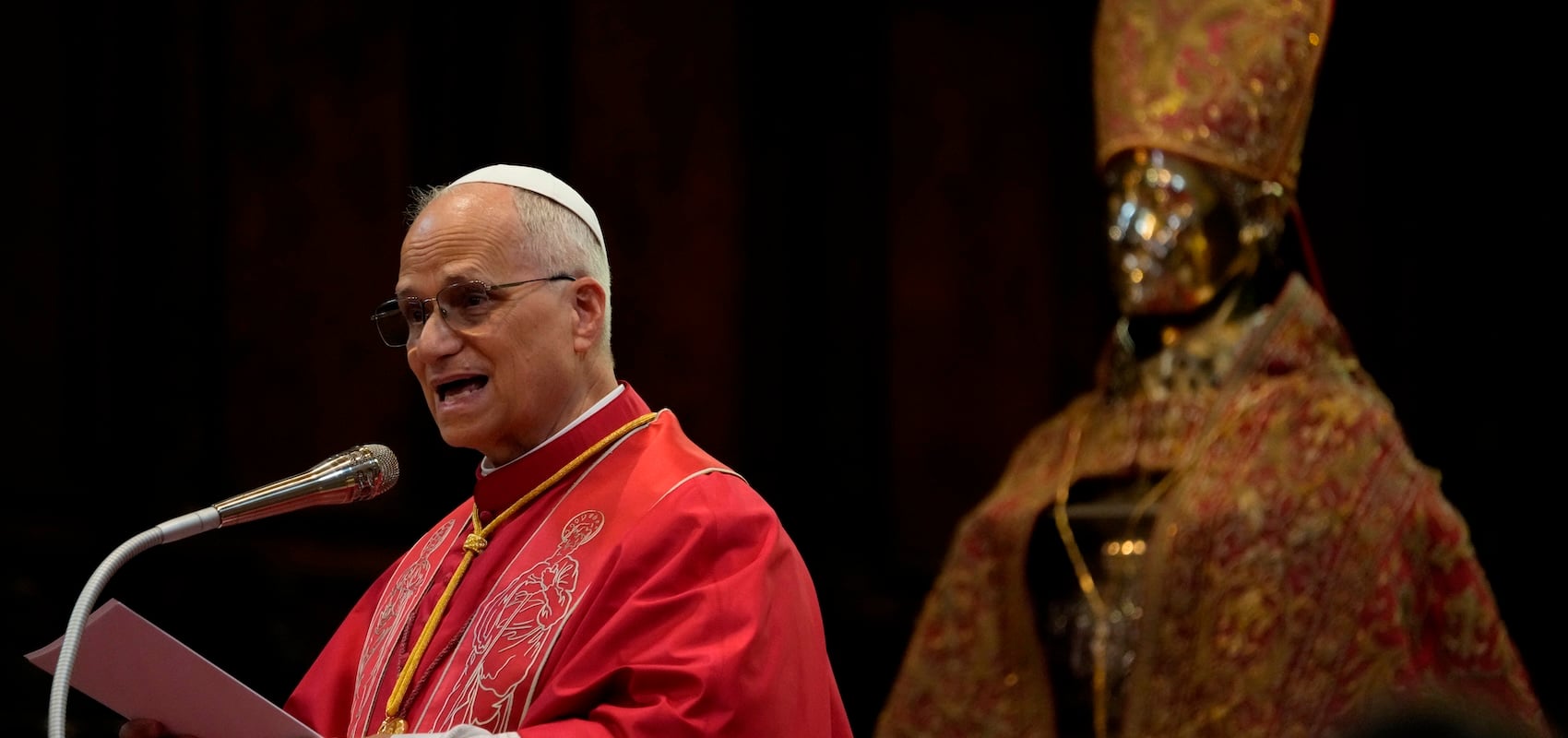
Not since the 2018 Vatican-themed Met Gala had Catholics paid such close attention to fashion. When the white smoke wafted out of the Sistine Chapel a year ago, there were not one but two questions: Who is the pope? What would he wear?
For many Catholics who previously would not have known a mozzetta from mozzarella, Pope Leo XIV’s appearance in the traditional papal red shoulder cape was a consolation, even a cause for rejoicing. Pope Francis had refused to wear it. Leo wears it so often that it would not be surprising if he plays tennis in it at Castel Gandolfo, the papal residence in the hills outside of Rome that he visits weekly. Pope Francis refused to visit there, preferring even in summer to live at Domus Sanctae Marthae, given his refusal to live in the papal apartments.
Thus Leo put an immediate end to the great symbolic refusals of the Franciscan papacy. Within weeks he restored the papal Corpus Christi procession, carrying the Blessed Sacrament himself from St. John Lateran to St. Mary Major. On the patronal feast of Sts. Peter and Paul, he restored St. John Paul the Great’s custom of bestowing the pallium on new archbishops. Francis had set that aside.
The learned Catholic convert Marshall McLuhan taught that the medium is the message; so too style conveys substance. Pope Francis deliberately chose to be disruptive; it was necessary, he thought, to free a Church “locked in the sacristy” to take up her evangelical mission. Disruption can be a necessary element of reform, refusing to simply do what has always been done. It can also divide, and Leo made an early priority of seeking greater unity in the Church, a unity rooted not in papal personalities or policies as much as in the proclamation of the gospel. His motto—In Illo uno unum (“In the One, we are one”)—emphasizes his priority on unity and communion in the Church. He is not a pope of rupture.
That also requires continuity with Pope Francis, who chose him as bishop and facilitated his rapid rise—less than two years as cardinal before election as pope, the quickest since Pope Pius XI in 1922. Leo quotes Francis often, and has taken up his signature issue of migration, which is also the position of the American bishops going back a century. He spoke favorably about “synodality” in his first appearance on the balcony of St. Peter’s.
But it is the early Francis that Leo quotes most often, turning repeatedly to Evangelii Gaudium, the 2013 apostolic exhortation in which Francis laid out his vision for a Church of missionary discipleship. It was an In Illo uno unum document, hailed in all corners of the ecclesial vineyard. Leo convened the cardinals in January and will do so again in June—something Francis was reluctant to do. It is Evangelii Gaudium that he wants them to focus on. Leo desires a Church at peace with herself, so that she can proclaim the peace of Christ—his first words upon his election—to the world. What came later under Francis—Amoris Laetitia, synodality, liturgical controversies, Fiducia Supplicans—gets pro forma recognition but there is little papal energy behind it. The interminable synod reports commissioned under Francis have been duly published—the latest this week—with little attention.
Leo’s vigor—the last time a pope was seventy was in 1990—is notable. The eleven-day, four-country visit to Africa was a return to the papal travels of the 1990s, and the speeches given there could have been delivered by John Paul or Francis. He will be in Spain next month, a visit to the heart of old Catholic Europe that Francis refused to make. The visit is centered around the completion of the final tower of the Sagrada Familia basilica, the dedication of which Pope Benedict XVI presided over personally.
Leo made the first ever papal trip to the micro-state of Monaco. On his predecessor’s list of potential destinations, the wealthy playground would have ranked even below Argentina. The sovereign, Prince Albert II, had recently refused to permit a liberal abortion law; perhaps the trip was a sign of papal approval and encouragement. It could be that Leo found endearing the House of Grimaldi’s nomenclature; Albert is styled “His Serene Highness.”
Leo has been His Serene Holiness.
That serenity was a welcome contrast in recent weeks to the dyspeptic eruptions of the disrupter in chief. While there is a vocal cadre of Trump-supporting Catholics in the United States who strain to accept papal statements but swallow whole the latest blasphemies, incoherencies, and falsehoods from the president, Donald Trump is regarded by many Americans with embarrassment. In the rest of the world, he is deeply unpopular.
God writes straight with crooked lines, and the crooked president helps Leo’s mission of unity. The contrast gives him a sympathetic hearing from many who might otherwise not pay close attention, for everyone does pay attention to Donald Trump. This week’s visit of the American secretary of state was regarded by everyone aside from MAGA partisans as an attempt at diplomatic repair by Marco Rubio. Leo was in the stronger position.
A pope cannot choose his adversaries, but having the right ones helps. John Paul’s anticommunism made him a hero. Benedict’s challenge to Islamist violence at Regensburg was the essential theological response to jihadism, and earned him allies in the Islamic world, including the king of Saudi Arabia, who visited the Vatican to signal his support. The first American citizen to be pope did not seek to be at odds with the Trump administration, but it does him good when figures such as Tom Homan—the border czar sent to Minneapolis to clean up the lethal fiasco of ICE operations there—boast of being “lifelong Catholics” and then instruct the Holy Father that “the Catholic faith is always in support of law enforcement. Always has been.”
It wasn’t on Good Friday. Or, more to the point in the United States, on Good Friday 1963, when Bull Connor and his goons threw Martin Luther King into a Birmingham city jail. God writes straight with crooked lines, and it was there the King wrote the definitive American text on just and unjust laws.
Leo is fortunate in his critics. Inside the Church, he will be the center of unity against the German bishops, given as they are to Protestant doctrinal erosion, and against the schismatic Society of St. Pius X, given to Protestant disobedience.
A year in, Leo is blessed with the goodwill of many, and the useful enmity of a few.
AP Photo/Gregorio Borgia

YOU MIGHT ALSO LIKE
Be Wise as Chameleons
Visiting Philippi on his second missionary expedition, Paul starts a riot. When he casts a python demon…
Betting Against Your Neighbor
At a semiannual conference of The Church of Jesus Christ of Latter-day Saints, D. Todd Christofferson—one of…
The Second Death of Charlie Kirk
It used to be that if you died horribly and honorably and happened to be a person…
