
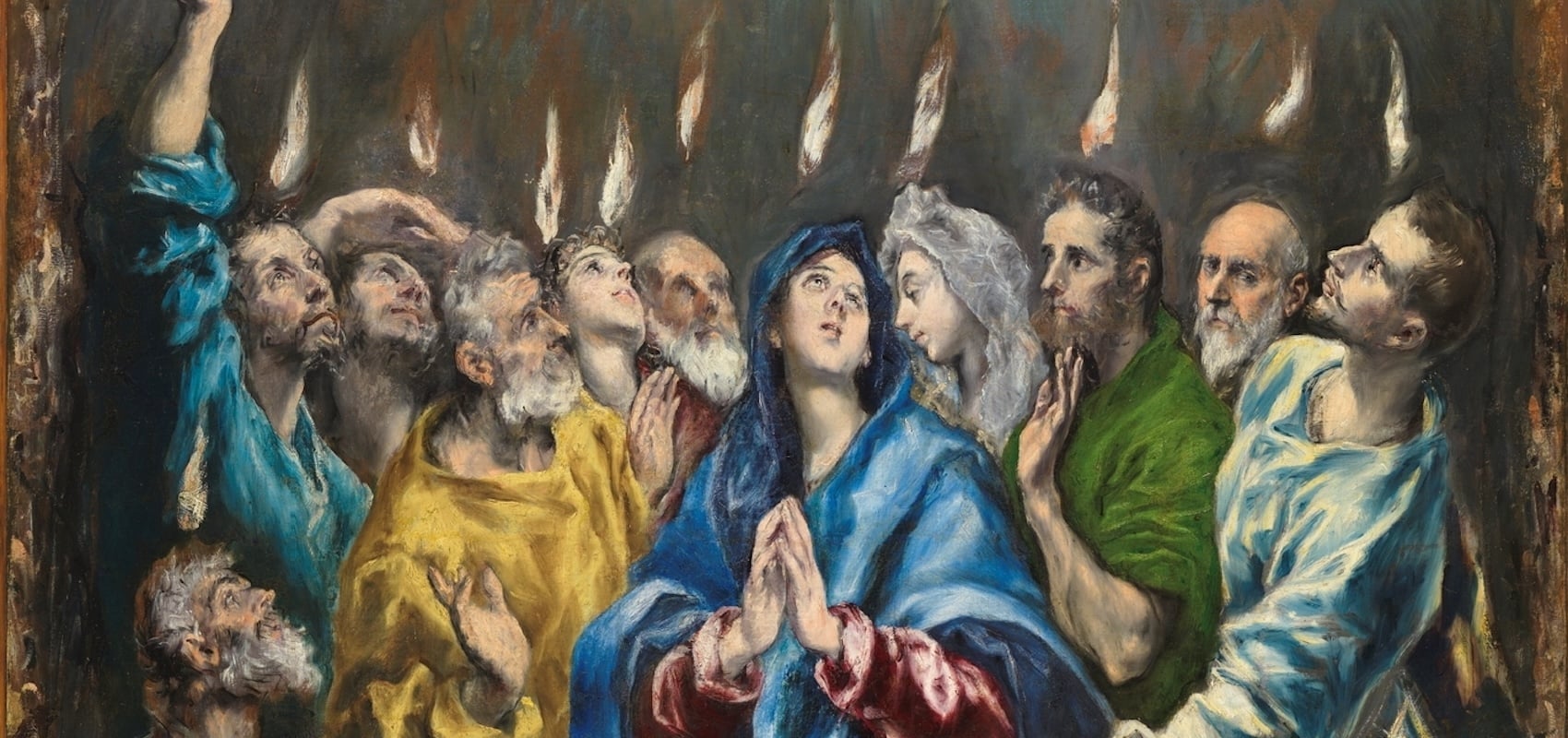
The Bible figures the Spirit as breath, wind, smoke, and flame. He blows where he will, circulates invisibly, flickers like glory. You can hear his voice, but you can’t determine where he came from or where he’s going. You can no more grasp or control the ethereal Spirit than you can mold the mist. Just so, at Pentecost, he arrives as a rushing, mighty wind and ignites tongues of fire on the heads of the assembled disciples. It seems one could almost be forgiven for mistaking the Spirit for an airy nothing.
That’s not the trajectory of Pentecost. The Pentecostal Spirit manifests himself in the bodies of those who receive him. Before the Spirit comes, one hundred and twenty disciples of Jesus huddle in an upper room, but the Spirit drives them out into the open, into the middle of an international throng of thousands. Before, the disciples spoke behind closed doors; now they speak openly in all the languages under heaven. Before, the apostles feared Jesus’s enemies would hunt them down; but the Spirit emboldens Peter to preach an accusatory sermon: “You nailed [Jesus] to a cross by the hands of godless men and put him to death” (Acts 2:23). As the hubbub of the day dies down, the disciples apply baptismal water to three thousand bodies, and the community begins to gather daily to break bread. Many sell property and possessions to provide for the needy. As the Church grows, the alarmed Jewish leaders warn, imprison, and beat the apostles to keep them from spreading the word about Jesus.
Elusive as the Spirit seems, his effects are evident in tongues loosed to speak, hands opened to share, flesh that, like the flesh of Jesus, bears the scars of the scourge.
Paul’s teaching about the Spirit runs in the same direction. In his letter to the Ephesians, he quotes from Psalm 68; or, rather notoriously, misquotes the psalm. The original psalm celebrates Yahweh’s triumphant ascent to his throne, leading a parade of captives and receiving tribute from conquered enemies. When Paul quotes the psalm, though, he turns it around: Christ “led captivity captive and gave gifts to men” (Eph. 4:8), specifically the gifts of grace apportioned out to each member of the body according to Christ’s gift (Eph. 4:7). Paul sees the psalm as a preview of the Ascension and Pentecost. Having taken his throne, Jesus the Christ distributes the one Spirit to the members of his one body (Eph. 4:4).
In Paul’s gloss on Pentecost, the ascended Jesus doesn’t give anything so ephemeral as the Spirit. Instead, he gives people—apostles, prophets, evangelists, shepherds, teachers—so that the saints can build the body and reach maturity, which is the fullness of Christ (Eph. 4:11–13). These leaders and ministers are embodied manifestations of the Pentecostal Spirit, who, like all the members of the body, are filled with the Spirit’s gifts for the common good of the body. Where the Spirit is active, there the bodies in the body devote themselves to prophecy, service, teaching, generous giving, leading, acts of mercy. Whenever and wherever the Spirit falls, bodies and souls are activated to construct the corporate body of Christ. The bodiliness of Christ’s body is a gift of the embodying Spirit.
Pentecost, in short, replays Advent in a corporate register. Gabriel told Mary the Spirit and his power would overshadow her so that the child she bore would be the Son of God, now made man. As the Spirit generated the flesh of the incarnate Son from the flesh of Mary, so the Spirit, poured out by the ascended Son, molds the ecclesial body of the Son from the flesh of human beings, so that, as Paul says, Christ may take form in and among us, as in a womb (Gal. 4:19). What Maximus the Confessor said about the Son applies also to the Spirit: “the Logos of God (who is God) wills always and in all things to accomplish the mystery of his embodiment.”


YOU MIGHT ALSO LIKE
Vatican II Didn’t Kneel to Modernity
In his weekly catecheses on Vatican II, Pope Leo is now discussing Gaudium et Spes, one of…
No Right to Erase Baptism
Is baptism an irreversible spiritual and ontological change or a piece of recorded personal data to be…
The Church in the Age of Therapy
In 1966, Philip Rieff wrote in The Triumph of the Therapeutic that “Religious man was born to…
