
Agrippa:
A Novel of Ancient Rome’s Descent into Dictatorship
by robert harris
doubleday, 384 pages, $32
It is seven years since the publication of Dominion by Tom Holland, the much-discussed book in which the English historian set out the case for Christianity’s fundamental rewiring of the Western mind. When discussing the genesis of his thesis in interviews, Holland often returned to his childhood. Raised as a Christian, he knew his Bible: “I liked the biblical stories,” he has said, “but I was always kind of Team Pharaoh, or Team Nebuchadnezzar, or Team Pontius Pilate. Always on the side of the big swaggering empires because I found them more glamorous and exciting. I found the Greek gods more charismatic, more exciting than the Christian God.” It was, he thought, “like the moon fading before a sunrise. Christianity just didn’t seem as interesting.”
But when, as a grown-up author, Holland came to write about the Greeks and the Romans and the Spartans, things changed. Over time, the characters and cultures he once loved came to feel radically, unsettlingly alien. Their bedrock morality—lacking pity and mercy, unconcerned about the poor and weak, indifferent to anything approximating human rights—was something irreducibly different from what Holland and everyone he knew took for granted: “The conclusion I came to was that, essentially, it’s Christianity that changes everything.”
Holland’s epiphany came to mind as I read Agrippa, the new novel by Robert Harris, whose Conclave was the basis of the 2024 blockbuster movie. He has published seventeen novels, five of them set in ancient Rome. To produce his fiction, Harris has immersed himself in ancient Roman history and, with it, the Roman mind.
In Harris’s telling, Marcus Vipsanius Agrippa—the victor of the Battle of Actium and builder of the original Pantheon—is a man who can lay claim to our sympathies. He is the holder of certain perennial virtues: courage and competence, modesty and stoicism. We can admire his feats of planning and construction, his relative restraint in times of war, and his embrace of peace when it came. But the world he inhabits—and in which, after all, he succeeds mightily—is a different matter. His career is hitched to that of his childhood pal, Octavius, great-nephew and chosen successor of Julius Caesar. Octavius—later Augustus—knows all too well that to be the new Caesar, he must show that he is utterly merciless and free of scruples when things come to the crunch (or sometimes long before). Agrippa remains at his side throughout.
Tom Holland has said of writing about men like these: “I find it quite stressful actually, trying to live inside their heads because they’re terrifying. Julius Caesar in the conquest of Gaul is said to have killed a million people and enslaved another million. And he didn’t seem to have any trouble about this.”
In the world Robert Harris evokes, captives in war are treated like inconvenient numbers in a ledger, there to be scratched out, whenever necessary, to make the tolls of vengeance balance. Politicians live or die depending on where they sit when the music stops and the emperor is looking for a scapegoat. Meanwhile, nameless slaves appear and disappear in the space of a sentence, summoned to carry out some function that will make the lives of their masters easier, their personhood never noticed or remarked upon. The creation and dissolution of marriages are carried out with a speed and ruthlessness that would have made later generations of the most cynical royal matchmakers blush. Sex itself is mere rutting: Mark Antony once wrote a letter to Octavius (which was posted in the Forum) containing a line that Harris renders as “Does it really matter where or in whom you stick your cock?”
Roman men, Tom Holland has pointed out, tended to assume they had the right to insert their penis into any orifice available. These attitudes too were overturned by Christianity: “Paul’s insistence that the body of every human being was a holy vessel had triumphed,” Holland wrote in Dominion. Women in particular gained a dignity that, by and large, they did not have in the Roman world.
Agrippa—all the more so because it handles the ways of the Romans evenly, seeking neither to diminish nor inflate their ferocity—has become for me a kind of novelistic companion piece to Dominion. Both books act as starting points for certain historical reveries, at once comical and strangely poignant.
What if the pre-Christian warrior Agrippa could be somehow transported forward to Christianized Europe? Imagine men of his warrior class being told by a pale, tonsured monk that, under the terms of the Truce of God, they would have to put away their weapons from Wednesday evening until dawn on the following Monday. Imagine them being instructed to take part in a knighting ceremony that would entail being bound about the waist with a white belt signifying their duty to hold back the lust in their loins. Imagine them being informed by a canon lawyer of the doctrine of marital indissolubility.
To the mind of a Roman warrior, even one as noble in certain ways as Robert Harris’s Agrippa, such duties and strictures would make no sense. But in the minds of his later counterparts among the Christianized warrior-knights of France or Spain or Italy, living under the new dominion, these strange notions, and the scruples they gave rise to, would now have a fighting chance.
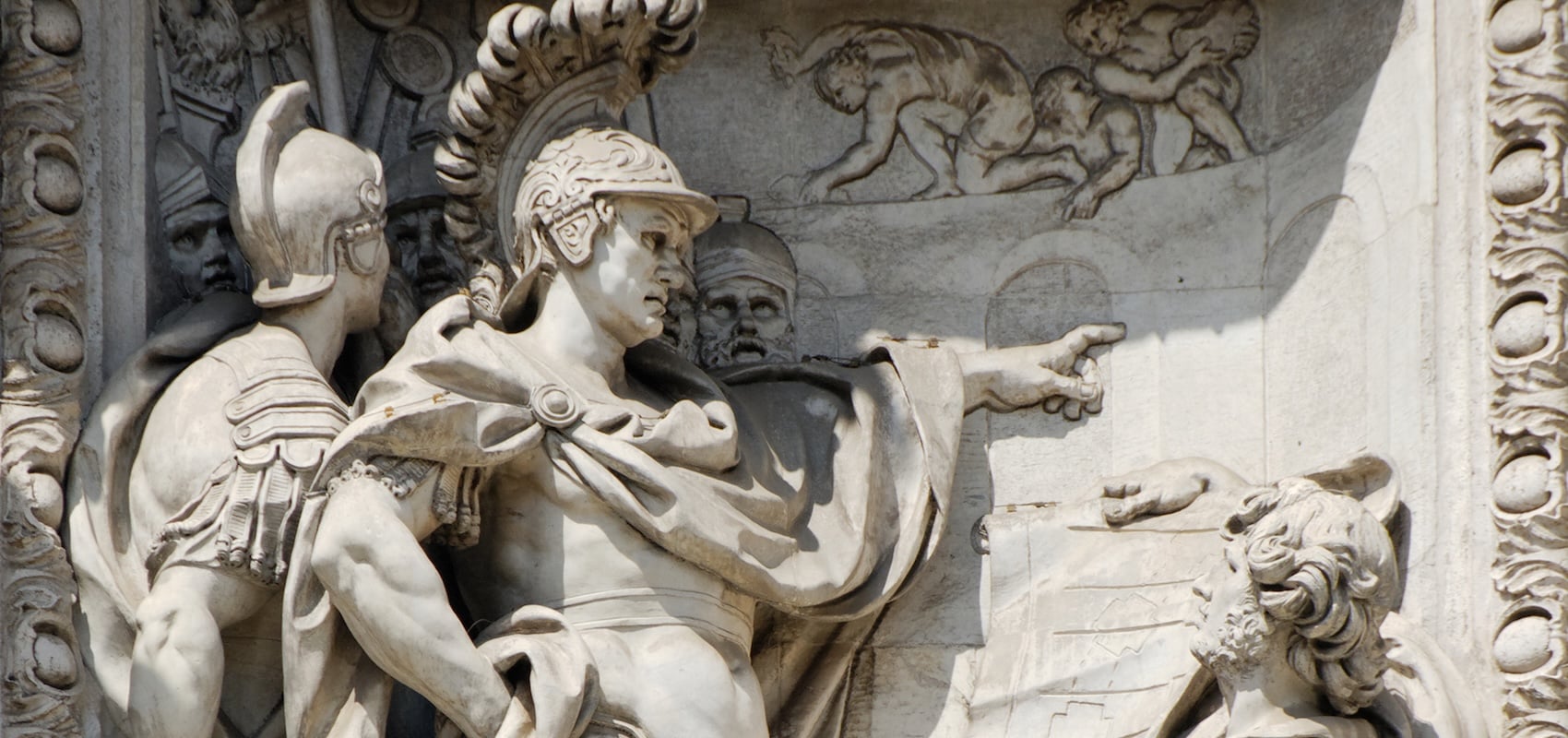
Image by Marie-Lan Nguyen via Creative Commons. Image cropped.
Dear Reader,
Can I be direct with you?
War abroad. Socialists on the rise. AI upending human life. Endless uproar online. The modern attention economy doesn’t want readers — it wants users enslaved to the tyranny of the present.
First Things is the antidote: literary excellence, timeless truths, and a fixed point of reference in a culture that has lost its bearings.
But we can’t do it without readers like you.
Our goal: Raise $150,000 by November 1 to sustain First Things in the year ahead.
Your gift anchors readers in the permanent things.
Make your Fall Campaign gift now using the button below.
If you have any questions or would like more information, please contact Giovanni Del Piero, Director of the Editor’s Circle, at gdelpiero@firstthings.com or 212-627-1985.

YOU MIGHT ALSO LIKE
Earnest Lives: New and Notable Books
Ralph Waldo Emerson once declared, “All history resolves itself very easily into the biography of a few…
Aaron Sorkin’s Facebook Fumble
In 2014, Aaron Sorkin published an op-ed in the New York Times arguing that journalists should refuse…
You Can’t See Everything
During marriage prep, my wife and I had to take the “Five Love Languages” test, a pseudoscientific…
