
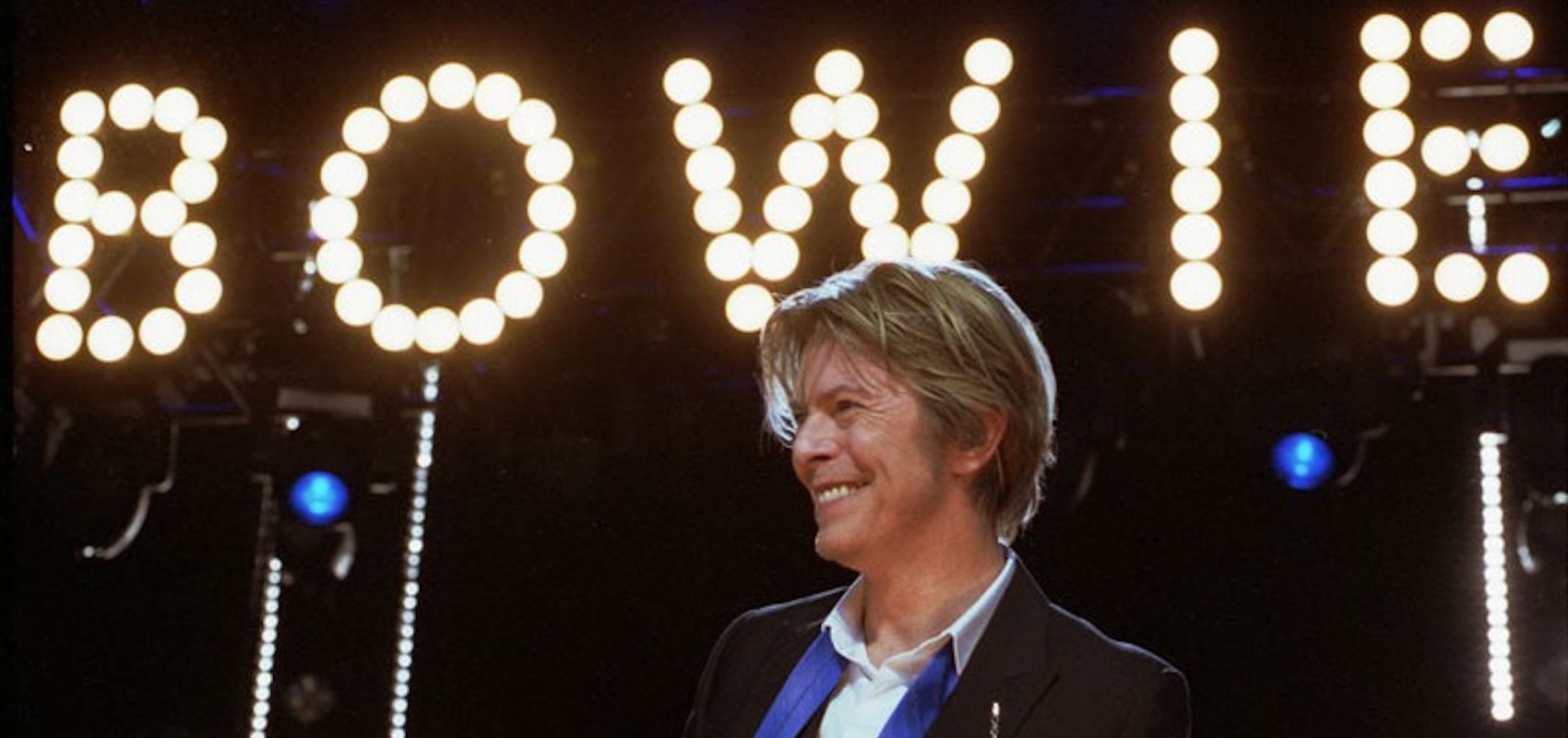
David Bowie and the Search for Life, Death and God
by peter ormerod
bloomsbury, 256 pages, $28
Thirty-four years ago today, David Bowie knelt on the stage at Wembley Stadium in front of 72,000 people attending the Freddie Mercury Tribute Concert for AIDS Awareness, bowed his head, and recited the “Our Father.” Moments before, he had been performing a barnstorming set with Mercury’s old band Queen. Then, quite suddenly, after some brief words of introduction: the great prayer of Christianity.
Bowie, who died in 2016, is revered as one of rock’s greatest chameleons and provocateurs; the man who fell to earth, a genius who tore up conventions and defied all expectations. Yet this one gesture, perhaps his most surprising and outrageous of all, seems to have been memory-holed. David Bowie and the Search for Life, Death and God, a new book by journalist Peter Ormerod, helps us make some sense of Bowie’s words and actions at Wembley. Bowie spoke of an undying belief in God’s existence: “For me it is unquestionable.” Running through his work was, he said, a search for “a spiritual foundation.” According to Ormerod, an obsession with spirituality and religion “powered some of his greatest songs”: The lyrics of “Pallas Athena” consist almost entirely of the words “God is on top of it all.”
Ormerod lovingly traces all the seams and wrinkles of spirituality present in Bowie’s music. Growing up in the London suburb of Bromley, Bowie felt a kind of fin de civilisation impatience and disgust with life in the West. So, he joined the disorderly queue of pop singers turning to Buddhism and the East, thus embarking upon a lifetime of pinballing thoughtfully through the -isms.
During his nightmare years (1974 to 1977), Bowie endured what Ormerod calls a “fetid brew of occultism and esotericism,” combined with depression, emaciation, and an “avalanche” of cocaine. (His mid-seventies, Aleister Crowley–inspired misadventures in occultism are eye-popping.) There was even a phase of expressing attraction to Nazism and fascism.
When he appears to have been close to a breaking point, Bowie began to wear a cross. Indeed, “Station to Station,” released in 1976, was, Bowie would later claim, “very much concerned with the Stations of the Cross.” (Ormerod even detects a possible echo of the “Agnus Dei” in the patterning of certain lines.) Despite the profane, eccentric wrapping they come in, it is impossible to ignore the Christ-like shadows flitting across assorted Bowie personae. Even the Ziggy Stardust album is described by Ormerod as “infused by Jesus, Christian imagery and matters of God.” He has a point. Take this verse from “Soul Love”:
the priest that tastes the word and
Told of love, and how my God on high is
All love, though reaching up my loneliness evolves
By the blindness that surrounds him . . .
By 1979, Bowie had reached the point where he realized “there must be something in the West that I could adhere to . . . surely we must have some kind of spiritual backbone.” However, as Ormerod takes pains to remind us, Bowie had no time for organized religion. He spoke of an abiding interest in early Christianity: before, that is, “the orthodoxy of the Catholic Church prevailed.” (For such a startlingly original artist, Bowie’s thinking was at times an unremarkable distillation of Boomerian groupthink.) The video for “The Next Day” is a gruesome, all-out assault on Catholicism, portraying priests and cardinals as decadent sexual exploiters.
So Bowie seemed to remain the ultimate spiritual mixer-and-matcher to the end: In 1992, his marriage to the supermodel Iman was solemnized in an Episcopalian church in Florence; after his death, his ashes were scattered in a Buddhist ceremony in Bali.
What, then, does Ormerod make of the Wembley prayer, surely of enormous salience to his own thesis? He is, in fact, curiously incurious about the incident, dispensing with it in about two pages. Perhaps knowing how much Bowie operated by instinct, and how these instincts could swiftly lead him somewhere else entirely, Ormerod concluded it would be a futile exercise to overload a spontaneous gesture with precise meaning. Bowie said that he dedicated the prayer to a friend who was dying of AIDS; and there the trail ends.
But this seems like a weak conclusion. After all, Gnosticism, yet another belief system Bowie investigated, appealed to him partly because there was “no great emphasis on sin, no need for confession.” But here he was uttering the words “forgive us our trespasses,” “lead us not into temptation,” “deliver us from evil.” Why recite this prayer, in front of this audience, at this event? Was Bowie using his clout (and the element of surprise) to deliver an otherwise undeliverable message? Writing for First Things in June 2018, John Waters suggested that, to an intelligent man like David Bowie, the various kinds of sexual and narcotic adventurism he had helped announce to the world in the early seventies would, by 1992, “have long since ceased to seem like unambiguous freedoms.”
We get disturbing glimpses of how far this adventurism went. Twenty years before Wembley, Bowie was “performing as an electrified otherworldly demigod in the English provinces”; he was a “lithe, redheaded, face-painted, very revealingly and very originally clothed polysexual stardust alien,” according to Angie, his first wife. This Bowie appears to have had a voracious, omnivorous sexual libido unchecked by . . . anything, really. Bowie’s hair and make-up artist Suzi Ronson, in a memoir published two years ago, recounts the disturbing abuse of “an adorable-looking boy . . . with an angelic face” after a gig—an incident in which she was, in effect, press-ganged into the role of a temporary sex trafficker.
As an adult, former child model Lori Mattix recounted (gleefully) being “de-virginized” by Bowie in the Beverly Hilton at the age of fifteen, having originally been propositioned by him when she was fourteen. Later in the evening, Bowie and Mattix had a threesome with Sable Starr, also fifteen. Bowie’s friend and collaborator Iggy Pop actually opened a song, recorded in 1996, with “I slept with Sable when she was thirteen.” (Yet on he tours. It is quite something that this generation of rock singers, dead or alive, are still on their pedestals.)
Was Bowie’s “Our Father” at the Freddie Mercury concert, then, the outworking, at least in part, of a long examination of conscience? Might he be placed in that tradition of artistic decadents who followed their solipsistic, hedonistic appetites all the way down, only to find that confrontation with their own depraved depths ultimately frightened them back into the arms of Christ? Were those clergymen in “The Next Day” video highly oblique or even subconscious ciphers for seventies pop stars, the assumers, Bowie among them, of quasi-religious roles that they wasted no time in exploiting?
We will never know. The Thin White Duke traded on elusiveness and doubt, including doubt about the greatest things. “Open up your heart to me / Show me who you are,” he sang (on an album called Heathen), “And I would be your slave.”

YOU MIGHT ALSO LIKE
Letters—November 2026
I appreciate J. H. H. Weiler’s desire for God’s mercy to be extended to Gentiles and his…
A Culture of Parricide
I learned a new word the other day: déploration. It’s the French, directly from the Latin, for “lament.”…
The Myth of St. Francis
At the beginning of his 2020 encyclical, Fratelli Tutti, Pope Francis speaks of “an episode in the…
