
Darel Paul’s excellent First Things article on the Jason Arday scandal pinpoints a number of the problems now rife in academia, problems that I can attest are so well-established that, were they not so immoral, one might call them “venerable.” The rot goes back decades.
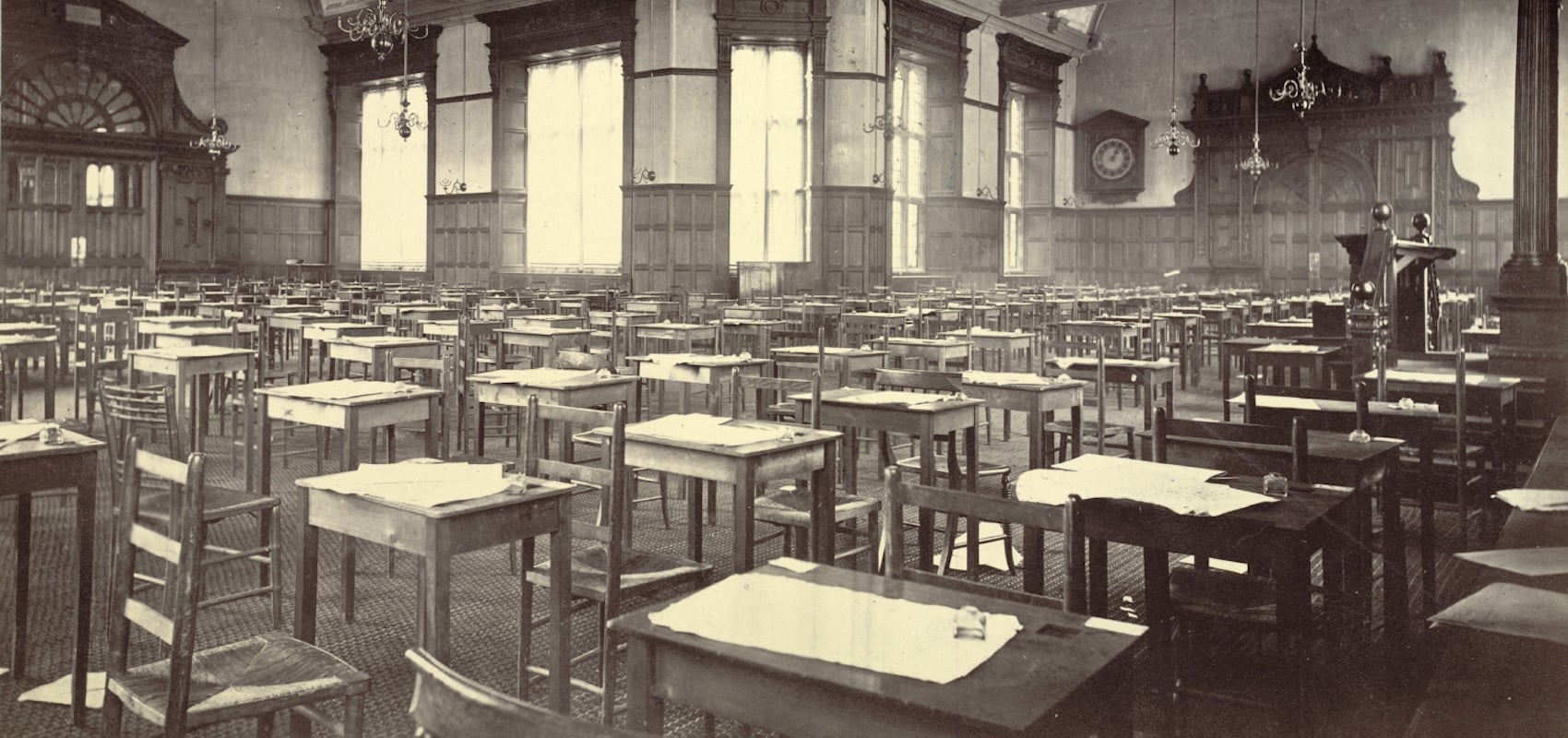
Thirty years ago, I was on faculty at one of the U.K.’s elite Russell Group universities. As the least important person in my department, I was assigned the administrative role that nobody else wanted: exams officer, in charge of overseeing all examinations, from the timetable to the grading. A colleague alerted me to a student paper that had been plagiarized word-for-word from the Encyclopedia Britannica. This was an era before students could easily access such texts online, and so he had done it manually, creating the odd result that the text was a verbatim copy but had multiple errors in punctuation.
Following university procedure, I filed an official charge and went before the university’s committee for academic standards, consisting of some of the top academics at the institution. I opened my case for the prosecution by distributing copies of the student’s paper and the encyclopedia article, stating simply: “If you compare the student’s paper to the encyclopedia article, you will see that it is a verbatim copy, and I find that unacceptable.”
At that point my life changed forever. One of the senior panel members interrupted me: “Why do you find that unacceptable?” I remember the moment clearly because it was one of only a few occasions in my academic life when I was at a complete loss for words.
There was a swift follow-up: “Did the student’s race play into your decision to single him out for this charge?” I explained that I had never taught this student, had never met him, was acting on a complaint I had received from a colleague, and had no idea what his ethnicity was. The disciplinary hearing was the first time I had ever set eyes on him. “So you cannot be bothered to learn the names of your minority students?” was the next question. I was now the one in the dock. “But he is not my student,” I stammered.
The hearing was essentially over. I had entered the room to address what I had always been taught was the most egregious academic error—plagiarism—with open-and-shut evidence. I left wondering if I really was a racist—a charge that was subsequently brought by the student against the colleague who had alerted me to the cheating. Ironically, that colleague was a Bennite socialist, a fact that helped (eventually) exonerate him from such a malicious accusation.
Plagiarism is the most serious academic crime. One can murder one’s wife and still have one’s academic work taken seriously (think Louis Althusser); one cannot steal another person’s work and take credit for it. But I learned that day that it is not so simple in an academy where the truth is a function of the therapeutic tastes of the day. Its purpose is to affirm and reassure. Traditional notions of truth make a demand upon the individual, requiring conformity or even sacrifice in the face of reality. Therapeutic notions of truth do not. If anything, they require a sacrifice of reality, which is deemed oppressive. And if academic standards, such as not stealing the work of others, obstruct that, then so much the worse for academic standards—or any objective standards at all.
Academia has no monopoly on this. The close connection between the therapeutic idea of truth and the political realm became clear in those years of “peak woke,” around 2018–22. It was remarkable how many people who had likely never opened a book of critical theory in their lives suddenly declared its affirmation to be a shibboleth of public virtue and any denial of it—or even silence about it—to constitute an act of violence.
Why did these denizens of social media make critical theory a point of orthodoxy? Because its clichés struck a chord with the therapeutic culture that had formed them. The language of victimhood, privilege, oppression, and blame—ridiculously inflated as it has become—is the currency of the therapeutic, as it is of the politics of identity. Critical theoretical approaches that can be reduced to such a taxonomy elicited a deep emotional response.
And the opposition had similar therapeutic ways of dismissing those it disliked or distrusted. Many expanded the terminology of “woke” and “cultural Marxism,” for example, to include and discredit anyone perceived to be even slightly to their left. The rhetoric functioned less to refute wrong arguments than to reassure one’s own side that opponents were just evil and could be dismissed out of hand. Right-wing “edgelords” and BLM activists share at least a couple of things in common: a therapeutic conception of the nature and purpose of “truth”; and a correlative feeling of being unsafe in the presence of people or ideas with which they disagree. Hence the retreat to safe spaces, online and elsewhere, where dissent is not tolerated.
The problem is not confined to university campuses but omnipresent. Victimhood and resentment have been used to disembowel truth and then to instrumentalize it in the service of whatever grievance group, left or right, cares to use it. To quote myself, I find that unacceptable. But I suspect the radicals on both political fringes will respond by asking me, “Why?”

YOU MIGHT ALSO LIKE
The Boys on the Brink
In the latest installment of the ongoing interview series with contributing editor Mark Bauerlein, Leonard Sax joins…
Serial Liar, Serial Comma
How would you write a public letter that you know will become front-page news? Would you write…
The Left Is Right About the Bible
“Texas Public School Students Will Be Required to Read the Bible,” warned a headline in the New…
