
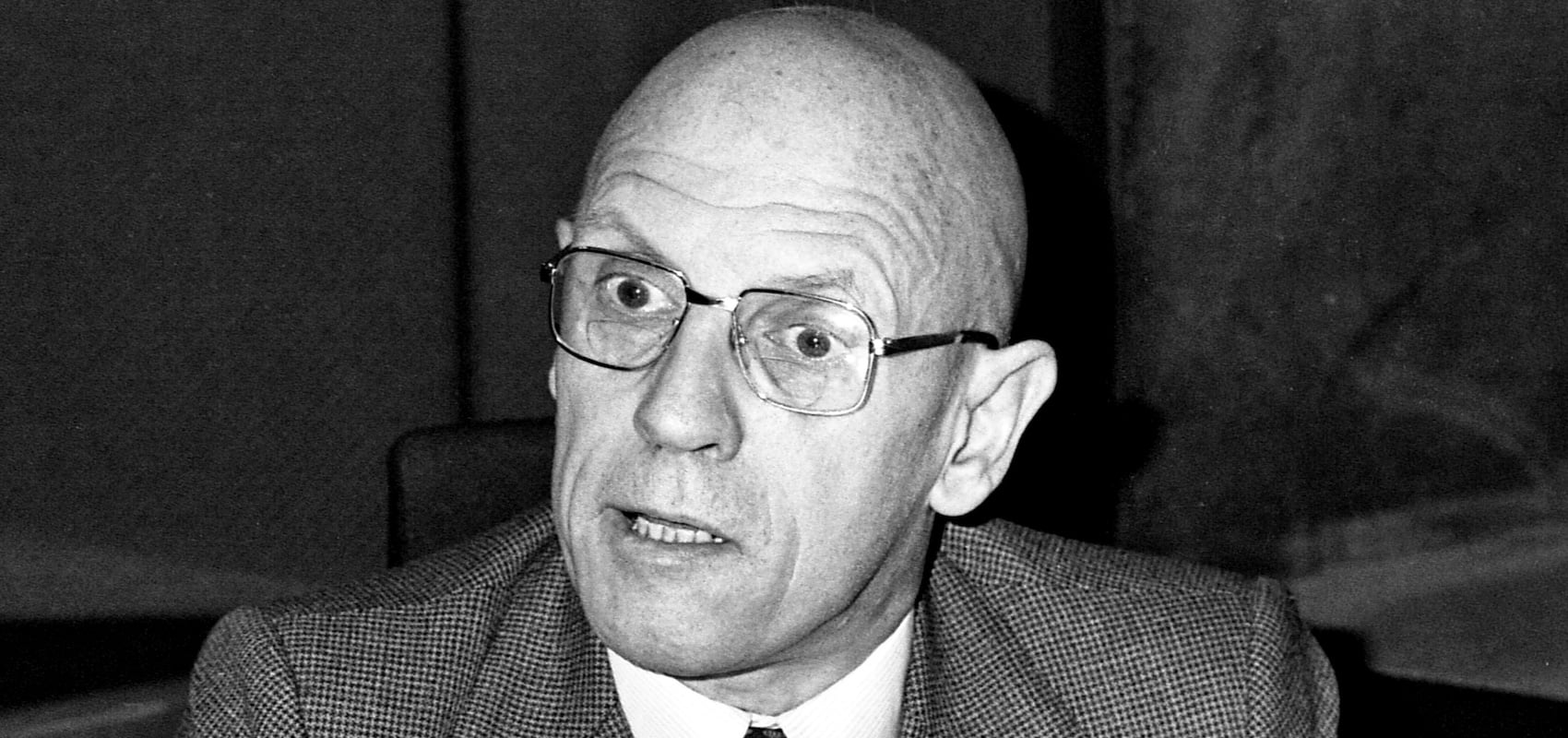
Today marks the 100th anniversary of the birth of Michel Foucault. He was influential in his lifetime, but forty-two years after his death, while contemporaries such as Derrida have faded from view, Foucault is still a force with which academics must reckon. From postcolonialism to queer theory, he remains one of the most cited and influential figures in the humanities. Indeed, he remade them in his own image. After Foucault, we are more aware of the cultural factors that shape what constitutes knowledge, more sensitive to how histories of the past serve (and are shaped by) political purposes in the present, and more suspicious of how power is pervasive, omnipresent, often invisible, and impossible to resist in any final or decisive way.
Had Foucault lived to see our day, he would most certainly have felt his thought vindicated in key areas. He would not be surprised by the morphing of the internet from a libertarian playground to a place of algorithms and surveillance. He would regard our current confusion over what, if anything, it means to be human as simply the latest iteration of an Enlightenment obsession. He would see the COVID crisis, from its militaristic language to its deployment of “science” and “experts” as a means of social control, as a clear example of “biopolitics,” the use of medicine to define, corral, and control. And it would be fascinating to hear his thoughts on the current state of the LGBTQ movement. Yes, his thinking helped demolish the old essentialism of what is disparagingly referred to as “heteronormativity.” But the LGBTQ movement itself now uses “born this way” language—essentialist language that treats sexuality as innate and fixed—to maintain its own cultural power. We will never know with certainty how Foucault would have positioned himself relative to this development, but LGBTQ opposition to, say, conversion therapy would seem to rest on a form of essentialism that is vulnerable to being debunked with the very Foucauldian categories that made the queer revolution possible.
Brilliant as he was, however, with Foucault the question of life and thought presses on readers with some urgency. He had a dark, sinister side. He seems always to have hovered on the edge of madness. His covert gay life led to early suicide attempts and mental breakdowns. Coming out in the 1970s, he immersed himself in the BDSM and bathhouse scene, anticipating the kinky excesses of today’s sexual anarchy. There are even claims—contested but compelling—that he went to Africa to pay to have sex with underage boys in graveyards and that he knowingly infected others with the AIDS virus.
Of course, the world of talented intellectuals is replete with figures whose private lives were marked by libidinous excess. But Foucault still seems extreme. And his sexual predilections, characterized as they were by transgression, pain, domination, submission, and flirtations with death, map too crisply onto his academic interests for the two to be neatly separable. He was not a particle physicist who just happened to enjoy frequenting bondage clubs after the lab closed for the evening. There was deep continuity between his philosophy and his way of life. The former provided him with theoretical legitimation of the latter.
There was also a deep nihilism underlying his thought that precluded any sense of moral values. In his lifetime, he appeared as a man of the left, but that was the result of context, not conviction. His critique of power meant that he was an oppositional figure, and the France of his day—that of de Gaulle and then d’Estaing—happened to be listing to the right. He was briefly a communist and did flirt with Maoism, but at heart he had no stable, positive political vision. His comments on the Iranian Revolution were ridiculous at the time and appear even more so today, yet they were consonant with his lack of any moral compass. In an interview published in Il Contributo in 1980, the interviewer asked him whether he considered democracy better than totalitarianism. Much to the interviewer’s frustration, Foucault kept deflecting the question. This was consistent with his commitment to a genealogical approach to history that eschewed the question of truth; but it also exposed the impotent nihilism of his thought. Indeed, in an essay on Nietzsche and genealogy, he quoted the philosopher’s comment on history as lacking providential shape and a meaningful destiny, being nothing more than the result of “the iron hand of necessity shaking the dice-box of chance.” Well, if history means nothing, neither do those who make it.
It was this emptiness that marked his end. In his novel To the Friend Who Did Not Save My Life, Hervé Guibert offered an account of his friendship with a man, Muzil, and the struggles they both faced after contracting AIDS. Muzil was Foucault, the “novel” a thinly disguised memoir.
Guibert’s description of the physical suffering of Muzil’s final days is harrowing, but most haunting is his account of a visit to see him in hospital as he approached the end:
Muzil was sitting in front of the sunny window in a white imitation-leather reclining chair, in that room reeking of fried mackerel, in the silence of that deserted hospital on Pentecost weekend. He avoided meeting my eyes, and said, “You always think that in a certain kind of situation you’ll find something to say about it, and now it turns out there’s nothing to say after all.”
Faced with death, Foucault finally fell silent. The man who remade the humanities in his own image and who inspired millions of words from his many epigoni died with nothing to say. Nothing.
When I first read that passage, my mind went to Psalm 115. After describing the lifeless idols that men make and worship, the psalmist draws a devastating conclusion: Those who make them will be like them. And Foucault had made an idol of nothingness. Thus, for all his fascinating insights, dazzling intellect, and vast influence, it was his nihilism that had the last word—or, perhaps better, stripped him of his last words.
Image by Alexis Duclos via AP.
Dear Reader,
Can I be direct with you?
War abroad. Socialists on the rise. AI upending human life. Endless uproar online. The modern attention economy doesn’t want readers — it wants users enslaved to the tyranny of the present.
First Things is the antidote: literary excellence, timeless truths, and a fixed point of reference in a culture that has lost its bearings.
But we can’t do it without readers like you.
Our goal: Raise $150,000 by November 1 to sustain First Things in the year ahead.
Your gift anchors readers in the permanent things.
Make your Fall Campaign gift now using the button below.
If you have any questions or would like more information, please contact Giovanni Del Piero, Director of the Editor’s Circle, at gdelpiero@firstthings.com or 212-627-1985.

YOU MIGHT ALSO LIKE
The Last Statesmen?
In the latest installment of the ongoing interview series with contributing editor Mark Bauerlein, Steven B. Smith…
Forget Odysseus. Aeneas Is the True American Hero.
Who is our Odysseus? Or more precisely, who is the most Odyssean hero of American film? Matt…
The Cold Beauty of Jan Morris
Jan Morris (1926–2020) was a writer of astounding gifts who not only recorded history but made it.…
