
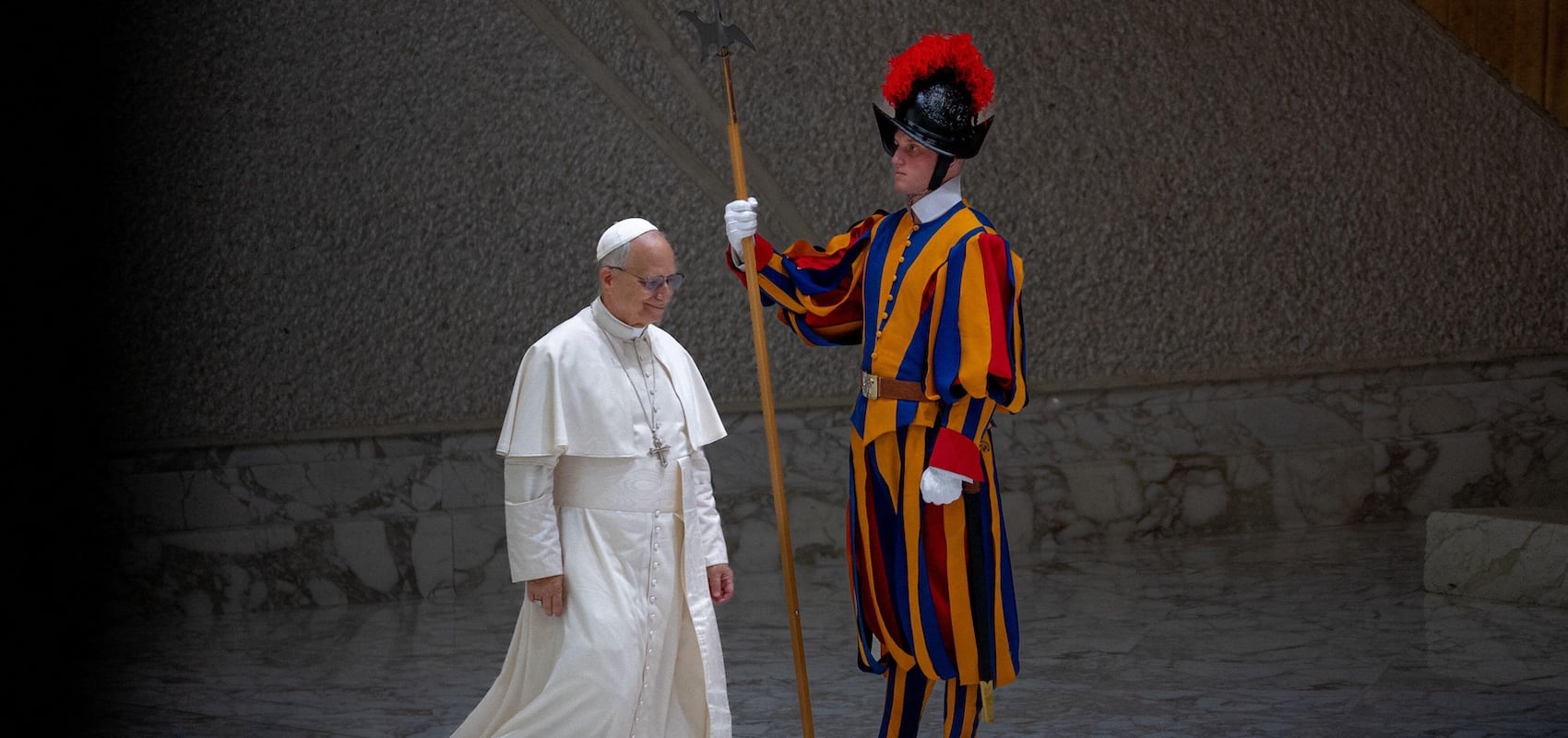
The first encyclical letter of Pope Leo XIV has been engaged widely on its substance, but its manner of presentation was also noteworthy—and likely contributed to how much attention it received.
Encyclicals are customarily presented by the relevant Vatican department heads in the press hall to journalists. Magnifica Humanitas was not presented at such a press conference, but to an audience of largely curial officials, more akin to delivering remarks on a paper at an academic conference. The usual curial cardinals gave their presentations, as did guest Chris Olah of Anthropic, with the Holy Father presiding and also addressing the gathering.
There were no questions from journalists, who no doubt would have felt obliged to ask Leo about Iran, or insults from Donald Trump on social media, or other topics that would have shifted attention away from artificial intelligence, the encyclical’s focus. As a result, some quite interesting questions also went unasked, such as: Should Catholic schools permit students to use AI? Should the pontifical universities in Rome? Homily “helpers” have been around for decades through the mail and internet—is AI something different, to be avoided by preachers in preparation?
Those questions will eventually get asked, and it is likely that the Holy Father thinks other people should answer them; Magnifica Humanitas refers often to the principle of subsidiarity.
How else was Magnifica Humanitas’s presentation noteworthy?
The Holy Father, presenting his first encyclical to the world, spoke entirely in English. As did Olah and one of the curial cardinals. It was the day after Pentecost, but the successor of St. Peter cannot be understood by all in their native languages, so he must choose one. It is usually Italian, the local language in Rome and thus the working language of the curia. And it is not an international language, showing no favor to English, or Spanish, or French.
The world of tech and commerce does have a lingua franca though, and it happens to be the Holy Father’s mother tongue, so it made perfect sense to use English. Still, it was a major departure from Vatican customs. It meant that every video clip featured the pope speaking in English—no translation needed by the audience he was trying to reach.
The most frequently shown clip was that of Leo saying that AI needed to be “disarmed.” The Holy Father then commented on his own choice of words, his communication strategy: “The word is strong, I know, but deliberately chosen because this moment needs words capable of attracting attention, awakening consciences and indicating paths forward for humanity.”
If attracting attention—and good, thoughtful attention—was the intention of Magnifica Humanitas’s presentation, it was successful. Over many years, Robert Prevost kept a low profile despite holding senior roles. In just a year as pope, he has learned about the media environment of the papacy.
In this there is a similarity to Pope Francis, who arrived in Rome famous for not giving interviews in Buenos Aires. He quickly began to do so as pope, and gave so many so frequently that there were even some book-length interviews that went unnoticed. Just as at Pentecost, Peter appears to receive the gift of speech, if not tongues.
Magnifica Humanitas continues a novelty introduced by Francis. Generally, encyclicals are addressed to the Church, often beginning with bishops and ending with the “lay faithful,” though St. John Paul the Great addressed two important encyclicals—Veritatis Splendor and Fides et Ratio—to his brother bishops alone. St. John XXIII addressed his landmark 1963 encyclical on peace—Pacem in Terris—to “all men of good will,” an innovation generally repeated for encyclicals on the Church’s social teaching.
The three encyclicals of Pope Francis—Laudato Si’, Fratelli Tutti, and Dilexit Nos—were not addressed to anyone in particular. It doesn’t greatly matter, but it is a new papal style. The epistolary form, even at more than 40,000 words, implied a relationship between a pastor and people, shepherd and flock. Could it be that Leo in Magnifica Humanitas is attempting to reach people with whom he has no relationship, and whose “good will” cannot be presumed?
Great attention was paid to the invitation extended to Chris Olah of Anthropic, one of the AI giants. Anthropic famously refused the Pentagon permission to use its products for autonomous warfare, in which potentially lethal decisions are taken by AI, not actual human beings. Since the presentation of Magnifica Humanitas, Anthropic has called for a general slowing down of all AI development, precisely to ensure that it does not develop without human oversight.
It’s a risk to invite guests—especially atheists like Olah. He spoke frankly, suggesting that AI might have a certain consciousness, even a form of personality, that Leo himself rejected in Magnifica Humanitas. Olah was respectful and confessed the need for others to point out what AI developers cannot see from the inside. “I will be honest,” Olah said. “We keep finding things that are mysterious, even unsettling. We find structures that mirror results from human neuroscience. We find evidence of introspection. We find internal states that functionally mirror joy, satisfaction, fear, grief, and unease. I don’t know what that means, but I think it warrants ongoing discernment.”
Olah’s address is one of the most important from within the tech world on the moral and cultural, not merely economic, implications of AI. Had it been given at a Silicon Valley investment meeting, it may have been overlooked. Given at the Vatican—urbi et orbi—it may get the audience it deserves.
A final note about how Magnifica Humanitas presents itself: The encyclical includes two lengthy chapters on the history of Catholic social doctrine, akin to the lectures about the discipline as a whole given at the beginning of a course before the particular subject is addressed. That fits with Leo’s clear intention to be a figure of continuity, lifting up all of his predecessors, even including the most unlikely image in that history, the “multifaceted polyhedron” that Francis introduced to the lexicon.
The principal images that Leo employed were biblical, juxtaposing the building of the Tower of Babel with Nehemiah’s rebuilding of Jerusalem. Encyclicals are filled with biblical quotations, but don’t often dwell on biblical moments to frame the entire discussion. The last to be framed as such was Veritatis Splendor, in which John Paul II used the encounter with the rich young man as the context for properly understanding moral theology.
The quiet missionary from Peru showed himself his own man with the presentation of Magnifica Humanitas, a sign that Peter can still speak to the nations.
Dear Reader,
Can I be direct with you?
War abroad. Socialists on the rise. AI upending human life. Endless uproar online. The modern attention economy doesn’t want readers — it wants users enslaved to the tyranny of the present.
First Things is the antidote: literary excellence, timeless truths, and a fixed point of reference in a culture that has lost its bearings.
But we can’t do it without readers like you.
Our goal: Raise $150,000 by November 1 to sustain First Things in the year ahead.
Your gift anchors readers in the permanent things.
Make your Fall Campaign gift now using the button below.
If you have any questions or would like more information, please contact Giovanni Del Piero, Director of the Editor’s Circle, at gdelpiero@firstthings.com or 212-627-1985.

YOU MIGHT ALSO LIKE
Why the Death Penalty Is a Sore Point for Papal Authority
Pope Leo XIV marked World Day Against the Death Penalty, observed on October 10, with the following…
Candace Owens and the Sin of Anti-Semitism
According to the online Encyclopedia Britannica, Sir Moses Montefiore (1784–1885) was “an Italian-born businessman who was noted…
The Myth of St. Francis
At the beginning of his 2020 encyclical, Fratelli Tutti, Pope Francis speaks of “an episode in the…
