
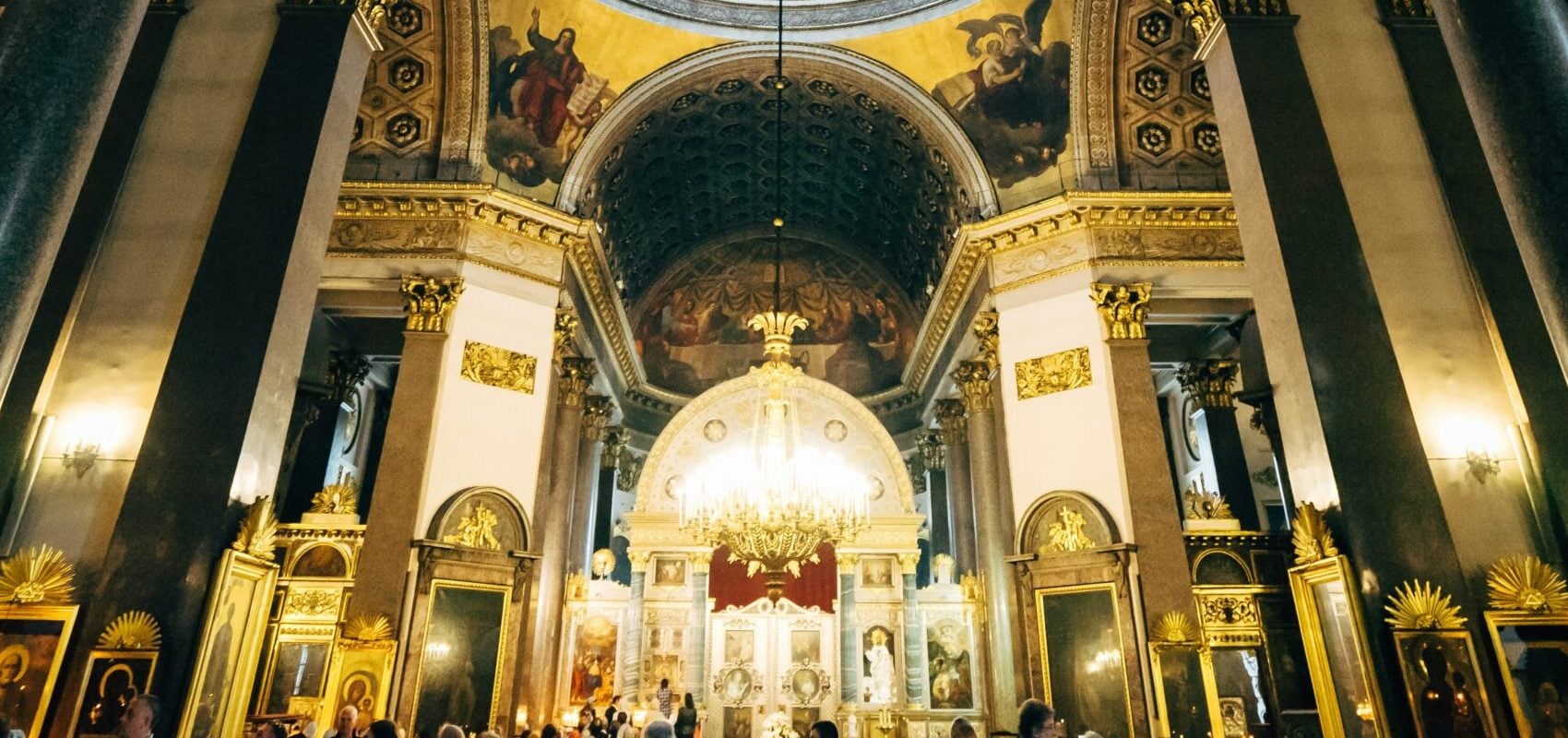
Bulbous onion domes topped the Corinthian columns, and baroque stucco architraves lit up the drowsy city toward the end of day. The clock struck five as I approached the Kazan Cathedral. Inside, the church was dark but gilt-edged. Puffs of incense lingered among the faded murals, whose shades merged in a sfumato. It was a Friday evening in late December 2015, and I was visiting St. Petersburg as a tourist. This was the first time I had attended the Divine Liturgy at an Orthodox church.
Enigmatic ladies in headscarves lit candles and queued to kiss ancient icons. They moved among relics lit by lamps and candles, kissing the glass and then quickly rubbing away the marks. Soft, fervent whispers echoed in the vaulted, frescoed naves. Church Slavonic—a language of soft sibilants and palatal fricatives, zigzagging sentences and repetitive poetics—was made for whispering and chanting.
Vigil lamps hung from brass chains. Somewhere, the First Antiphon was being chanted a cappella: fragments of a mystical vision, a bridge to the beyond. The purity of the human voice, the most perfect instrument of praise. No guitars here, just tradition and continuity.
Bearded men in heavy cassocks emerged from hidden doorways behind the iconostasis, swinging chinking censers. Then they disappeared, dragging their shadows behind them, only to reappear moments later from another concealed door, bearing a heavy, ancient book with marbled edges. The booming basso profondo of the priest’s voice resonated from the ambon.
By the end of the service, I was aware that I had witnessed a kind of reverence and holiness that I had never found elsewhere. This form of worship appealed to the inner self, the private inner sanctuary of peace. In the days that followed, I walked the streets of St. Petersburg beneath cupolas that glittered in the reddish light of the low sun. Occasionally, I hopped into a church to escape the cold and return to that otherworld of holiness. I felt that I was being taken to an ancient past and at the same time being shown a new future. A single moment of revelation, and a life can be transformed.
After five days in the city, I returned to Oxford, but I couldn’t forget those glimpses of the transcendent. The following year, I went to Romania and once again found myself going from church to church, drawn by Orthodoxy’s continuity, steadfastness, and philosophical magnetism. I had not had a theistic upbringing. Never tempted by atheism, I subscribed to Pascal’s wager. Perhaps I wanted to be a Christian but regarded this path as too difficult in the modern, hedonistic world. I am a linguistic anthropologist, and I had long enjoyed visiting churches, in part because I perceived them to be a window onto the local culture.
Then, fate intervened. I was offered a post as an associate professor at one of the universities in Moscow. It was some years later, after I became an Orthodox Christian, that I realized that God had brought me to Russia.
When I first came to Moscow, I frequently visited a host of churches and monasteries around the city. Billed as the third Rome, Moscow is home to hundreds of Orthodox churches. Initially, my interest was more ethnographic than personal. I was intrigued by Church Slavonic and how parishioners relate to this language, which many of them only partially understand. Every Easter and Christmas, I would attend the Divine Liturgy at St. Nicholas the Benefactor, which dates from the seventeenth century. It was a phenomenological awakening that left me suspended somewhere between heaven and earth.
I was looking for the romance of Holy Russia, I suppose, but it was much more than that. I felt closer to the sacred in these places where worshippers had been coming for hundreds of years, because a greater sense of otherness is to be found there. As an exotiste (as the French might describe me), I have no difficulty in admitting that otherness has a great appeal for me. An English-language Orthodox service in a brand-new church would never have the same sacred allure.
Over time, it became apparent that this allure was not merely academic. My heart was yearning for the sacred; there was an emptiness that needed to be filled. I could no longer be just an observer.
I met Fr. Andrei in August 2023. We sat on the bench in the garden at St. Antipas Church in the center of Moscow, a stone’s throw from the Kremlin. Fr. Andrei’s first question was, “How old are you?” Perhaps he was wondering what would make a person seek God at this point in his life. That question was followed by, “Why do you want to become Orthodox?” (I was christened in the Church of England.) It was an obvious question, but I didn’t have an answer. I had not yet really grasped the idea that I might actually convert. “I am looking for the transcendent, and I think I can find it here,” I replied—perhaps pompously, but honestly. I wanted to deepen those intimations I had received of a world beyond.
At the end of our meeting, Fr. Andrei gave me his number. We both had left our phones at home, so he wrote the number down on a piece of paper. When I got home, I found his name and profile photo in my WhatsApp list, even though I had never met him before. I told my friend Olga, who had put me in touch with Fr. Andrei. “Oh,” she said. “Stick with him. He is your batyushka” (spiritual guide). At times I did not feel entirely in control of the “conversion” process. It was as if a wind were blowing behind me.
I spent six months reading the Gospels, the psalms, The Way of a Pilgrim, and some of the early Church Fathers, as well as the works of Schmemann, Alexander Men, and Seraphim Rose. There were certainly many doubts. What made me most anxious of all was the life confession I would have to give—in Russian! Where would I start with that? How would I structure it? John Krestiankin’s book The Experience of Preparing a Confession was a great help in this respect.
I close the door of the church and shut out the vexations of the ordinary world. A few worshippers skulk in the antechapel. Confessants queue, asking to have their transgressions wiped away. Old women bent like question marks whisper supplications. Dripping candle wax: God is listening to the accounts of mortals.
It is eight o’clock on a Wednesday morning in March 2024. I join the congregation at matins and stand in my normal spot. My sweaty hands grip my five-page life confession, over which I have been laboring these past weeks. I am a little tense. I am not sure that Fr. Andrei will understand my confession, or indeed what the ceremony will entail.
After about twenty minutes, Fr. Andrei appears. He leads me down to the crypt, kisses the icon of St. Matrona, then leads me into a small private room. I wish he would fill the silence with some chitchat. I feel myself tensing up slightly. He leads me to the analogion, where I will read the confession, and asks me to kiss the Bible and crucifix. I read the confession, stumbling over the odd word. I have the text in front of me, and I notice that Fr. Andrei occasionally peers at it to check what I am saying. It probably takes fifteen or twenty minutes. I am relieved to get it over with. There are no questions or points of clarification. I had expected to be interrupted, but there was nothing. I stand in silence, my head bowed.
Fr. Andrei takes the text, tears it into pieces, and tells me to carry it away and bin it. One life has ended, and a new one begins. He places the epitrachelion over my head and pronounces the words of absolution. Then he reads a number of lengthy prayers. I am asked to read aloud certain oaths to the Russian Orthodox Church. Then I am asked to say the Nicene Creed. I have not memorized it in Church Slavonic and am fortunately given the text. There are some more prayers, and then he asks me to remove my socks and shoes. He opens a little wooden box containing scissors, holy oil, and various small instruments. It looks like a repair kit, and I suppose in a way it is. He dips the anointing brush in the holy oil and paints a cross on my forehead, then all over my face, ears, hands, and feet. It is a regal ceremony.
He tells me to attend the liturgy and take communion. I put on my shoes and socks and go up to the nave. The congregants are on their knees. I soon realize that this is not the normal St. John Chrysostom Liturgy. Later I discover that I have been chrismated on the day of the Liturgy of Presanctified Gifts—an ancient service in which the Eucharist is received from gifts that were consecrated in a previous Divine Liturgy. The service is long and very penitent, with lots of kneeling and praying.
The ritual repetition of liturgy is a spiral of conflated endings and beginnings. At the end of the liturgy, there is communion. This will be my first time partaking of the divine gifts. I cross my arms over my chest and join the line of worshippers. I say my Orthodox name (Stephan), take the holy gifts, and kiss the chalice. I used to associate kissing with sexuality, but increasingly I associate it with my new spiritual path. I walk out of the nave, arms crossed, head bowed. I felt—to use Kundera’s term—a “lightness of being” (I literally felt ten kilograms lighter), a stillness, and a profound happiness. These feelings lasted for about two months after my chrismation.
At first I told relatively few people of my conversion. It shocked even those who understood that it was not politically motivated. Some stopped speaking to me. An old friend from Oxford said he was disappointed that I had “subscribed to a conspiracy theory.” Yet none of these reactions perturbed me much. Everything had more meaning now. A few months after my chrismation and after the sudden death of my beloved spaniel, Stan, I developed a relationship with the icon of Seraphim of Sarov, known for living many years with animals in the forest. This icon and others became, along with the liturgy, features of Orthodox worship that manifest for me God’s grace.
Since becoming Orthodox, I visit a church a few times a week. I might just light a candle and say a prayer; sometimes I attend the Divine Liturgy or listen to an akathist. Before I became Orthodox I often visited churches, but now I have a dialogue with God and some of the saints. The sacred that I sought previously has been found and anchored to a faith.
I say grace before meals in Church Slavonic, always wear my cross, and often have a prayer rope in my pocket. Orthodoxy has imparted a new structure to my days. Perhaps above all, Orthodoxy has reminded me of the centrality of love to the Christian creed. In the back of my mind, I always have Fr. Andrei’s voice: Bog yest’ lyubov’, Stephan. Bog yest’ lyubov’ (“God is love, Stephan. God is love”).
When I return to Britain, it feels like a spiritual void. When you talk about God, people look at you as if you were mad. In place of the transcendent, Anglicanism serves up rationalism and social-justice rhetoric unrelated to any notion of the sacred. A church should be a window onto the divine. The dogmatic prioritization of secularism over Christianity surely explains many of the ills of contemporary Europe.
I understand why British people respond as they do when you talk about God. The style of contemporary Anglican worship does not invite otherworldliness. I think a transcendent style can begin with the senses. But these sensations must be anchored to a faith and draw the worshipper closer to God. Orthodox worship is not just “smells and bells”!
The Russian people are spiritually grounded, guided by mystery. I am struck by this fact time and again. Relatively few Russians attend church services regularly, but it is obvious that the majority believe in God and have roots in their faith. I have visited many homes of Russian people who haven’t been inside a church for years but have an icon on the wall of St. Nicholas the Wonderworker or St. Sergius of Radonezh.
Orthodoxy has shown me that the spiritual can be reached through the sensual. I like the fact that Orthodoxy does not try to explain things too much, but lets beauty be the conduit to the divine. Orthodoxy is centered on the monastic tradition, and I like that too: the solitude and simplicity manifested in the Jesus Prayer. This is the faith of the Desert Fathers; it goes right back to the foundational figures of Christianity and their immense wisdom. This faith guides so much of our worship. I also like the fact that the psalms feature so prominently in Orthodox worship. This ancient poetry is full of divine guidance on how to live your life. So many people go to therapy nowadays, and I can’t help thinking they would find some answers in the psalms and the Book of Proverbs. Eighteen months after entering into the Orthodox faith, I still have some difficulties with confession, but the appeal of icons grows all the time. Icons help me develop a personal relationship with a saint, the Theotokos, or Jesus Christ. Over time, veneration brings about a sense of proximity.
I have always been a traveler, and I am still starting out on my spiritual journey. Orthodoxy has two thousand years of history, and every day there is something new to learn about one of the saints. I have found the transcendent, even if not the transcendent I had in mind. I have found an everyday transcendent, which manifests itself in inner calm and stability amid the chaos of the modern world. You only need to have a clean heart (chistoye serdtse), to keep God close to you, and the path to serenity will open up. Occasionally, I find I can float above things because I understand what really matters: God and the people and animals around you whom you love. The rest is just window dressing, more or less.
Dear Reader,
Can I be direct with you?
War abroad. Socialists on the rise. AI upending human life. Endless uproar online. The modern attention economy doesn’t want readers — it wants users enslaved to the tyranny of the present.
First Things is the antidote: literary excellence, timeless truths, and a fixed point of reference in a culture that has lost its bearings.
But we can’t do it without readers like you.
Our goal: Raise $150,000 by November 1 to sustain First Things in the year ahead.
Your gift anchors readers in the permanent things.
Make your Fall Campaign gift now using the button below.
If you have any questions or would like more information, please contact Giovanni Del Piero, Director of the Editor’s Circle, at gdelpiero@firstthings.com or 212-627-1985.

YOU MIGHT ALSO LIKE
Why the Death Penalty Is a Sore Point for Papal Authority
Pope Leo XIV marked World Day Against the Death Penalty, observed on October 10, with the following…
The Myth of St. Francis
At the beginning of his 2020 encyclical, Fratelli Tutti, Pope Francis speaks of “an episode in the…
Job and Her
It is said that Job lost everything, but she has lost more. All her possessions—the money, the…
