
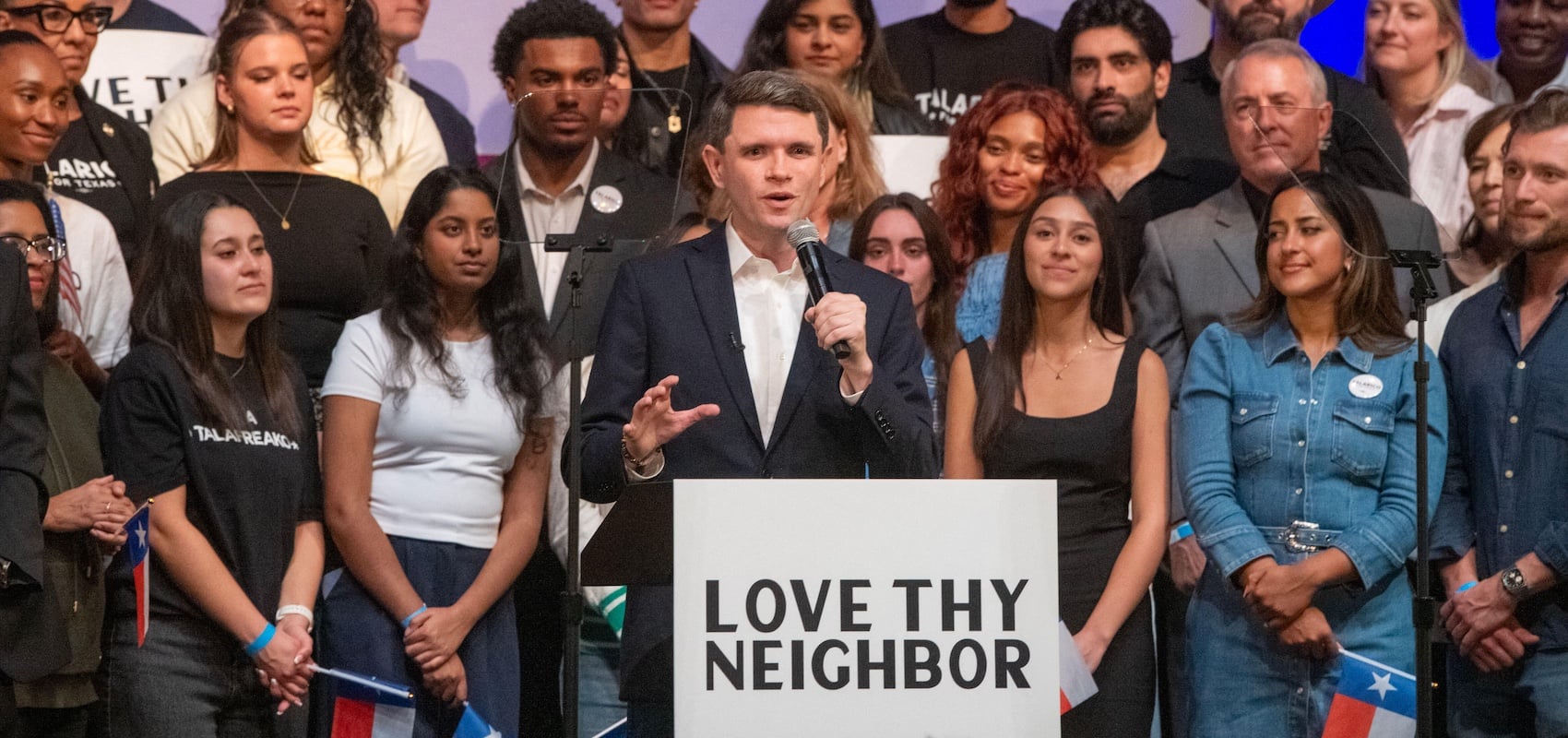
Democrats won a string of midterm victories across the country, many of them unexpected. One popular narrative to emerge from the results is captured in this Wall Street Journal headline: “After Decades of a Religious Right, Democrats Find a Religious Left.”
James Talarico, a Presbyterian (PCUSA) seminarian, will be the first Democratic senator elected in Texas since the 1980s. Adam Hamilton, a Methodist (UMC) megachurch pastor, will be the first Democratic senator from Kansas in more than eighty-five years. In addition, Sarah Trone Garriott, an ELCA pastor, and Lindsay James, a PCUSA minister, each flipped a House seat from Republican to Democrat in Iowa. All four of these candidates—three ordained ministers and a seminarian—cited Christ’s call to care for the poor as their primary motivation for supporting the Democratic policy agenda.
If you had told me a year ago that the Democratic Party would have a number of candidates in major congressional races who centered their campaigns on their Christian ministry, I would have been shocked. If you had further revealed that the entire party would rally around these candidates and that they would pull off historic wins, I would have been incredulous.
Something startling happened, yes. But it wasn’t the birth of a “religious left” counterpart to the “religious right.” Despite commentators affixing the broad label, what they are really referring to is the white mainline Protestant left. All four of these successful candidates come from churches that are theologically and politically liberal, the types of churches that were prominent in the Social Gospel movement that arose at the end of the nineteenth century. At that time, these churches and denominations were the largest, wealthiest, and most culturally powerful institutions in the country and had significant influence in the progressive movement. They were successful in setting up private institutions and advocating for government assistance to address social problems such as poverty, poor public health, and lax worker protections.
While Senator-elect Hamilton has an enormous congregation in his own church, mainline denominations continue to shed members and are a faint shadow of what they used to be. These are not institutions that are presently capable of bringing about and supporting a potent new political movement. There is no indication that widespread organized action occurred at the grassroots level across these churches in this election. Nothing happened that demonstrated the rise of a movement comparable to the “religious right,” which influences tens of millions of voters and has an extensive grassroots network.
The victorious campaigns of these candidates do suggest, however, that some potentially significant changes may be afoot in the Democratic Party and in American politics. Over the years, the Democratic Party became largely captured by anti-religionists who assert that religious faith must be kept out of the public square. The main reason these candidates received so much attention is that it is highly unusual for someone who highlights their Christian ministry (and is not black) to make it through a Democratic primary election and be widely embraced in the party. That all four did suggests anti-religionists had already lost some of their power. Now that these candidates have won and become political heroes, the party has an incentive to make more room for those who speak openly about their Christian faith.
That receptiveness is likely to be limited, at least at first. After all, none of these candidates stepped far out of line, if at all, on the Democratic issue agenda. It will be another matter when a faithful candidate’s convictions lead somewhere the party doesn’t want to go. But it will be welcome progress if the party begins to rid itself of the intolerance shown to those who speak about the primacy of their faith in guiding their politics. This is a necessary first step if there is any hope of returning the Democratic Party to the position it held not long ago, when abortion was considered an issue of conscience and those who supported pro-life policies were accepted.
Outside of the party, the fact that Democratic senators and representatives are forthrightly speaking about how their Christian faith calls them to be active in politics should help quiet the anti-religionists. Hopefully this will dispel the prejudice against voices of faith in the public square and allow us to return to the kind of open debate that our nation desperately needs.
These victories will also likely draw more liberal Christians into politics. When something new succeeds in politics, others are bound to follow suit. The downside of this will be more candidates who make false Christian claims, such as James Talarico’s ghastly interpretation of the Annunciation as proof of God’s support for abortion.
Our disgust over such statements, however, should not stop us from giving credit to these candidates for proclaiming and demonstrating some of Jesus’s foundational teachings. In the midst of an incredibly brutal campaign, when Talarico was asked by an interviewer whether he loved his opponent, Ken Paxton, he said, “Yes, [because] Ken Paxton is a child of God. He is my brother in Christ.” The placard on the rostrum from which he gave his victory speech on election night simply read “Love Thy Neighbor.” It is my profound hope that these and other examples of Christian witness we saw in this election will give courage to others to do the same.
The midterm elections may have ushered in a big shift, one especially consequential for Christians. But it is probably not the one that mainstream observers would have us think.

YOU MIGHT ALSO LIKE
The Birth of Free Speech
In the latest installment of the ongoing interview series with contributing editor Mark Bauerlein, Michael Fontaine joins…
The Vatican and the Good of Judaism
Since the Second Vatican Council, Catholics have known that they can’t accuse Jews of “killing God.” But…
The Internet of Almost Everything
The editors discuss Pope Leo’s South America journey and his voting habits, a string of suspicious “cyber-faliures,”…
