
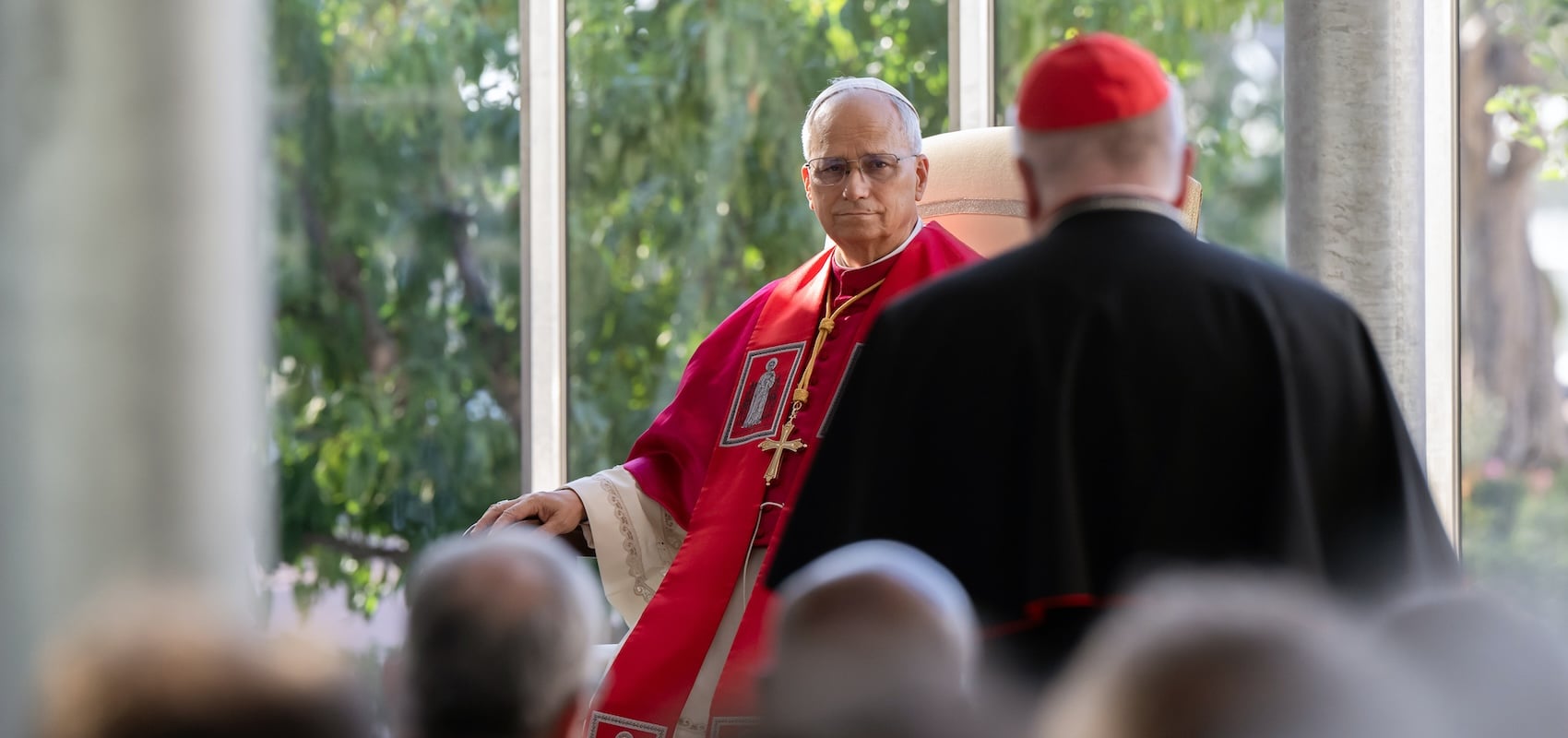
Pope Leo XIV marked World Day Against the Death Penalty, observed on October 10, with the following message on X:
The death penalty is inadmissible because it is an attack on the inviolability and dignity of the person. The common good can be safeguarded and the requirements of justice can be met without recourse to capital punishment: effective systems of detention have been developed that protect citizens while at the same time do not completely deprive those who are guilty of the possibility of redemption. #NoDeathPenalty
To all but the crustiest reactionaries among Western elites, plus some populists, the statement might well seem obvious. It is not obvious, however, for Catholics, and this needs to be explained.
The X post borrows language from Pope Francis’s 2018 revision of the Catechism of the Catholic Church. That revision also notes that “recourse to the death penalty on the part of legitimate authority, following a fair trial, was long considered an appropriate response to the gravity of certain crimes and an acceptable, albeit extreme, means of safeguarding the common good.” The difficulty is that it was “considered” in this way throughout Scripture, by the Fathers and Doctors of the Church, and by all the popes who spoke on the subject, up to and including Pope Pius XII.
Pope Francis’s novel position on the death penalty built on foundations laid by Pope John Paul II, who developed the view that capital punishment is no longer necessary and is at least in some tension with human dignity. As he wrote in his 1995 encyclical Evangelium Vitae, appealing to “the inviolability of human life”: “Modern society in fact has the means of effectively suppressing crime by rendering criminals harmless without definitively denying them the chance to reform.”
Leaving aside the curious claim that criminals on death row don’t have “the chance to reform,” it is worth noting that a few years earlier, in the then-new Catechism, the teaching had been more cautious: “If bloodless means are sufficient to defend human lives against an aggressor and to protect public order and the safety of persons, public authority should limit itself to such means, because they better correspond to the concrete conditions of the common good and are more in conformity to the dignity of the human person.” This is still surprising, however, as what precedes it is a discussion about punishment’s “medicinal” and, if accepted voluntarily, “expiatory” effects. The Catechism does not explain why the ultimate punishment, death, is contrary to the criminal’s dignity, whereas lesser punishments affirm it.
Pope John Paul’s position was, nevertheless, anchored to a prudential judgment. Though he expressed it emphatically, he was clearly taking a view about social and institutional realities, and when assessing such complex and continuously changing facts about the temporal realm, a pope is not able to exercise the gift of infallibility. Some pointed out, for example, that countries outside the rich world could not in practice render criminals harmless by incarceration. The notorious drug baron Joaquín Guzmán, known as “El Chapo,” escaped from prison in Mexico in 2001, and then again in 2015. Before escaping, he, like many criminals, continued his activities—coordinating drug smuggling and ordering the assassination of opponents—from behind bars. At any rate, Pope John Paul was making a generalization about specific historical conditions, not stating a universal moral principle.
Pope Francis’s statements, and now Pope Leo’s, build on this threefold confusion: first, that modern conditions have made the death penalty unnecessary for the defense of public order; second, that it is contrary to human dignity; and third, that it makes it less likely that a criminal will repent. Pope Francis made the situation incomparably more difficult, however, with the conclusion he drew from these contentions, in his revised Catechism text: “Consequently, the Church teaches, in the light of the Gospel, that ‘the death penalty is inadmissible because it is an attack on the inviolability and dignity of the person.’” This looks very like a claim that the death penalty is always and everywhere wrong, and not merely unjustified in modern conditions.
It was characteristic of Pope Francis to leave a degree of ambiguity in his more controversial statements, and some of his defenders have insisted that “inadmissible” (in Latin, non posse admitti; in Italian, inammissibile) actually means “not ideal in modern conditions.” This is stretching the point, but an even more implausible reading is needed of the words “it is an attack on the inviolability and dignity of the person.” The fact is, if Pope Francis had been happy with the original wording of the Catechism, which tied the rejection in practice of the death penalty to modern conditions, he need not have changed it.
What Pope Francis did was crystallize Pope John Paul II’s perhaps over-hasty generalization about modern prisons into something that is clearly incompatible with the historic teaching of the Church. We do not have to go back very far to find statements such as this, from Pope Pius XII in 1952: “Even when it is a question of the execution of a condemned man, the State does not dispose of the individual’s right to life. In this case it is reserved to the public power to deprive the condemned person of the enjoyment of life in expiation of his crime when, by his crime, he has already disposed himself of his right to live.”
There is another problem. Incarceration is routinely invoked to show that capital punishment is unnecessary, but life imprisonment today means decades of hideous overcrowding, constant violence, and sexual abuse. In 2024, Pope Francis himself called life imprisonment “a hidden death penalty,” hitting on an important point. As the Anglican theologian Oliver O’Donovan argued, all punishment takes something from a criminal’s life, and implies the state’s right to take it all. O’Donovan in fact opposed the death penalty in practice, for a quite different reason: a concern over the competence of the legal system. Opposition of that kind has always been open to Catholics. What is new, and what Pope Leo has now repeated, is the claim that the death penalty itself is wrong.
Image by Mazur/cbcew.org.uk via Creative Commons.
Dear Reader,
Can I be direct with you?
War abroad. Socialists on the rise. AI upending human life. Endless uproar online. The modern attention economy doesn’t want readers — it wants users enslaved to the tyranny of the present.
First Things is the antidote: literary excellence, timeless truths, and a fixed point of reference in a culture that has lost its bearings.
But we can’t do it without readers like you.
Our goal: Raise $150,000 by November 1 to sustain First Things in the year ahead.
Your gift anchors readers in the permanent things.
Make your Fall Campaign gift now using the button below.
If you have any questions or would like more information, please contact Giovanni Del Piero, Director of the Editor’s Circle, at gdelpiero@firstthings.com or 212-627-1985.

YOU MIGHT ALSO LIKE
Candace Owens and the Sin of Anti-Semitism
According to the online Encyclopedia Britannica, Sir Moses Montefiore (1784–1885) was “an Italian-born businessman who was noted…
The Myth of St. Francis
At the beginning of his 2020 encyclical, Fratelli Tutti, Pope Francis speaks of “an episode in the…
Job and Her
It is said that Job lost everything, but she has lost more. All her possessions—the money, the…
