
It’s now 250 years since America declared her independence and embarked on the experiment of fashioning a nation dedicated to liberty. Do those long-ago events and the deliberations of men who wore frock coats and powdered wigs continue to matter today? My assignment for Hillsdale College’s seventeenth annual Constitution Day Celebration in Washington, D.C., was to answer this question.
Hillsdale is well known for its devotion to America’s founding principles, which motivated me to begin my remarks to the gathered patriots with the mischievous suggestion that there are plausible reasons to answer the question with a resounding “no.”
One of those reasons rests in our nation’s history. We speak of the Revolution, by which we mean 1776 and its aftermath. We also capitalize “the Founders,” the heroic generation that led men on the battlefield, articulated noble and enduring principles for government, and wrote our Constitution. But truth be told, there have been subsequent revolutions and other founders.
The Civil War marked the American character in profound ways. Its bloodshed was unprecedented, and the outcome of the war put an end to the sectional settlement that accommodated slavery in the South, which had been an important aspect of our first founding. Scholars—premier among them, Harry Jaffa—have argued that Abraham Lincoln was the guardian and restorer of the true meaning of the nation’s founding. I’ll concede the claim. Nevertheless, the war transformed the relation of the various states to the federal government. The people of South Carolina (and any other state) no longer had the liberty to forge a way of life at odds with the national consensus.
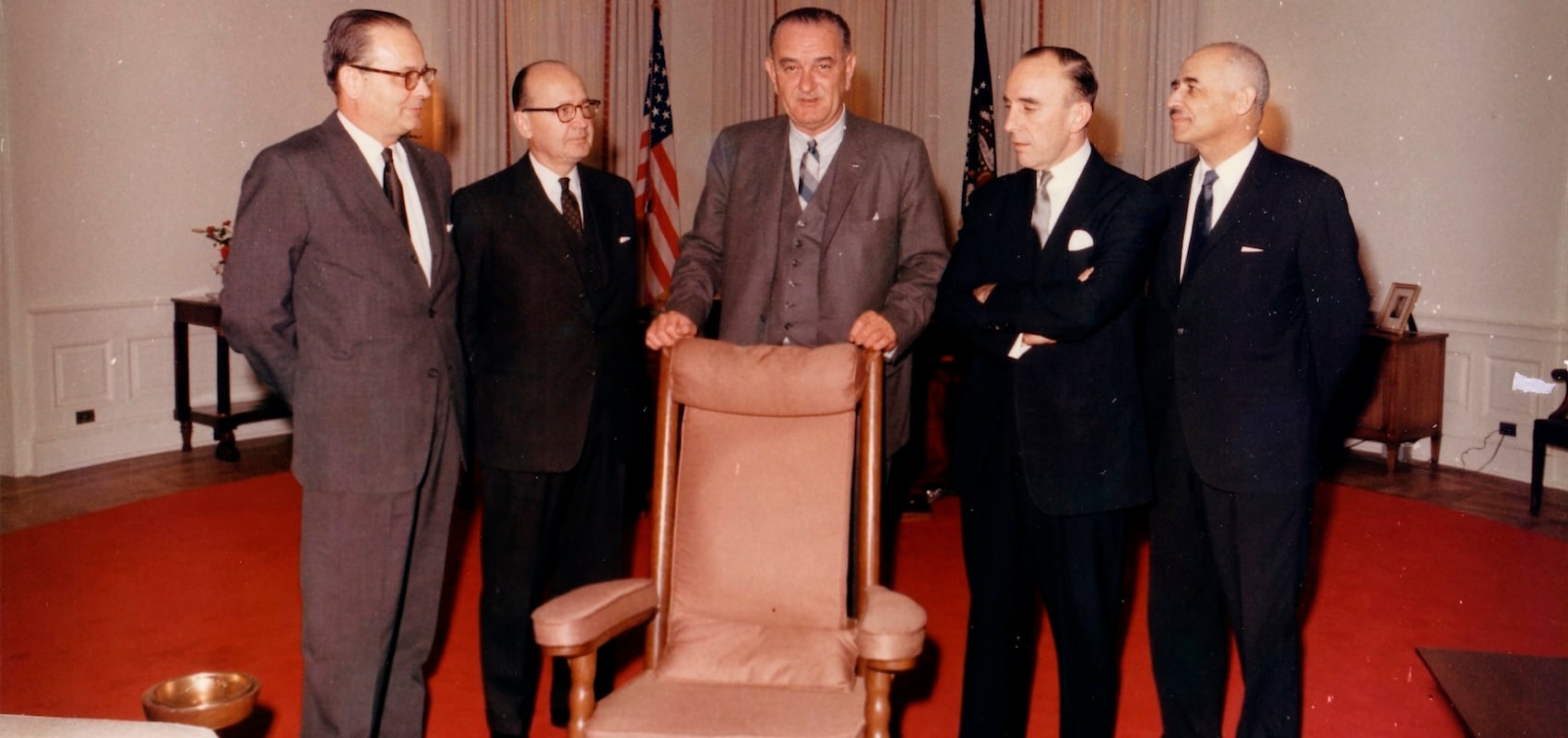
In the decades after the Civil War, the rise of modern industry created a new economic power unimagined by James Madison when he so wisely conceived of the notion of separation of powers, which ensures checks and balances to fend off tyranny. Beginning with Teddy Roosevelt and Woodrow Wilson, we entered another revolutionary phase, erecting an administrative state to limit economic power. That revolution was amplified by FDR’s New Deal, and it was made permanent by the total mobilization necessary to win World War II. In his 1936 speech accepting the Democratic Party’s renomination as their presidential candidate, Roosevelt himself made the argument that his new measures vindicated and fulfilled the Founders’ principles. Again, even if we concede the claim (I find it plausible), we must allow that FDR oversaw a profound transformation of government and economic affairs. The same can be said of Lyndon Johnson’s presidency. The cause of Civil Rights and the vast ambitions of his Great Society programs fundamentally altered the relationship between government and civil society.
As the old TV commercial for Virginia Slims cigarettes put it, “You’ve come a long way, baby.” Under our present political and social arrangements, which are so different from those that obtained in the early years of the republic, the treatises written by German legal theorist Carl Schmitt cast more light on today’s functional Constitution than do the Federalist Papers.
There’s another reason to think that the Founding offers little in the way of guidance in our current circumstances. The men who drafted the Constitution recognized the fragility of a free society. They knew that the experiment in republican self-government required a morally disciplined populace and strong traditions of civic obligation. As John Adams said, “Our Constitution was made only for a moral and religious People. It is wholly inadequate to the government of any other.”
Here, too, we’ve come a long way, baby, and the journey has not been toward consolidating and strengthening ourselves as a moral and religious people. Most troublingly, as I discussed last month (“The Stench of Corruption”), those in positions of leadership in twenty-first-century America seem possessed by an imperative of self-enrichment that is indifferent to honor and civic obligation. Under these circumstances, we can be forgiven if we conclude that the Founders are relevant only insofar as they warn us that their political genius can be of little use to us, given our degraded moral character and civic life.
But I did not draw this conclusion when I spoke at Hillsdale’s Constitution Day Celebration, for I believe that careful study of the remarkable achievement of the American Founding can in fact be of great help to us today. We should adopt the Founders’ larger purpose, which was to undertake a revolution for the sake of preservation. And in pursuit of that goal, we should imitate their boldness.
Edmund Burke defended the rebellion in England’s American colonies. He understood the revolution as resistance to novel imperial demands that threatened the colonists’ long-standing liberties. On this interpretation, the revolution was conservative; it was revolution for the sake of protecting the culture of freedom that their forebears had already established on this continent.
In the event, what was preserved was also renovated, and on a grand scale. The Founders recognized that to sustain the promise of America, they had to create something never before attempted. I marvel at the inventiveness of our Constitution. Its design is original and counterintuitive. When I meet with European legal scholars and political theorists, I am often confronted with their skepticism about our regime. How can any coherent system of government operate without a clear concept of sovereignty? Who has final authority in disputed questions? Good questions, I allow. (Saying that “the people” have final say begs the question, since Madison’s design aimed to blunt all the instruments of government that the people might employ to have final say.) But I point out that, somehow, it has worked—and for a long time.
Perservation and renewal undertaken with a bold imagination: That’s what we need today. America’s traditions, our culture of freedom, and even our existence as a coherent people is being assailed—not by an imperious sovereign in London, but by powerful twenty-first-century realities buttressed by allied ideologies and powerful interests.
Economic transformations in recent decades have reshaped our society. It’s not just globalization, although that has had many well-documented effects on America’s working class. The domains of life that were once outside the market are now monetized. Let me give a small example. As a young man, I attended church dances and college parties with the aim of meeting girls. These were activities outside the marketplace. Today, I’m told, this primordial goal must be pursued through dating apps—creatures of the market, not civil society. Moreover, the economic system that makes market principles invasive has also produced unprecedented wealth, much of it concentrated in a new oligarchy. There is a money-power in today’s political culture that puts the robber barons of the Gilded Age into the shade.
Mass migration is another twenty-first-century reality that is transforming America. We are presently at historic highs of non-native-born residents of the country, approaching 15 percent. The cultural and political implications are dramatic, and if the rate increases, something like the Old South’s slave interest emerges, which is to say, the problem of determining how to preserve the democratic representation of actual citizens. When those who cannot vote swell to large numbers, this problem becomes difficult, as the Founders recognized.
Finally, we return to the concern the Founders expressed about the moral and religious character of the American people, but with an unhappy twist. Today, we witness the perverse phenomenon of the state-tolerated and even state-sponsored degradation of our general population. Legalized marijuana, so-called prediction markets, cryptocurrency: These and other ventures encourage vice and allow elites to asset-strip their fellow citizens.
This is not an exhaustive list of challenges facing America as we celebrate its 250th anniversary, but it is a daunting one. We must meet these difficulties and others (I have not addressed the pressure that our global empire puts on the workings of our domestic republic) if we are to remain true to the genius of the Founders. As they did, we must fight to preserve and renew our best traditions of liberty and republican self-government. And, like the Founders, we need to be bold, ambitious, and inventive. Our circumstances are difficult. There’s a great deal of ruin in the nation. In my estimation, we’ll need yet another revolution, a deep and lasting renovation of our regime that is as bold as the Founders’ grand venture more than two centuries ago and as far-reaching as FDR and Lyndon Johnson’s revolutions in the last century, however different in character ours must be.


YOU MIGHT ALSO LIKE
While We’re At It
♦ Erin Piacenti, a thirty-two-year-old wife and mother, was killed in Times Square on August 31. Her…
Smashing the Images
As the postwar era draws to an end, some Christians continue to reach for analogies to the…
A Cold Beauty
Jan Morris (1926–2020) was a writer of astounding gifts who not only recorded history but made it.…
