
Pope Leo XIV’s remarkable apostolic journey to Uruguay, Argentina, and Peru has been rich from so many perspectives—personal, pastoral, and theological. That it occurred at all, after the pope’s operation and removal of a cancerous growth on his lung, was little less than miraculous. The intensity of the exchanges in all three nations, but especially in his “home country” of Peru, was singularly affecting. The pontiff’s habitual pursed-lip smile opened into a radiant beam. And the content and import of his addresses—to civil authorities, to youth, to bishops and pastoral workers, to inhabitants of the Andes highlands and the Amazon rainforest—will be parsed for months to come.
Throughout his journey, but with understandable emotion in Argentina, Pope Leo referred to his predecessor, Pope Francis, affectionately and respectfully. He frequently cited Francis’s teachings in the encyclicals Laudato Si’ and Fratelli Tutti. But, as has been evident throughout his still-young pontificate, the document of Francis that clearly enjoys pride of place in Leo’s missionary mind and heart is Francis’s inaugural apostolic exhortation, Evangelii Gaudium. Its themes of loving encounter with the Savior and loving desire to share the Good News, so that others too may experience a saving encounter, enkindle Leo’s own spiritual and theological imagination and impel his call to evangelization.
In fact, Leo develops Francis’s insights and sensibilities more consistently and compellingly than Francis himself managed to do. Most strikingly, in his address to youth in Buenos Aires, Leo intoned Francis’s well-known invitation to “todos, todos, todos”; but he read it through a distinctively Christological lens. Leo said: “I would like to draw inspiration from those words to speak about what it means to live as disciples of Jesus: everyone toward Christ, everyone with Christ, everyone like Christ.” James Keating, in The Fourth Watch newsletter, rightly calls this a “subtle enhancement of Francis.” I would go even further and suggest that it bespeaks Leo’s own consistent and cogent focus on an explicit Christic center.
Another telling contention by the pope seems to have attracted far less attention. Yet I think it equally important, for it extends his Christological concentration to ecclesiology. In an address to “the bishops, priests, men and women religious, seminarians, synodal teams and pastoral councils” of the Chiclayo region, Leo asked: “How can we become a more synodal and missionary Church?” And he provided a response: “At the foundation lies our bond with Christ, rooted in Baptism. We all know that Baptism is the foundation of our Christian identity. Through it, we are incorporated into Christ, made children of God, members of the Catholic Church and sharers in her mission.” He then added this crucial conviction: “The first witness that any Christian community must give is the fraternal love that exists among its members, thereby reflecting the Most Holy Trinity. . . . For this reason, communion must precede mission.”
Communion must precede mission! For, if Christ is the joy of the gospel, then communion with Christ and with the members of his Body both enables and sustains all evangelizing efforts. Indeed, the unity and peace to which Leo so frequently urges both his fellow believers and people of good will are themselves the fruit of this deeper communion in Christ. And mission is the joyful extension of this communion. The Church’s social justice teaching is Christic in its inspiration and purpose. As Leo told another ecclesial assembly in Córdoba: “The pilgrim Church in Argentina is enriched by a deep sensitivity to the social needs of its children. From this sensitivity have sprung so many generous efforts to stand alongside those who suffer. However, this closeness must take us even further, because every person we serve is called to encounter Christ and to be transformed by him.”
Another forum in which Pope Leo’s Christic concentration is evident is that of the Catholic university. In a lovely reflection at the Catholic University of Uruguay, the pope dwelt on the need to cultivate the spiritual senses and said, “It is essential that we defend the sweet fragrance of the human person, grounded in the sweet fragrance of the Messiah. We need to proclaim anew that human life must be respected at every stage and in every condition.”
Then, addressing the faculty and students at the Catholic University in Chiclayo (of which he had been grand chancellor), Leo affirmed even more explicitly: “The university is called to be a training ground for talent and a laboratory of meaning, a place where intelligence does not bow to utility, but rather serves the truth faithfully. Above all, it is called to serve Truth—with a capital ‘T’—who is Christ, the Savior of the world.” In this regard, he celebrated the pastoral vision and undertakings of St. Turibius of Mogrovejo (after whom the university is named). In defending the dignity of the indigenous peoples, learning their languages, and proclaiming the gospel in their culture, Turibius was always guided by “the logic of the Incarnation.”
On his last full day in Peru, Leo traveled to Cusco, high in the Andes, and recalled how the ancient inhabitants ascended the majestic cliffs “in search of the divine.” But the gospel joyfully proclaims “God who descends in search of his sons and daughters,” becoming incarnate in the womb of Mary. And Christian faith continues to take on flesh in the customs and devotions, the culture, of a people.
From the Andes the pope flew to the Amazon city of Pucallpa, as if to embrace in one fond gesture the entire breadth of his beloved Peru. There, in a land of promise and exploitation, of heroism and bloodshed, Leo extolled believers who “are witnesses of our Lord Jesus Christ, who rather than coming down from the cross, gives his life for his people. Christ never abandons us. Christ is with you. The Church is with you, and you are her members. We are the body of Christ.” This is the foundation of synodality’s true substance and scope.
Toward the conclusion of Evangelii Gaudium, Francis wrote: “The primary reason for evangelizing is the love of Jesus which we have received, the experience of salvation which urges us to ever greater love of him. What kind of love would not feel the need to speak of the beloved, to point him out, to make him known?”
In the course of Leo’s magnificent journey, he not only proclaimed the joy of the gospel but also embodied it.
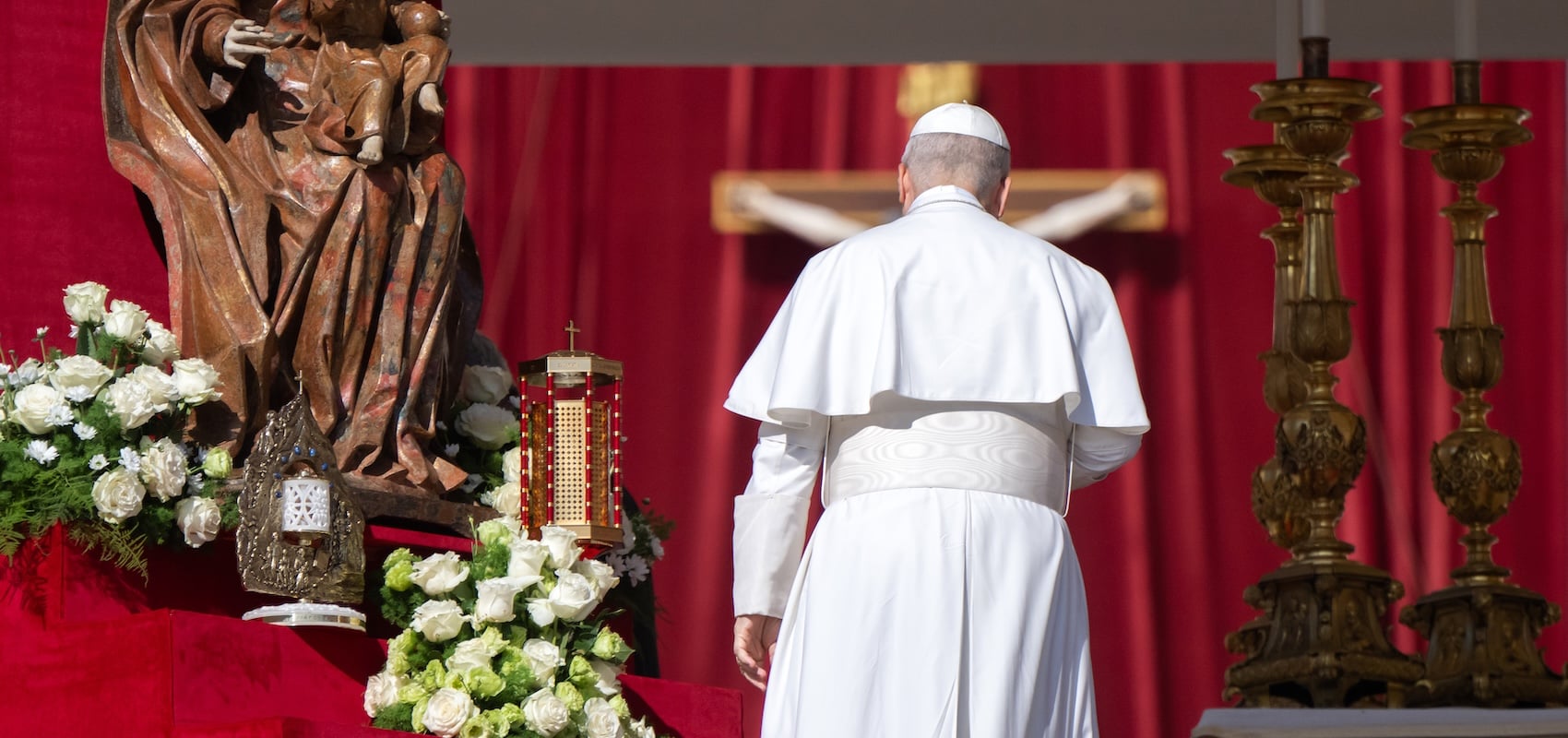
Image by Catholic Church England and Wales via Creative Commons. Image cropped.

YOU MIGHT ALSO LIKE
The Internet of Almost Everything
The editors discuss Pope Leo’s South America journey and his voting habits, a string of suspicious “cyber-faliures,”…
Realism and Reunion
Ecumenism has, to put it mildly, stalled. Since the beginning of this century, efforts aimed at bringing…
Peace in a Humbler Form
As we anticipate Advent and a month of preparation for the birthday of the Prince of Peace,…
