
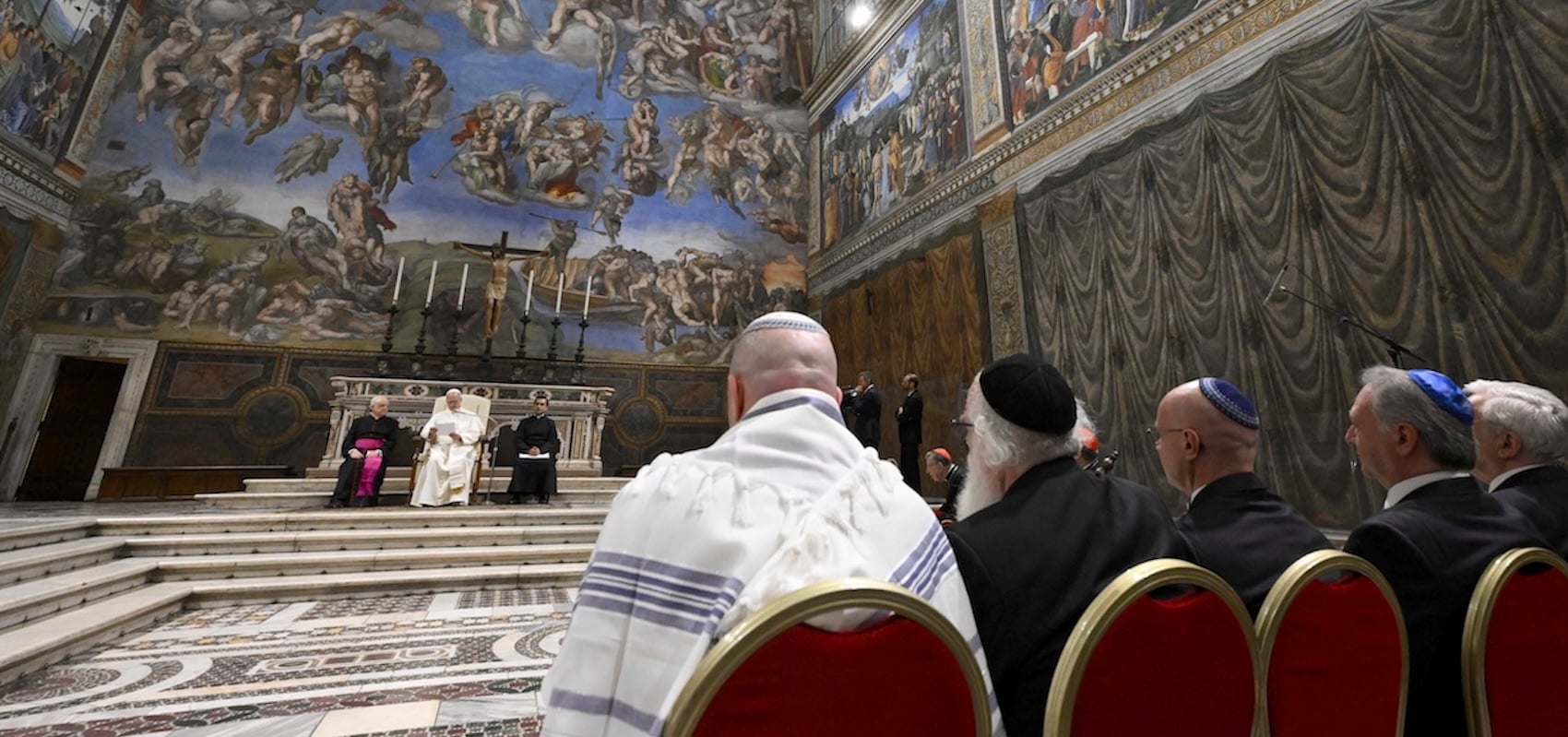
Since the Second Vatican Council, Catholics have known that they can’t accuse Jews of “killing God.” But does the Catholic Church find any good in modern Judaism, beyond the “spiritual patrimony” it shares with Christianity? Are Jews valued only inasmuch as they provide insights into the ancient Jewish context of Christ? On what grounds can Catholics respect Jews as Jews—especially given that Jewish religious practice has often been described as mortifera (death-dealing, poisonous) by Catholic sources? Does the Catholic Church still want Jews to abandon Judaism and become Catholic?
Though in many ways a seminal document, the Vatican II declaration Nostra Aetate (1965) addressed the tone of Catholic engagement with Judaism rather than its content. Some have accused Nostra Aetate of engaging in ecumenical political correctness, or of effecting a superficial reconciliation by failing to reckon theologically with modern Judaism. Catholics who accept Nostra Aetate have often, with utmost respectfulness, devalued the Jewish religion—by assuming that Catholics need learn from ancient Judaism only, or that modern Judaism is merely a deficient version of Christianity.
Catholic magisterial documents on Judaism since 1980 develop Nostra Aetate in the opposite direction, arguing that modern Jewish religious practice is imbued with goodness. The September 2026 Vatican note on interreligious dialogue, A Journey of Hope, presents the most explicit and practical statement yet: “Indeed, Jewish religious life can be regarded as an effect of the revealed Word, always living and effective, which they have received; for this reason, it has a present and dynamic value that can always enrich us.” This newly developed teaching has the potential to revolutionize Catholic understandings of Judaism in ways that surpass the developments of Vatican II.
Unfortunately, recent Catholic teaching on the goodness of Jewish religious practice awaits widespread acceptance and understanding in the Catholic world. Often for want of an interpreter, Catholics little understand what exactly modern Jewish religious practice is or what they can learn from it. And for those who take tradition seriously, these ideas are difficult to square with the rejection of religious indifferentism and with the older sense of Jewish religious practice as mortifera.
The Vatican note is not dismissive of these concerns. Indeed, the same concerns shaped the evolution of the doctrines laid out in the note. By understanding the evolution of Catholic responses to modern Judaism, we can understand the significance of the note’s proposed solution. Far from being untraditional, it masterfully develops the Catholic tradition to produce a synthesis through which Catholics may engage Judaism.
Nuanced perspectives on Jewish religious practice have existed throughout Church history, largely as a result of St. Augustine’s writings. Many Christian theologians of late antiquity offered harsh portrayals of Jewish religious practice. Augustine theorized Jewish practice more ambivalently, arguing that Jews were engaged in the divine plan of salvation. By practicing Judaism, Jews were bearing witness to the authenticity of the Hebrew Bible and to the Jewish context of Christ himself.
Augustine’s theory of the utility of Judaism was influential in his day. Whereas paganism was persecuted in Catholic Europe and became extinct there, the Augustinian theory grounded legislation that tolerated an ongoing Jewish presence. We may also detect a trace of Augustinianism in Pope John Paul II’s Mainz address of 1980, in which he stated that the Old Covenant was “never revoked by God”: As an ongoing reality, the Old Covenant would bear witness to the New.
Augustine’s (and John Paul’s) theory of Judaism was certainly more positive than that of Jerome (and Marcel Lefebvre), who argued that Judaism was null and void—and perhaps had been so since the beginning. Nevertheless, the Augustinian theory had several important weaknesses. Most significantly, it defined Judaism’s value as merely instrumental. Since the New Covenant was strictly superior to the Old Covenant, the Old Covenant’s value was relative to that of the New Covenant.
To Augustine, this meant that Jews must be subjugated to Christians. And though John Paul II believed that the human dignity of Jews must be recognized, his use of the term “Old Covenant” situated Judaism as just that: old, and in need of renewal by Christianity. John Paul also rejected dual-covenant theology (the idea that Judaism and Christianity were parallel tracks to salvation). Thus the questions of the goodness of Jewish religious practice and the need for Jewish conversion remained unresolved.
Pope Benedict XVI attempted to resolve these questions. Without abandoning the “salvific universality” of Jesus Christ (which he had asserted in the 2000 document Dominus Iesus), Benedict argued that perhaps instead of “old” and “new,” both covenants were mysteriously part of one covenant. In his 2018 essay on the Catholic doctrine of Judaism, Benedict also claimed that the “cultic laws” of Judaism, when practiced by Jews, continued to serve a purpose as part of that one covenant.
Though theologically powerful, Benedict’s theory manifested the same weakness found in the pro-Jewish characterizations of John Paul II and of Augustine: namely, an unfamiliarity with the essence of modern Judaism. Augustine’s doctrine of Jewish witness presumed that the Judaism of his own day was simply a diminished form of the Judaism of Jesus. Judaism has, in fact, developed since the time of Jesus. The Temple and the sacrifices were lost; the Talmud (a commentary on law, Scripture, and life), the Siddur (a prayerbook analogous in some ways to the Liturgy of the Hours), and the rabbinic cycle of mitzvot (religious observances often tied to the liturgical calendar) were gained.
Augustine was ignorant of these developments. John Paul II called for better understanding of rabbinic Judaism, but without any sense that Christians might learn from rabbinic Jewish religious life. Benedict likewise was relatively disengaged from understanding modern Judaism. In Evangelii Gaudium, Pope Francis asserted that the Church should learn mostly from the “values of Judaism.” Other papal documents have argued that Catholics should learn from Jewish biblical exegesis. Not until Leo’s pontificate, with the recent note, has high-level Catholic teaching argued that Catholics should learn about and from the religious practices of modern rabbinic Judaism.
By suggesting precisely and explicitly that modern Jewish religious practice is “an effect of the revealed Word,” the note further opens the door to Catholic engagement with Judaism. Rather than subordinate to Christianity, Jewish religious practice possesses an inherent goodness. The Catholic rejection of proselytism now has a fuller explanation: Jews can receive God’s grace without Christians convincing them to change, alter, or lessen their Jewish practices. Christians can appreciate Jews not just as witnesses to Judaism at the time of Christ but as participants in the ongoing revelation of God’s Word.
This potentially revolutionary teaching will require Catholics to abandon the view that Jewish practices are mortifera. However, the view that Jewish practices are fundamentally un-Christian is not deeply grounded in Catholic history. Though some medieval Catholics argued that Jewish practice was mortifera, others hotly contested this view, arguing that Jewish practice could be sanctifying through the grace of Christ. To restore positive views of Judaism, Catholics don’t need to discard their own history; they can simply recover this important strand of their own tradition. The Vatican note can be regarded as an intervention in this long-running debate over the valence of Judaism, on the side of those who advocated the sanctity of Jewish practice.
In the ninth century, Catholics first realized that contemporary Judaism had evolved since the time of Christ. Their initial reaction to this divergence was negative. Jews enjoyed legal and theological protection precisely because they were trapped in history as witnesses to the time of Christ. So why should Jewish practices that did not witness Christ’s era be tolerated or celebrated? Throughout the medieval period, some Catholic leaders banned or burned the Talmud, which was seen as exemplifying contemporary Judaism’s divergence from its historic norm.
Other medieval Catholics developed a different approach, by reading the Talmud christologically. Such Catholics argued that the Talmud concealed spiritual truths of Christianity, and that it should be highly valued rather than burned. These Catholics (such as Alain of Lille, Raymond Martini, and Paul of Burgos) went so far as to characterize the rabbis featured in the Talmud as Christians and saintly figures. The medieval sense that Talmud-reading Jews could be sanctified by following the counsels of the rabbis is perhaps not so different from the conception in A Journey of Hope’s of the God-bearing nature of Jewish religious practice.
Modern Jews may recoil from christological readings of the Talmud, which might seem to appropriate Jewish sacred tradition. This is a difficult point, for it is in the nature of Christianity to consider its surroundings in the light of Christian theological beliefs. Polite indifference to the Talmud (or to any religious practice of any group) is not an option. As numerous Vatican statements reiterate, the Christian belief in Christ as the Messiah and the revealed Word written across creation is a major obstacle in Jewish–Christian dialogue. Nonetheless, Christians’ positive valuation of Jewish texts, even on terms disagreeable to Jews, is preferable to the alternative.
Modern Jews may also be uncomfortably aware that medieval christological readings of the Talmud were often linked to conversionary campaigns. Though the Catholic Church recently articulated a rejection of institutional missionary activity directed toward Jews (in the 2015 statement The Gifts and the Calling of God Are Irrevocable), some Jews in every generation will inevitably make the choice to become Catholic. It would seem to benefit the Jewish community when these baptized Jews imbibe a theology that encourages them to cherish Judaism rather than to denigrate it.
The Catholic Church has historically demonstrated its attitude toward the Jewish community through its treatment of baptized Jews. When baptized Jews were expected to abandon all Jewish practice as mortifera, the Catholic Church was enacting a negative valuation of Judaism, in which Jewish practices served only to anticipate the coming of Christ. After the proclamation to the Gentiles was completed—that is, once the apostolic period, when the apostles still observed some mitzvot, had ended—to engage in Jewish practice was implicitly to claim that Christ had not yet come. Baptized Jews who engaged in Jewish practice were, at times, potentially subject to execution as heretics.
Yet A Journey of Hope’s positive valuation of Jewish practices also finds precedent in Catholic history. In the fifteenth century, the bishop and theologian Paul of Burgos noted that many modern Jewish practices date to the rabbinic period, and thus cannot be said to be anticipatory procedures that were nullified by Christ’s coming. Christ’s coming delegitimized the Temple sacrifices, but Jews in the fifteenth century were not offering mortifera sacrifices; they were engaged in patterns of prayer established by the rabbis. These prayers, Paul argued, were an exercise of the virtue of religion and therefore beneficial rather than harmful for Jews (baptized or unbaptized) to practice.
Empowered by Paul of Burgos’s theological ideas and pastoral programs, baptized Jews in fifteenth-century Spain could retain a close connection to Judaism: celebrating Jewish feasts, engaging in Jewish prayer practices, observing mitzvot. Although rabbinic leaders at the time struggled to evaluate this phenomenon, they generally held that it was better for baptized Jews to have some connection to Judaism than no connection. Perhaps they hoped that a taste of Judaism would entice baptized Jews to renounce their baptism; perhaps they merely upheld the Talmudic dictum, “Israel, even though he has sinned, is still Israel.”
The Spanish Inquisition was later formed (in my reading) precisely to contest this positive valuation of Jewish religious practice. The Inquisition’s assertion that Jewish religious practice was inherently un-Christian had dire consequences for baptized Jews and their converso descendants. Any evidence that a converso was engaged in Jewish religious practice could result in his or her execution. The Inquisition blamed practicing Jews for converso “relapses” and pushed for them to be expelled from Spain. By denying the validity of Jewish religious practice and defining Christianity as the absence of Judaism, the ecclesiastics of the Inquisition created a divide between Jews and Christians.
The Vatican note revisits the basis for the Inquisition’s negative judgments. By upholding Jewish religious practice as good, recent Catholic teaching on Judaism may give us an opportunity to return to the theological point of departure of medieval Iberia, and create a future in which Jewish religious practice is not inherently noxious to Christians. This ressourcement may benefit both tradition-minded Catholics and modern Jews, though many questions remain.
First among the questions is this: How are Catholics to be enriched by the religious practices that are proper to Judaism, as called for by A Journey of Hope? It would be unreasonable to expect Jews to teach Christians about their religious practices, which are traditionally seen as reserved for Jews. Furthermore, the broader Jewish community might well have reservations about Christian–Jewish learning in light of this troubled history.
Regardless of what Catholics can learn about Judaism from the broader Jewish community, they will inevitably learn about Judaism from the Jews in their midst, namely Jewish Catholics. Though never numerically large, the Jewish Catholic contingent has a long history of interpreting Judaism to Catholics. Unfortunately, Jewish Catholics have sometimes projected an image of Judaism that was negative or partial. The theology of mortifera influenced eminent Jewish Catholics such as St. Edith Stein and Jean-Marie Cardinal Lustiger against retaining Jewish practices after baptism (much to the dismay of Michael Wyschogrod).
A Journey of Hope’s positive valuation of Jewish practices empowers the ecclesia ex circumcisione to engage more fully in Jewish religious life. Then, by living Judaism and Catholicism, this component of the Church can build bridges between Judaism and the ecclesia ex gentes. The Vatican note aims to orient the Church away from converting Jews to Christianity and toward converting Christians to greater appreciation of modern Judaism. Let us pray it succeeds.

YOU MIGHT ALSO LIKE
Form vs. Monsters
The nature and aims of Catholic fiction have been a matter of debate for generations now. What…
Realism and Reunion
Ecumenism has, to put it mildly, stalled. Since the beginning of this century, efforts aimed at bringing…
Say It with Your Chest
Recent years have seen an explosion in a particular subgenre of sociopolitical commentary. Bonnie Kristian calls it…
