
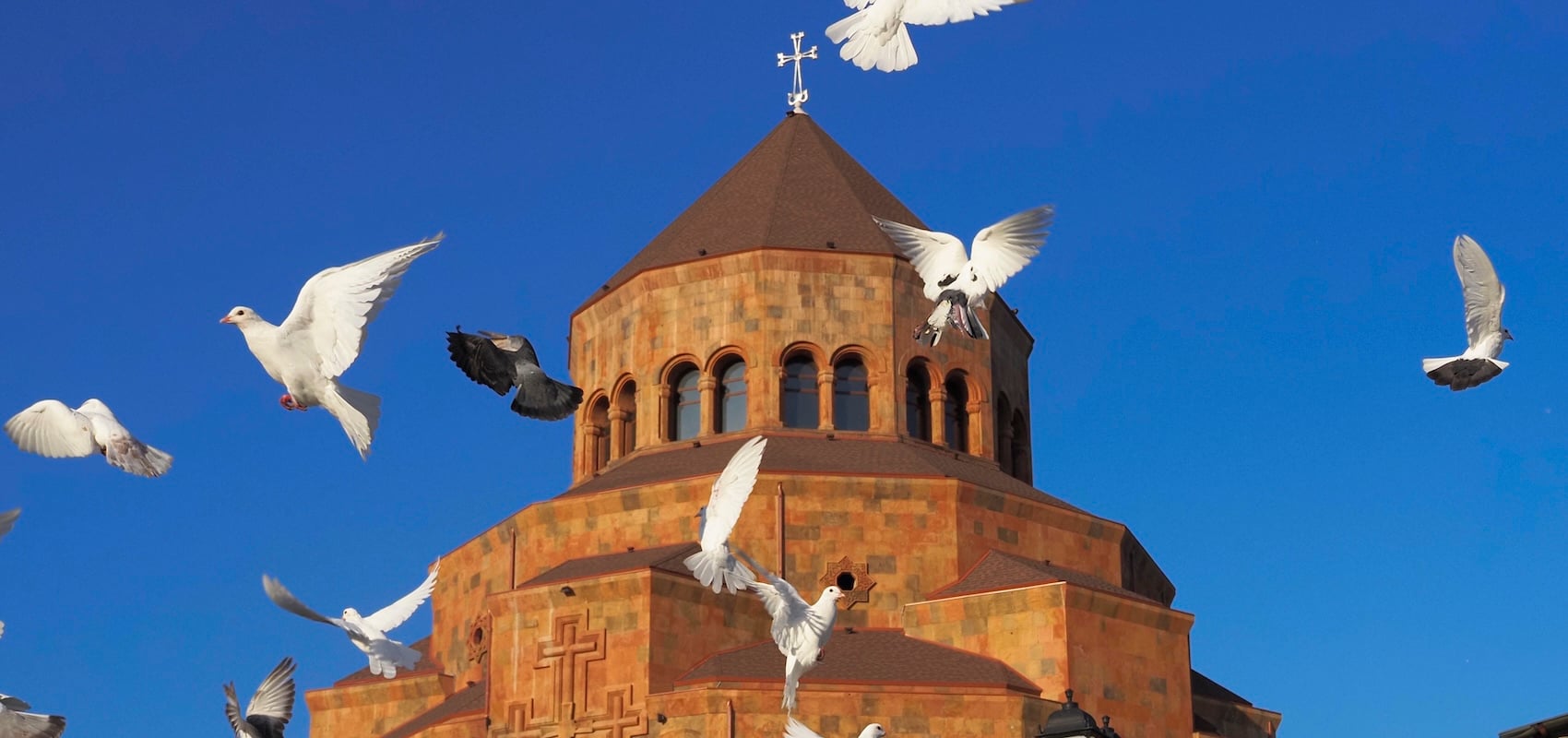
In the center of Stepanakert, the capital city Armenians call the heart of Artsakh, there once stood a white limestone cathedral crowned with a dome and bell tower that were visible across the city. It bore witness to countless prayers, baptisms, and weddings; to mothers lighting candles for sons at the front. It bore witness to a faithful community whose Armenian Christian roots in that land stretched back centuries. During the bombardment of 2020, families crowded into its basement as shells fell, and they recited the Lord’s Prayer while the sanctuary shook above. Today, satellite imagery shows only an empty scar where the Holy Mother of God Cathedral once stood. The dome is gone. The bell tower is gone. The cross is gone.
Construction on the cathedral began in 2006, and it was consecrated in 2019 after thirteen years of work. Though newly built, it stood within one of Christianity’s oldest living landscapes. Armenia adopted Christianity as a state religion in the early fourth century, before Rome and Europe’s kingdoms. Artsakh has long formed part of that spiritual geography. Although the cathedral in Stepanakert was a modern structure, it was a visible continuation of a very old Christian presence.
Between early March and early April 2026, satellite imagery and investigative reporting confirmed that the cathedral had been systematically demolished. Azerbaijani authorities later acknowledged destroying both the Holy Mother of God Cathedral and the nearby St. Hakob Church. The demolition of the churches follows the displacement of more than 120,000 Armenians from Artsakh after Azerbaijan’s 2023 military operation.
The demolition also took place only days before April 24, when Armenians around the world commemorate the Armenian Genocide. A cathedral that was built within living memory was erased on the eve of remembering a catastrophe that once sought to erase an entire Christian people.
For many Western Christians, Artsakh can seem distant and difficult to place on a map. But the destruction of this cathedral is not merely a regional detail within another contested borderland. It is an event with theological meaning. Churches are not interchangeable structures. They mark where the gospel has taken root in a particular place among a particular people. They testify that Christian worship has endured across generations and across regimes.
When such a church is removed after its congregation has been displaced, something more than architecture disappears. A witness disappears.
The Armenian Apostolic Church is among the oldest continuous Christian communities in the world. Its monasteries, inscriptions, and liturgies testify to a faith that has survived empires, invasions, and attempted annihilation. In Artsakh, that continuity shaped both the landscape and the imagination of those who worshiped there. Whether one approaches the question through the language of international law, through the framework of cultural heritage, or through the claims of Christian solidarity, the implications are serious. A sacred presence that endured for centuries is being removed within a matter of years.
The Epistle to the Hebrews instructs believers to remember those in prison as though they were in prison with them. That command has never been limited by geography. It extends to remembering communities whose churches are destroyed and whose presence is threatened, even when they live far away and speak another language.
The stones of Stepanakert’s cathedral may not scream, but they still speak. They remind us that Christianity is not only a set of beliefs that is handed down through time. It is also a presence that is handed down through places. The churches of Armenia belong not only to Armenians but to the history of Christianity itself. When those places disappear, the loss belongs to the whole Church.
AP Photo
Dear Reader,
Can I be direct with you?
War abroad. Socialists on the rise. AI upending human life. Endless uproar online. The modern attention economy doesn’t want readers — it wants users enslaved to the tyranny of the present.
First Things is the antidote: literary excellence, timeless truths, and a fixed point of reference in a culture that has lost its bearings.
But we can’t do it without readers like you.
Our goal: Raise $150,000 by November 1 to sustain First Things in the year ahead.
Your gift anchors readers in the permanent things.
Make your Fall Campaign gift now using the button below.
If you have any questions or would like more information, please contact Giovanni Del Piero, Director of the Editor’s Circle, at gdelpiero@firstthings.com or 212-627-1985.

YOU MIGHT ALSO LIKE
The Last Statesmen?
In the latest installment of the ongoing interview series with contributing editor Mark Bauerlein, Steven B. Smith…
De Gaulle Triumphant
The Second World War left Europe invaded and ruined, divided between Soviet and American occupations. Hitler’s defeat…
Forget Odysseus. Aeneas Is the True American Hero.
Who is our Odysseus? Or more precisely, who is the most Odyssean hero of American film? Matt…
