
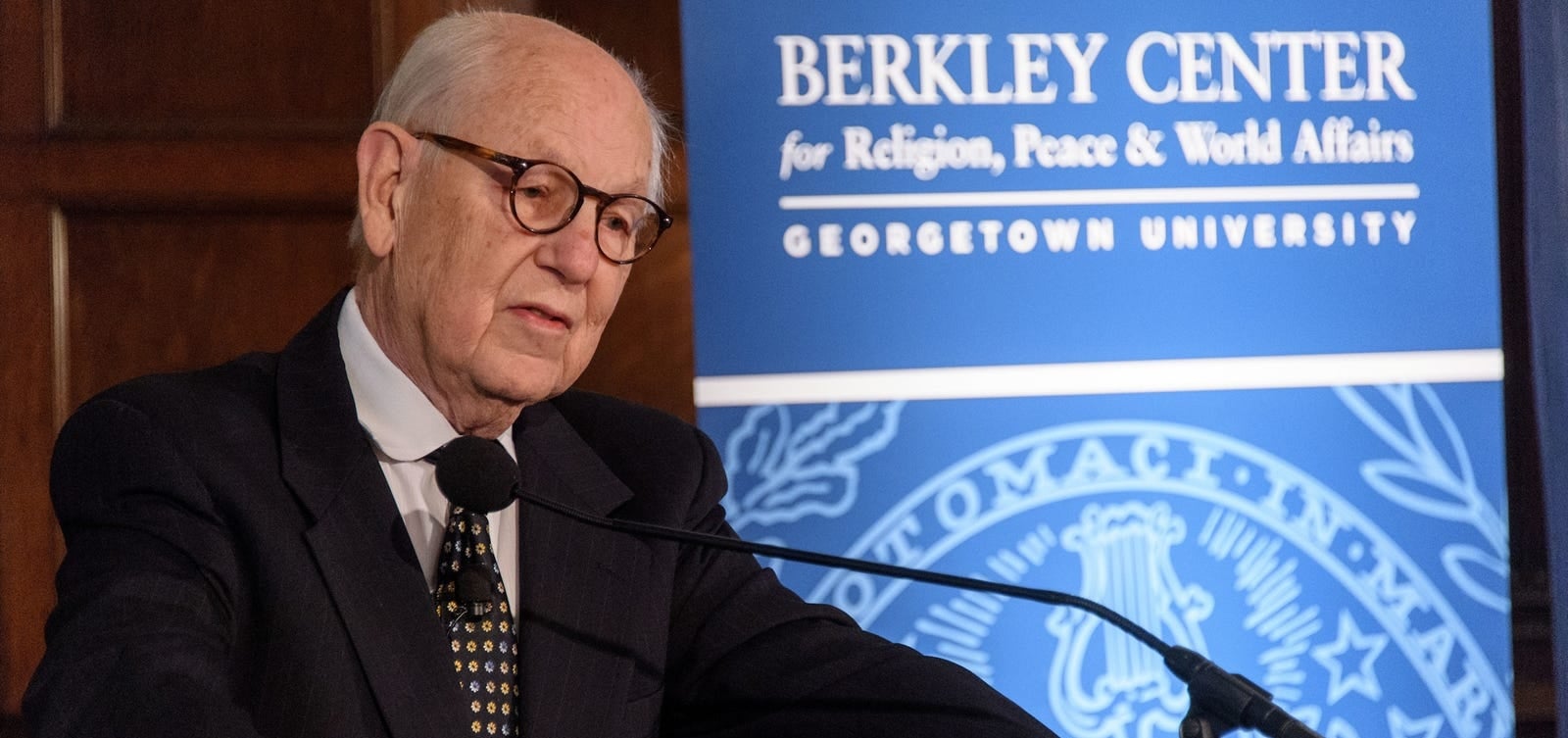
Robert Louis Wilken (1936–2026) passed away on Saturday, June 6, at age eighty-nine. A former chairman of the board of the Institute on Religion and Public Life and lifelong friend of Richard John Neuhaus, Wilken was one of the foremost historians of early Christianity of his generation. Raised and ordained as a Lutheran minister, he entered the Catholic Church in 1994. Wilken spent his scholarly career at Fordham University, the University of Notre Dame, and finally the University of Virginia, where he became the William R. Kenan Jr. Professor of the History of Christianity and founded the St. Anselm Institute for Catholic Thought.
David Novak
I had the privilege and the great pleasure of having Robert Louis Wilken as a colleague and friend for over forty years. We were brought together by Richard John Neuhaus, and we were both “charter members” of “the family,” as we called the circle Richard gathered around himself. Those years of almost daily contact (1989–96), when Robert and I were colleagues in the Department of Religious Studies at the University of Virginia, were among the happiest of my life.
Robert was not only a great scholar (his doctoral mentor, the late Jaroslav Pelikan, told me “Wilken was the best student I mentored”), he had the rare virtue of what Aristotle (in book 4 of Nicomachean Ethics) called megalopsychia, literally “greatness of soul.” Some modern philosophers have called this empathy, meaning the ability and the willingness to put yourself in somebody else’s position and feel what they are feeling. Let me illustrate Robert’s “great soul” with the following anecdote.
Fr. Neuhaus had the great ability to conduct seminars—including members of “the family” and other carefully invited participants—where “first things” were discussed at a level I have never encountered since. On the morning of the second day of one such seminar, Robert saw me in the lobby of the hotel where we used to stay, at 7 a.m. When he asked me why I was up so early, I told him I was going to a morning service in a nearby synagogue (which happens to be the oldest synagogue building in New York City in continual use since the 1860s). Robert said to me: “David, you’ve been in Christian space, I can see why you need to be in Jewish space. Do you mind if I come along with you?”
When we reached the synagogue, it was obvious Robert was not Jewish as he was the only man there not wearing a prayer shawl (tallit) and phylacteries (tefillin). Yet Robert, who knew the rabbinic Hebrew of the siddur and the Jewish liturgy quite well, was able to follow the prayers, even reciting many of them along with the congregation. The rabbi of the congregation, whom I knew quite well from my years as an active rabbi in New York before coming to UVA, assumed that a gentile participating in a Jewish service was a candidate for conversion. When he stopped by the pew Robert and I were occupying, he stage-whispered how welcome such persons are in his synagogue. On my next visit to that synagogue, without Robert accompanying me, the rabbi asked me: “Rabbi Novak, where is your friend who was with you the last time you were here?” Not wanting to go into details, I told the rabbi that “my friend was busy.” To which he replied: “Well, you can’t rush these things.” When I told Robert the rabbi’s words about him, we both roared.
During all the years of our friendship, neither of us ever engaged in even covert proselytizing. We were constantly discussing what our two respective traditions have in common, while never losing sight of what divides them.
Stanley Hauerwas
Robert had just been hired to teach historical theology at the University of Notre Dame. David Burrell, at the time the Hesburgh Professor of Philosophy and Theology, had asked me to show Robert around. We were walking toward the library when the prominent New Testament scholar Josephine Massyngbaerde Ford appeared, coming from the other direction. I introduced Robert to Josephine, and Robert greeted her by asking how she was. She confessed that she was dying. I might have thought Robert would have been taken aback by Josephine’s normal way to introduce herself to those she did not know. Robert, however, accepted Josephine’s description—expressing his willingness to keep her in his prayers. Such was Robert’s complex personality. He was a deeply committed Lutheran with the habits of a Jesuit—that is, he knew that the intellectual life of the Christian theologian required prayer that was continuous and woven throughout the everyday.
That aspect of Robert’s character led him to give an account of the Church Fathers that did not separate their thought from their life. I remember sitting on Robert’s screen porch in South Bend discussing the lives of Athanasius and Cyril. Robert claimed that he had learned from reading Aristotle with me how it was that the theologian cannot separate his thinking from his life. I think that emphasis was the basis for his wonderful book that describes the first thousand years of Christian thought (The First Thousand Years: A Global History of Christianity). He had a gift for recovering theological insights that others might miss.
Robert, of course, was a bit craggy; he suffered fools not at all. We often found ourselves in disagreement, but they were the kind of disagreements that made learning possible. Nowhere is this better illustrated than in Robert’s interactions with Richard John Neuhaus and Neuhaus’s decision to become a Roman Catholic. He had tried to talk Neuhaus out of his decision to convert. Robert told Richard that he need not convert because our Father’s house has many mansions. Richard responded by noting that, while that may be true, some of the mansions were better furnished than others. That is the kind of observation that Robert enjoyed, and happily shared with us.
We will miss him. He’s now in our Father’s house, and I hope there is good furniture.
Robin Darling Young
When the very Roman Catholic Church, represented by the now-Archbishop Joseph Augustine Di Noia, O.P., received Robert Wilken back into the corner of its sheepfold in the Dominican House of Studies in Washington, D.C., in 1994, I was one of his sponsors. Afterward, we had a party for him at our house in the Maryland suburbs, and there he celebrated with beer and his characteristic, quietly boisterous irony. Robert tells the tale of his conversion in an interview, the video for which can be found here—and it comprises an autobiographical (and argumentative!) account of his gradual persuasion that the German Lutheran tradition in which he had been raised and ordained as a minister was a true but insufficient representation of the apostolic and scriptural faith to which he had given his allegiance. He still loved that tradition—it’s clear from his posture and his expression—but he felt called back to the undivided Church of the first millennium, as Pope Benedict put it (optimistically).
For the Robert Wilken I came to know over the course of a half-century was a warm and feisty loyalist: loyal to the New Orleans of his birth, loyal to his wife and family, and loyal to his friends and colleagues. He had become disenchanted with the politics of this decade, but to the Church to which he had transferred his allegiance, he gave his heart. He read the breviary in Latin, returned to the study of early Christian writings with new depth, and continued to write histories of the early Christian community with a sharpened attention to the historical context in which it multiplied, divided, fought, wrote, and prayed. At the University of Virginia, the culmination of his academic career, he founded the St. Anselm Institute for Catholic Thought, and it remains today as his suitable monument: a place of ideas and conversation.
Robert was an acute reader. He enjoyed novels—particularly George Eliot’s Daniel Deronda and Tomasi di Lampedusa’s The Leopard, among the ones we discussed at our regular meetings for beer and friendly debate at the Tabard Inn, the downtown D.C. hotel and bar. There, like Chaucer’s pilgrims, we sat by the fireplace and told stories of universities—both of us had graduated from the University of Chicago, and even had mutual friends from that austere and demanding place—and we guardedly discussed the only Washington subject matter: politics. He generously listened to a yellow-dog Virginian Democrat, and I to a rock-ribbed Southern Republican, but we always returned to the dearest subjects: scholarship, early Christianity, family, the many-chambered house of the Church.
As his health declined, and the subway system got too tiring, we met at his house in Wheat Row, often on the terrace, joined by his wife Carol once we had exhausted academic subjects. As he cleared out his library, he gave me his collection of the writings of the great early Christian philosopher Origen. How dear it is now to see his pencilled underlinings and comments; they remain, as we all do in that world, as marginalia, silent voices pondering the texts, a discordant chorus of scholars listening to the ancients.
Robert’s last months and weeks, as he began to cross over, were increasingly silent. But he was still thinking of his ancient and venerable company of scholars. When he heard only ten days ago that the patristics society he had once led had enjoyed a vigorous conference with excellent papers, he whispered “That’s good.”
Joseph E. Davis
While I had met with Robert Louis Wilken once in graduate school, my relationship with him began in 2000, the year he invited ten or twelve faculty members to his house to discuss the possibility of creating a Catholic institute at UVA. That first night Robert told of his visit to the recently formed Lumen Christi Institute at the University of Chicago and the plans that founders Cardinal Francis George, Paul Griffiths, and Thomas Levergood had for it. He wanted to gauge our interest in starting a similar initiative, with a similar goal of bringing the long Catholic tradition into the intellectual conversation at the university.
The idea was warmly received. In a subsequent planning meeting, Robert proposed the name of St. Anselm, whose motto was “faith seeking understanding.” He pulled together a board of directors, and we set about scheduling the first year’s speakers. Robert, Fr. Augustine Thompson, O.P. (then at UVA), and I met with Bishop Walter Sullivan that year and invited him to serve as episcopal moderator. Somewhat to our surprise, he enthusiastically agreed and would go on to participate in many events, including our first public lecture on October 4, 2001, when the Hon. John T. Noonan Jr. spoke on “Religion, Freedom, and Catholicism.”
Robert was the perfect person to launch and lead an institute of this kind. He was a distinguished historian, widely respected here and abroad, and well known among many of the very scholars who were on our A-list (Avery Cardinal Dulles, Dana Gioia, Richard John Neuhaus, Russ Hittinger, et al.) to invite to Virginia to give talks and lead seminars and retreats. His lofty stature in the university was critical to gathering the Catholic faculty at UVA, and rather than a think tank, we built the institute as an association of the faculty. Robert eschewed polemics in favor of a constructive educational vision for the institute that has been a hallmark of our success ever since. He was even pretty good at fundraising.
I am forever indebted to him and honored to have been his friend. Robert, requiescat in pace.

YOU MIGHT ALSO LIKE
A Cold Beauty
Jan Morris (1926–2020) was a writer of astounding gifts who not only recorded history but made it.…
No Place Like Home
Who is our Odysseus? Or more precisely, who is the most Odyssean hero of American film? Matt…
Cornell’s Secret History
The editors discuss the NatCon in Jerusalem, the scandal at Cornell University and its broader implications, and…
