
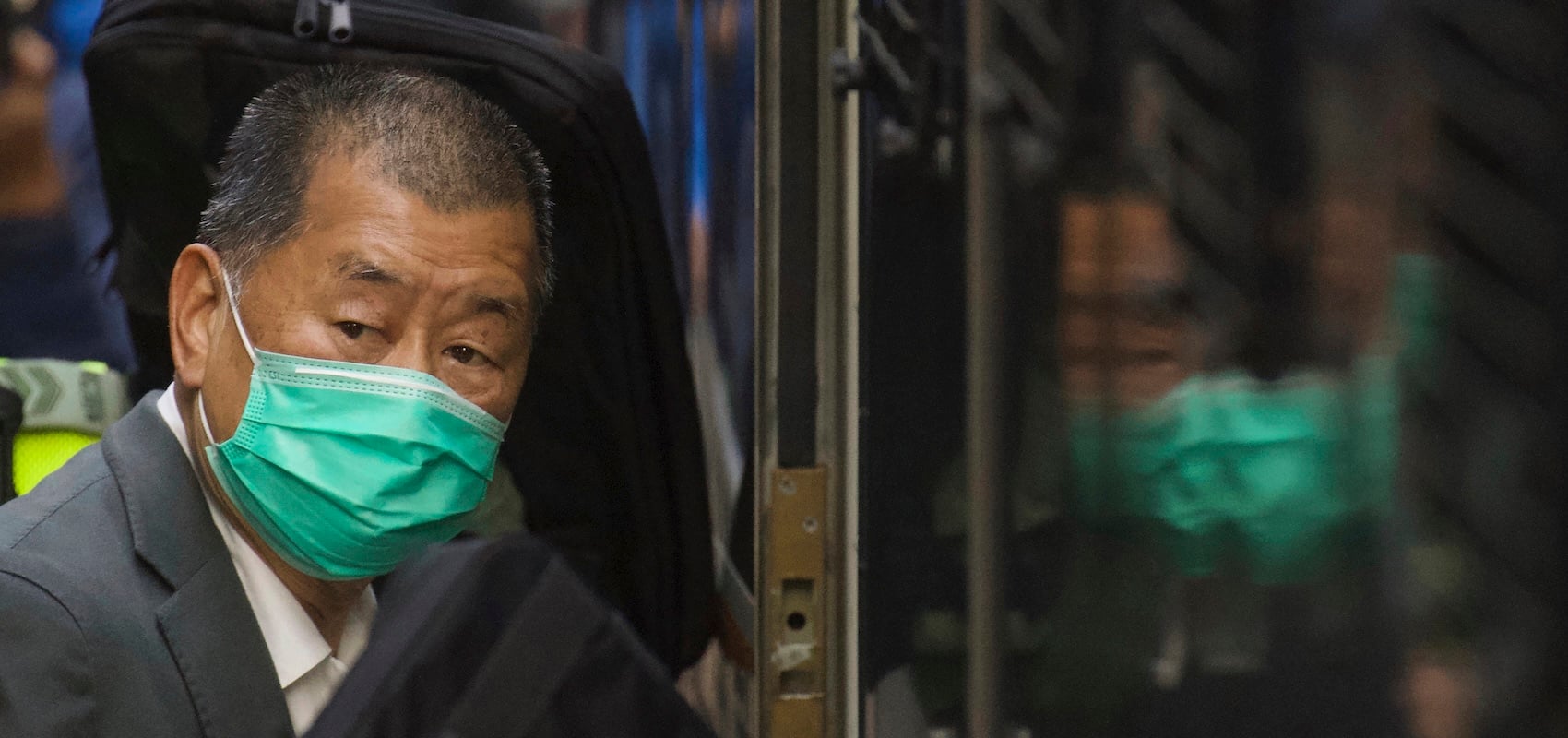
At his May summit in Beijing, President Trump made an effort to convince Chinese leader Xi Jinping to release Jimmy Lai from his imprisonment in Hong Kong. Jimmy, whom I am honored to call a friend, is a seventy-eight-year-old diabetic who has been in solitary confinement some seven hundred days longer than the United States was engaged in World War II, and is now serving a twenty-year sentence for threatening Chinese national security. That conviction has no more legal or moral validity than that of the Lord by Pontius Pilate. And I find it deeply moving that, in the prison cell where Jimmy does colored pencil sketches of religious scenes, many of them depict the Crucifixion; one of those sketches is among my most prized possessions. By conforming himself in prayer to the crucified Lord, Jimmy Lai is living his unjust punishment as an occasion of grace.
That, however, doesn’t change the brutal reality of his situation: namely, the virtual certainty that he will die in jail, having never been restored to his family, unless Emperor Xi lets him go into exile.
Donald Trump does not strike me as a sentimental man, but I have the impression that he really does care about Jimmy Lai and his fate. All the more reason, then, to wonder why, in explaining his attempt to convince Xi Jinping to let Jimmy go, the president recycled communist talking points about Jimmy causing “bedlam”—by which the Chinese communists mean encouraging and participating in peaceful demonstrations demanding that the Beijing regime honor the commitments to freedom it made when Hong Kong reverted to Chinese sovereignty in 1997. Causing this “bedlam,” the president said, made Jimmy’s case a “tough one” for the Chinese communist dictator. But is that the real reason for Xi Jinping’s intransigence, thus far, in the matter of Jimmy Lai?
For several years now, well-informed sources have told me that Jimmy is caught in a conflict between the Chinese foreign ministry and the Chinese internal security mandarins in Beijing and Hong Kong.
For the diplomats of the foreign ministry, Jimmy Lai is a problem they’d like to be relieved of so that it doesn’t come up, time and again, in negotiations with other powers. So at the time of Jimmy’s lengthy show trial in 2023–25, the foreign ministry favored “convict and expel”: save the repulsive National Security Law imposed on Hong Kong in 2020 by finding him guilty of its violation, but then expel him from Hong Kong into exile—presumably in Great Britain, of which Jimmy is a citizen.
The security goons, on the other hand, are said to have been arguing that, if Jimmy is exiled, that will only encourage others in Hong Kong to protest the ever-increasing repression in that once-vibrant city-state. So, their line of reasoning goes, let the twenty-year sentence play out, and if that means Jimmy Lai dies in Stanley Prison, so be it. In their twisted minds, such cruelty might be useful.
Any such argument between two factions of the Chinese communist regime can only be settled by one man: Xi Jinping. His refusal, thus far, to resolve it in favor of the foreign ministry suggests the possibility that the emperor has fewer clothes than the rest of the world thinks: Either he lacks the power to resolve the dispute between the prudential diplomats and the security thugocracy, or he fears that coming down on the side of the foreign ministry would jeopardize his firm grip on the internal security apparatus, to his own peril.
And that, I suggest, is why Jimmy Lai’s case is a “tough one” for Xi Jinping: The nonsense about Jimmy causing “bedlam” is a cover for the emperor’s weakness.
What can his fellow Catholics do for Jimmy Lai at the moment? We can hold him in prayer every day. We can urge the administration to continue to press for Jimmy’s release, and we can urge our representatives and senators to press the administration to keep pressing the Chinese regime. We can urge the bishop of Hong Kong, Cardinal Stephen Chow, S.J., who has been notably AWOL throughout the Jimmy Lai drama, to remember that Catholicism’s premier political prisoner is his diocesan congregant, and that this white martyr deserves every pastoral support the Church in Hong Kong can offer as he faces the possibility of red martyrdom.
And, inspired by Jimmy Lai’s own rock-solid faith, we can hope that those continued intercessions and pressures lead to his restoration to his family, and to the freedom Jimmy so nobly defended because he believed doing so was a religious and moral obligation.
George Weigel’s column “The Catholic Difference” is syndicated by the Denver Catholic, the official publication of the Archdiocese of Denver.
Image by ASSOCIATED PRESS


YOU MIGHT ALSO LIKE
Reflections on a Diamond Jubilee
I am not usually given to apocalypticism, but I think I got the imagery exactly right when,…
Roger Scruton’s Eternal Youth
In this episode, First Things senior editor Dan Hitchens joins R. R. Reno on The Editor’s Desk…
The Left Is Right About the Bible
“Texas Public School Students Will Be Required to Read the Bible,” warned a headline in the New…
